

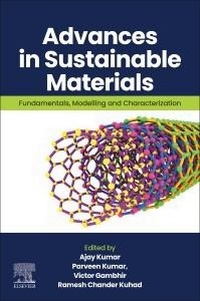
Advances in Sustainable Materials
Fundamentals, Modelling and Characterization
Published on 1. November 2024
Book
Paperback/Softback
594 pages
978-0-443-13849-2 (ISBN)
Description
Advances in Sustainable Materials: Fundamentals, Modelling and Characterization provides a comprehensive review of recent technological developments and research accomplishments in this important field.
The chapters cover characterization techniques, modeling of sustainable materials, the role of artificial intelligence, Industry 4.0, nature-inspired algorithms, and optimization possibilities. Various computational and simulation approaches for maintaining the sustainability of materials are also covered in detail. In addition to the above, various case studies are also included on the application of sustainable materials in medical, environmental, production, mechanical, and civil engineering.
This collection of state-of-the-art techniques, with an emphasis on using various analytical strategies, and computational and simulation approaches, as well as artificial intelligence will encourage researchers, as well as manufacturers to develop more innovative sustainable materials.
The chapters cover characterization techniques, modeling of sustainable materials, the role of artificial intelligence, Industry 4.0, nature-inspired algorithms, and optimization possibilities. Various computational and simulation approaches for maintaining the sustainability of materials are also covered in detail. In addition to the above, various case studies are also included on the application of sustainable materials in medical, environmental, production, mechanical, and civil engineering.
This collection of state-of-the-art techniques, with an emphasis on using various analytical strategies, and computational and simulation approaches, as well as artificial intelligence will encourage researchers, as well as manufacturers to develop more innovative sustainable materials.
More details
Language
English
Place of publication
Philadelphia
United States
Target group
Professional and scholarly
Product notice
Paperback (trade)
Unsewn / adhesive bound
Dimensions
Height: 228 mm
Width: 152 mm
Thickness: 30 mm
Weight
898 gr
ISBN-13
978-0-443-13849-2 (9780443138492)
Copyright in bibliographic data and cover images is held by Nielsen Book Services Limited or by the publishers or by their respective licensors: all rights reserved.
Schweitzer Classification
Other editions
Additional editions
Ajay Kumar | Parveen Kumar | Victor Gambhir
Advances in Sustainable Materials
Fundamentals, Modelling and Characterization
E-Book
11/2024
Elsevier
€260.99
Available for download
Persons
Ajay Kumar is a Professor (Research Track), Department of Mechanical Engineering, School of Core Engineering, Faculty of Science, Technology & Architecture, Manipal University Jaipur.
Parveen Kumar is an Assistant Professor in the Department of Mechanical Engineering, at Rawal Institute of Engineering and Technology, Faridabad, Haryana, India. His areas of research include advanced materials, die-less forming, additive manufacturing, CAD/CAM, and optimization techniques. Victor Gambhir is a President and Vice-Chancellor of JECRC University, Jaipur, Rajasthan, India. His areas of research include industrial engineering, manufacturing, and materials. Ramesh Chander Kuhad is a Distinguished Professor at Maharshi Dayanand University, Rohtak, Haryana; Sharda University, Greater Noida, Uttar Pradesh and the Director, at the DPGITM, Gurugram, Haryana. His areas of research include plant biomass biotechnology, biorefineries for sustainable production of biofuels, and other bio-based products.
Parveen Kumar is an Assistant Professor in the Department of Mechanical Engineering, at Rawal Institute of Engineering and Technology, Faridabad, Haryana, India. His areas of research include advanced materials, die-less forming, additive manufacturing, CAD/CAM, and optimization techniques. Victor Gambhir is a President and Vice-Chancellor of JECRC University, Jaipur, Rajasthan, India. His areas of research include industrial engineering, manufacturing, and materials. Ramesh Chander Kuhad is a Distinguished Professor at Maharshi Dayanand University, Rohtak, Haryana; Sharda University, Greater Noida, Uttar Pradesh and the Director, at the DPGITM, Gurugram, Haryana. His areas of research include plant biomass biotechnology, biorefineries for sustainable production of biofuels, and other bio-based products.
Editor
Professor (Research Track), Department of Mechanical Engineering, School of Core Engineering, Faculty of Science, Technology & Architecture, Manipal University Jaipur, India
Assistant Professor, Department of Mechanical Engineering, Rawal Institute of Engineering and Technology, Faridabad, Haryana, India
President and Vice-Chancellor, JECRC University, Jaipur, Rajasthan, India
Distinguished Professor, Maharshi Dayanand University, Rohtak, Haryana. Sharda University, Greater Noida, Uttar Pradesh. Director, DPGITM, Gurugram, Haryana
Content
1. Sustainable bio-polymeric materials
2. Sustainable fiber reinforced biopolymer composites: preparation, properties, and applications
3. Sustainable, smart, and novel material
4. Green synthesis of carbon dots: a path toward sustainability
5. Emerging sustainable nanomaterials and their applications and future scope
6. Recent advances in nanomaterials and nanocomposites in environmental applications
7. Analysis of surface roughness of polyamide parts fabricated by selective laser sintering process
8. Synthesis and characterizations of La-doped BiFeO3 solid solutions for solar cell application
9. The role of artificial intelligence in materials science: a review
10. Experimental and optimization analysis on mechanical properties of polymer-based natural composites
11. Experimental investigation of self-healing properties of bacteria concrete with basalt and flax fibers by direct application
12. Fabrication and evaluation of mechanical properties of natural fiber composites
13. Identifying factors affecting the choice of sustainable materials: a factor analysis approach for sustainable development
14. Anisotropy and tensile characterization of dual phase steel sheets
15. Optimizing surface roughness in WEDM for enhanced manufacturing performance: a response surface methodology approach
16. Enhancing tribological performance of bio-lubricants with nanoadditives: a four-ball tribometer study on vegetable oil-based lubricants
17. A comparative study on nickel oxide-based hole transport materials for inverted perovskite solar cells
18. Role of di-electric materials as substrate for the performance of microstrip patch antenna: a review
19. Screening assessment of thrombogenicity of candidate bioceramic material of zirconium oxide (IV) in ex vivo experiment
20. Hot corrosion and high-temperature oxidation studies of hard-faced nickel alloy on stainless steel 321
21. Experimental investigation of broken fiber strands and their location in E-glass/epoxy composite laminates
22. A comprehensive review of metal matrix composites: manufacturing techniques, mechanical properties, and industrial applications
23. Medical and pharmaceutical applications of sustainable biopolymers
24. Sustainable materials role in COVID-19
25. Sustainable materials as a novel source for biomedical applications
26. Recent advancements in sustainable materials for biomedical applications
27. Sustainable materials for urban streets: trends, challenges, and case studies
2. Sustainable fiber reinforced biopolymer composites: preparation, properties, and applications
3. Sustainable, smart, and novel material
4. Green synthesis of carbon dots: a path toward sustainability
5. Emerging sustainable nanomaterials and their applications and future scope
6. Recent advances in nanomaterials and nanocomposites in environmental applications
7. Analysis of surface roughness of polyamide parts fabricated by selective laser sintering process
8. Synthesis and characterizations of La-doped BiFeO3 solid solutions for solar cell application
9. The role of artificial intelligence in materials science: a review
10. Experimental and optimization analysis on mechanical properties of polymer-based natural composites
11. Experimental investigation of self-healing properties of bacteria concrete with basalt and flax fibers by direct application
12. Fabrication and evaluation of mechanical properties of natural fiber composites
13. Identifying factors affecting the choice of sustainable materials: a factor analysis approach for sustainable development
14. Anisotropy and tensile characterization of dual phase steel sheets
15. Optimizing surface roughness in WEDM for enhanced manufacturing performance: a response surface methodology approach
16. Enhancing tribological performance of bio-lubricants with nanoadditives: a four-ball tribometer study on vegetable oil-based lubricants
17. A comparative study on nickel oxide-based hole transport materials for inverted perovskite solar cells
18. Role of di-electric materials as substrate for the performance of microstrip patch antenna: a review
19. Screening assessment of thrombogenicity of candidate bioceramic material of zirconium oxide (IV) in ex vivo experiment
20. Hot corrosion and high-temperature oxidation studies of hard-faced nickel alloy on stainless steel 321
21. Experimental investigation of broken fiber strands and their location in E-glass/epoxy composite laminates
22. A comprehensive review of metal matrix composites: manufacturing techniques, mechanical properties, and industrial applications
23. Medical and pharmaceutical applications of sustainable biopolymers
24. Sustainable materials role in COVID-19
25. Sustainable materials as a novel source for biomedical applications
26. Recent advancements in sustainable materials for biomedical applications
27. Sustainable materials for urban streets: trends, challenges, and case studies