

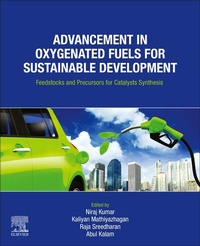
Advancement in Oxygenated Fuels for Sustainable Development
Feedstocks and Precursors for Catalysts Synthesis
Published on 11. November 2022
Book
Paperback/Softback
412 pages
978-0-323-90875-7 (ISBN)
Description
Advances in Oxygenated Fuels for Sustainable Development: Feedstocks and Precursors for Catalysts Synthesis provides a roadmap to the sustainable implementation of oxygenated fuels in internal combustion engines through sustainable production, smart distribution and effective utilization. Focusing on the sustainability of feedstocks, the book assesses availability, emissions impact and reduction potential, and biodiversity and land utilization impact. Existing technologies and supply chains are reviewed, and recommendations are provided on how to sustainably implement or update these technologies, including for rural communities.
Furthermore, effective supply and distribution network designs are provided alongside methods for monitoring and assessing their sustainability, accounting for social, economic, environmental and ecological factors. This book guides readers through every aspect of the production and commercialization of sustainable oxygenated fuels for internal combustion engines and their implementation across the global transport industry.
Furthermore, effective supply and distribution network designs are provided alongside methods for monitoring and assessing their sustainability, accounting for social, economic, environmental and ecological factors. This book guides readers through every aspect of the production and commercialization of sustainable oxygenated fuels for internal combustion engines and their implementation across the global transport industry.
More details
Language
English
Place of publication
Philadelphia
United States
Target group
Professional and scholarly
Product notice
Paperback (trade)
Illustrations
310 illustrations (60 in full color); Illustrations
Dimensions
Height: 235 mm
Width: 191 mm
Thickness: 22 mm
Weight
710 gr
ISBN-13
978-0-323-90875-7 (9780323908757)
Copyright in bibliographic data and cover images is held by Nielsen Book Services Limited or by the publishers or by their respective licensors: all rights reserved.
Schweitzer Classification
Other editions
Additional editions
Niraj Kumar | Kaliyan Mathiyazhagan | V. Raja Sreedharan
Advancement in Oxygenated Fuels for Sustainable Development
Feedstocks and Precursors for Catalysts Synthesis
E-Book
11/2022
Elsevier
€148.00
Available for download
Persons
Dr. Niraj Kumar is currently a Professor in the Department of Mechanical Engineering, at Amity University, Noida, India. He obtained his Ph.D. from NIT, Hamirpur (H.P.). He has teaching and research experience of over 15 years. He has published papers in reputed international/national journals/conferences and also contributed chapters in many books. He has almost seven years of industrial experience in various organizations and has received much recognition and appreciation. Presently, he is a reviewer for multiple international SCI listed journals and member of the peer-reviewing committee for the evaluation of scientific projects for different countries. Dr. K. Mathiyazhagan is a Professor & Head of Research Centre at Thiagarajar School of Management, with over 10 years of research and teaching experience. Listed among Stanford's Top 2% Scientists, with 7000+ citations Assistant/Associate Editor in Technological Forecasting and Social Change, Business Strategy and the Environment and Journal of Knowledge Management. Active reviewer in 30+ International journals. Published extensively in top-tier journals and recipient of the Excellence Citation Award, Top Cited Article and Best Paper awards. Edited international books on Blockchain, Lean-Green, and Society 4.0. Actively collaborates with global universities, including Roma TRE University, Italy, and Nottingham Trent University, UK. Secured multiple research grants which include AICTE ATAL FDPs. Research interests: Sustainable Supply Chain Management, Circular Economy, Lean Six Sigma, and Multi-Criteria Decision Making. Invited resource person for international research collaborations and workshops in Roma TRE University (Italy), Nottingham Trent University (UK), University of Rome Tor Vergata, (Italy).
V. Raja Sreedharan is a Senior Lecturer at Cardiff School of Management, Cardiff Metropolitan University, Llandaff, Wales, United Kingdom. Previously he worked as a Lecturer at the School of Management, University of Bradford, UK. He obtained his PhD in Industrial Engineering and Master in Industrial Engineering from the College of Engineering Guindy, Anna University, India. He is a certified Six Sigma green belt. He has published his works in peer-reviewed journals, and his current research interests focus on managing the VUCA in business operations. His works are focused on the productivity paradox and process improvement for industries to achieve sustainable business outcomes. He gained his corporate exposure working with Apollo Hospital as an external auditor for 5S implementation and spearheading the operations for the entire southern region in Tamil Nadu, India. He also worked as a process engineer in VOLVO Buses for lean projects. Later, he worked with the apparel manufacturer in Morocco for French fashion brands on projects related to the process of ambiguity in the in-house supply chain. He was also associated with the Societe Nationale des Transports et de Logistique to understand the VUCA in the inbound supply chain for circular business models. Currently, he is working on carbon neutrality for essential commodities from an operational perspective using emerging technologies in the VUCA world. Dr. Md. Abul Kalam is a full professor in the Department of Mechanical Engineering, the University of Malaya. His research specialization is on the Internal-combustion engine, Biodiesel/Biofuel, Lubricant testing, and Engine Tribology. Prof Kalam obtained his undergraduate degree from Bangladesh Institute of Technology (B.I.T) Khulna, and his Masters and Ph.D. from University of Malaya, Malaysia. Prof Kalam has been listed as "Highly Cited Researcher in the Year? in 2017, 2018 and 2019 and ranks among the top 1% of researchers for the most cited documents in the area of engineering by Web of Science and Clarivate Analytics. He received the 'University of Malaya Excellence Award 2017' for outstanding achievement in the category of "Academic Staff with Most Highly Cited Paper (Sciences) as well as Excellence Service award in 2018. He received Malaysia's research star award in 2018 and again in 2019. He was appointed as the Head of Bioresources and Fuel Technology under the Centre for Energy Sciences (CES) in 2010.
V. Raja Sreedharan is a Senior Lecturer at Cardiff School of Management, Cardiff Metropolitan University, Llandaff, Wales, United Kingdom. Previously he worked as a Lecturer at the School of Management, University of Bradford, UK. He obtained his PhD in Industrial Engineering and Master in Industrial Engineering from the College of Engineering Guindy, Anna University, India. He is a certified Six Sigma green belt. He has published his works in peer-reviewed journals, and his current research interests focus on managing the VUCA in business operations. His works are focused on the productivity paradox and process improvement for industries to achieve sustainable business outcomes. He gained his corporate exposure working with Apollo Hospital as an external auditor for 5S implementation and spearheading the operations for the entire southern region in Tamil Nadu, India. He also worked as a process engineer in VOLVO Buses for lean projects. Later, he worked with the apparel manufacturer in Morocco for French fashion brands on projects related to the process of ambiguity in the in-house supply chain. He was also associated with the Societe Nationale des Transports et de Logistique to understand the VUCA in the inbound supply chain for circular business models. Currently, he is working on carbon neutrality for essential commodities from an operational perspective using emerging technologies in the VUCA world. Dr. Md. Abul Kalam is a full professor in the Department of Mechanical Engineering, the University of Malaya. His research specialization is on the Internal-combustion engine, Biodiesel/Biofuel, Lubricant testing, and Engine Tribology. Prof Kalam obtained his undergraduate degree from Bangladesh Institute of Technology (B.I.T) Khulna, and his Masters and Ph.D. from University of Malaya, Malaysia. Prof Kalam has been listed as "Highly Cited Researcher in the Year? in 2017, 2018 and 2019 and ranks among the top 1% of researchers for the most cited documents in the area of engineering by Web of Science and Clarivate Analytics. He received the 'University of Malaya Excellence Award 2017' for outstanding achievement in the category of "Academic Staff with Most Highly Cited Paper (Sciences) as well as Excellence Service award in 2018. He received Malaysia's research star award in 2018 and again in 2019. He was appointed as the Head of Bioresources and Fuel Technology under the Centre for Energy Sciences (CES) in 2010.
Editor
Professor, Department of Mechanical Engineering, Amity University, Noida, India
Professor & Chairperson, Research Center, Thiagarajar School of Management, India
Senior Lecturer, Cardiff School of Management, Cardiff Metropolitan University, Llandaff, Wales, United Kingdom
Full Professor, Department of Mechanical Engineering, the University of Malaya, Kuala Lumpur, Malaysia
Content
1. Global climate change in newer perspective causes and possible solutions
2. Comparative investigation of suitability of fuel properties of oxygenated biofuels in IC engine
3. Recent advances in technological developments to produce biomass-derived liquid transportation fuels from oxygenated bio-crudes
4. Methanol reformation based strategies for using methanol as IC engine fuel: A brief overview
5. Comparison of different feedstocks for biodiesel production
6. Latest Advancement in Technology to utilize Oxygenated Biofuels in the Diesel Engine
7. Sustainable bioconversion of Lignocellulosics to biodiesel: Pretreatment, fermentation and cost analysis
8. Methodologies for modifications of characteristics of biofuels for wider acceptability
9. Biofuel production via Phyto and Microbial power system: Adaptation of Ecotechnology a step towards sustainable energy
10. Challenges to the sustainable development of vehicle transport
11. Production, Performance and Emission Analysis of New Generation biodiesel in Unmodified Engine
12. Unregulated emission from oxygenated fuels: A threat or boon?
13. Effect of oxygenated fuel additives on the Performance and emissions of CI engine running on biodiesel: A review
14. Combustion, performance and emission characteristics of methanol fuelled engines
15. Utilization of ketone-based oxygenated fuels in internal combustion engines
16. Evaluation of challenges for sustainable oxygenated fuel industry in India
17. Sustainable Development in Oxygenated fuels
18. Performance Analysis of Domestic Energy Usage of European Cities from the Perspective of Externalities by Using Fuzzy MCDM approach
19. Formation of Polycyclic Aromatic Hydrocarbons in Oxygenated Fuels: An Overview
2. Comparative investigation of suitability of fuel properties of oxygenated biofuels in IC engine
3. Recent advances in technological developments to produce biomass-derived liquid transportation fuels from oxygenated bio-crudes
4. Methanol reformation based strategies for using methanol as IC engine fuel: A brief overview
5. Comparison of different feedstocks for biodiesel production
6. Latest Advancement in Technology to utilize Oxygenated Biofuels in the Diesel Engine
7. Sustainable bioconversion of Lignocellulosics to biodiesel: Pretreatment, fermentation and cost analysis
8. Methodologies for modifications of characteristics of biofuels for wider acceptability
9. Biofuel production via Phyto and Microbial power system: Adaptation of Ecotechnology a step towards sustainable energy
10. Challenges to the sustainable development of vehicle transport
11. Production, Performance and Emission Analysis of New Generation biodiesel in Unmodified Engine
12. Unregulated emission from oxygenated fuels: A threat or boon?
13. Effect of oxygenated fuel additives on the Performance and emissions of CI engine running on biodiesel: A review
14. Combustion, performance and emission characteristics of methanol fuelled engines
15. Utilization of ketone-based oxygenated fuels in internal combustion engines
16. Evaluation of challenges for sustainable oxygenated fuel industry in India
17. Sustainable Development in Oxygenated fuels
18. Performance Analysis of Domestic Energy Usage of European Cities from the Perspective of Externalities by Using Fuzzy MCDM approach
19. Formation of Polycyclic Aromatic Hydrocarbons in Oxygenated Fuels: An Overview