

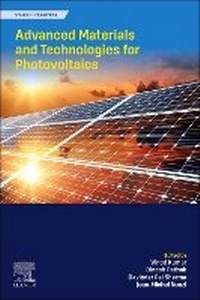
Advanced Materials and Technologies for Photovoltaics
Published on 9. December 2025
Book
Paperback/Softback
500 pages
978-0-443-29250-7 (ISBN)
Description
Advanced Materials and Technologies for Photovoltaics explores the transformative developments in photovoltaic energy conversion, offering insightful coverage on the theoretical and fundamental aspects of this field. The book delves into the diverse materials and technologies that drive innovation, connecting them with emerging applications that disrupt traditional energy paradigms. Catering to both seasoned and early-career researchers, this publication provides an accessible yet comprehensive guide to photovoltaic science, bridging the gap between foundational knowledge and cutting-edge advancements.
In addition to theoretical foundations, the book emphasizes practical tools, such as detailed sections on characterization techniques for solar cells and advanced modeling methods using software like COMSOL. It offers a balanced perspective on the intersection of materials science and photovoltaic applications, making it a crucial resource for researchers and professionals working on solar energy solutions.
In addition to theoretical foundations, the book emphasizes practical tools, such as detailed sections on characterization techniques for solar cells and advanced modeling methods using software like COMSOL. It offers a balanced perspective on the intersection of materials science and photovoltaic applications, making it a crucial resource for researchers and professionals working on solar energy solutions.
More details
Series
Language
English
Place of publication
Philadelphia
United States
Target group
Professional and scholarly
Dimensions
Height: 229 mm
Width: 152 mm
Weight
450 gr
ISBN-13
978-0-443-29250-7 (9780443292507)
Copyright in bibliographic data and cover images is held by Nielsen Book Services Limited or by the publishers or by their respective licensors: all rights reserved.
Schweitzer Classification
Other editions
Additional editions
Vinod Kumar | Dinesh Pathak | Davinder Pal Sharma
Advanced Materials and Technologies for Photovoltaics
E-Book
12/2025
Elsevier
€209.99
Available for download
Persons
Vinod Kumar is an Assistant Professor in Renewable Energy and Coordinator of the MSc Renewable Energy Technology (RENT) program in the Department of Physics at The University of the West Indies, Saint Augustine, Trinidad and Tobago. His primary research interests include oxide-based nanomaterials, dye-sensitized solar cells, perovskite and organic solar cells, photon management in solar cells, and the development of advanced materials for WLEDs.
Dinesh Pathak serves as Head of the Department of Physics at The University of the West Indies, Saint Augustine, Trinidad and Tobago. His primary research focuses on nanostructured compound semiconductors, oxide nanocomposites, ion beam synthesis of nanomaterials, organic semiconductors, and organic-inorganic hybrid semiconductor systems.
Davinder Pal Sharma is an Associate Professor in the Department of Physics at The University of the West Indies, Saint Augustine, Trinidad and Tobago. His main research interests lie in modeling and optimization of solar cells, microbial fuel cells for electricity generation and wastewater treatment, application of digital signal processing for communication systems, speech recognition, smart grid technology, and medical devices.
Jean-Michel Nunzi is a Professor with a joint appointment in the Department of Physics, Engineering Physics and Astronomy, and the Department of Chemistry at Queen's University, Kingston, Canada. His research focuses on the optical and electronic properties of organic materials and devices, chiral photonics, and solar cells.
Dinesh Pathak serves as Head of the Department of Physics at The University of the West Indies, Saint Augustine, Trinidad and Tobago. His primary research focuses on nanostructured compound semiconductors, oxide nanocomposites, ion beam synthesis of nanomaterials, organic semiconductors, and organic-inorganic hybrid semiconductor systems.
Davinder Pal Sharma is an Associate Professor in the Department of Physics at The University of the West Indies, Saint Augustine, Trinidad and Tobago. His main research interests lie in modeling and optimization of solar cells, microbial fuel cells for electricity generation and wastewater treatment, application of digital signal processing for communication systems, speech recognition, smart grid technology, and medical devices.
Jean-Michel Nunzi is a Professor with a joint appointment in the Department of Physics, Engineering Physics and Astronomy, and the Department of Chemistry at Queen's University, Kingston, Canada. His research focuses on the optical and electronic properties of organic materials and devices, chiral photonics, and solar cells.
Editor
Assistant Professor, Department of Physics at The University of the West Indies, Saint Augustine, Trinidad and Tobago
Head of Department of Physics, The University of the West Indies, Saint Augustine, Trinidad and Tobago
Associate Professor, Department of Physics, The University of the West Indies, St. Augustine, Trinidad and Tobago.
Professor, Department of Physics, Engineering Physics and Astronomy, and the Department of Chemistry, Queen's University, Kingston, Canada
Content
1. An overview of photovoltaics technology
2. Theoretical aspect of solar cells
3. Advance characterization tools for photovoltaics technology
4. Silicon technology
5. Thin film based solar cells
6. Multijunction solar cells
7. Bulk heterojunctions solar cells
8. III-V compound-based solar cell technologies
9. Dye sensitized solar cells
10. Quantum dots solar cells
11. Lead halide perovskite solar cells
12. Lead-free perovskite solar cells
13. Organic solar cells
14. Plasmonic aspect in solar cells
15. Photon management in solar cells
16. Life-cycle analysis for solar cells
17. Internet of Things (IoT) for advanced photovoltaics technology
2. Theoretical aspect of solar cells
3. Advance characterization tools for photovoltaics technology
4. Silicon technology
5. Thin film based solar cells
6. Multijunction solar cells
7. Bulk heterojunctions solar cells
8. III-V compound-based solar cell technologies
9. Dye sensitized solar cells
10. Quantum dots solar cells
11. Lead halide perovskite solar cells
12. Lead-free perovskite solar cells
13. Organic solar cells
14. Plasmonic aspect in solar cells
15. Photon management in solar cells
16. Life-cycle analysis for solar cells
17. Internet of Things (IoT) for advanced photovoltaics technology