

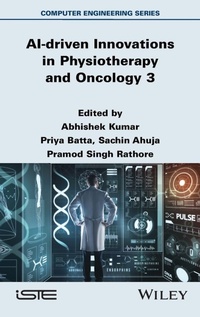
AI-driven Innovations in Physiotherapy and Oncology 3
1st Edition
Published on 20. April 2026
Book
Hardback
432 pages
978-1-83669-088-7 (ISBN)
Description
AI-driven Innovations in Physiotherapy and Oncology 3 is positioned at the intersection of artificial intelligence (AI), clinical rehabilitation and cancer care, addressing the growing need for data-driven, personalized and technology-enabled healthcare solutions. The book contextualizes recent advances in machine learning, deep learning, computer vision and intelligent decision-support systems within modern physiotherapy and oncology practices.
This book systematically explores how AI models enhance diagnosis, treatment planning, therapy optimization and outcome prediction across musculoskeletal rehabilitation, neuro-physiotherapy, radiation oncology and precision cancer care. It covers sensor-based motion analysis, AI-assisted imaging, predictive analytics, digital therapeutics and intelligent rehabilitation platforms, supported by real-world case studies and implementation frameworks. The book also discusses ethical considerations, clinical validation, interoperability and regulatory challenges to bridge the gap between research and practice. Designed for researchers, clinicians, graduate students and healthcare technologists, this book provides both theoretical foundations and practical insights for integrating AI into next-generation physiotherapy and oncology workflows
This book systematically explores how AI models enhance diagnosis, treatment planning, therapy optimization and outcome prediction across musculoskeletal rehabilitation, neuro-physiotherapy, radiation oncology and precision cancer care. It covers sensor-based motion analysis, AI-assisted imaging, predictive analytics, digital therapeutics and intelligent rehabilitation platforms, supported by real-world case studies and implementation frameworks. The book also discusses ethical considerations, clinical validation, interoperability and regulatory challenges to bridge the gap between research and practice. Designed for researchers, clinicians, graduate students and healthcare technologists, this book provides both theoretical foundations and practical insights for integrating AI into next-generation physiotherapy and oncology workflows
More details
Series
Language
English
Place of publication
London
United Kingdom
Target group
Professional and scholarly
Product notice
Laminated cover
Dimensions
Height: 234 mm
Width: 156 mm
Thickness: 24 mm
Weight
782 gr
ISBN-13
978-1-83669-088-7 (9781836690887)
Copyright in bibliographic data and cover images is held by Nielsen Book Services Limited or by the publishers or by their respective licensors: all rights reserved.
Schweitzer Classification
Other editions
Additional editions
Abhishek Kumar | Priya Batta | Sachin Ahuja
AI-driven Innovations in Physiotherapy and Oncology 3
E-Book
04/2026
1st Edition
Wiley
€146.99
Available for download
Abhishek Kumar | Priya Batta | Sachin Ahuja
AI-driven Innovations in Physiotherapy and Oncology 3
E-Book
04/2026
1st Edition
Wiley-ISTE
€146.99
Available for download
Persons
Abhishek Kumar, Senior IEEE Member and Professor at Chandigarh University, India, is a prolific researcher with 170+ publications and has international postdoctoral experience. His expertise spans AI, renewable energy and image processing.
Priya Batta is Associate Professor at Amity School of Engineering and Technology, Amity University Punjab, Mohali, India. She has over 12 years of academic experience and has edited several books. She actively contributes her research to reputed journals and conferences. Her expertise includes AI, blockchain and IoT.
Sachin Ahuja is Executive Director of Engineering and Professor at Chandigarh University, India. He has guided numerous ME and PhD scholars, and currently specializes in AI, machine learning and data mining.
Pramod Singh Rathore, Assistant Professor at Manipal University Jaipur, India, has over 12 years of experience and 85+ publications. His research interests include NS2, networks, data mining, DBMS and professional memberships, including ACM and IAENG.
Priya Batta is Associate Professor at Amity School of Engineering and Technology, Amity University Punjab, Mohali, India. She has over 12 years of academic experience and has edited several books. She actively contributes her research to reputed journals and conferences. Her expertise includes AI, blockchain and IoT.
Sachin Ahuja is Executive Director of Engineering and Professor at Chandigarh University, India. He has guided numerous ME and PhD scholars, and currently specializes in AI, machine learning and data mining.
Pramod Singh Rathore, Assistant Professor at Manipal University Jaipur, India, has over 12 years of experience and 85+ publications. His research interests include NS2, networks, data mining, DBMS and professional memberships, including ACM and IAENG.
Content
Preface xxiii
Abhishek KUMAR, Priya BATTA, Sachin AHUJA and Pramod Singh RATHORE
Chapter 1. Reinforcement Learning Models for Adaptive Cancer Rehabilitation in Physiotherapy 1
Trupti YADAV and Sanjay BADJATE
1.1. Introduction 2
1.2. Fundamentals of reinforcement learning (RL) 4
1.3. Cancer rehabilitation needs and challenges 7
1.4. RL-based framework for adaptive rehabilitation 8
1.5. Benefits of RL in cancer physiotherapy 11
1.6. Limitations and ethical considerations 13
1.7. Future directions 14
1.8. Conclusion 15
1.9. References 15
Chapter 2. AI-Enabled Gait and Balance Assessment in Oncology Rehabilitation 19
Dhairyasheel PATIL and Pankaj THOTE
2.1. Introduction 19
2.2. Clinical background: gait and balance in cancer survivors 21
2.3. AI-enabled gait and balance assessment: overview of technologies 24
2.4. Evidence base and validation in the oncology setting 26
2.5. Core components of an AI-enabled oncology gait-balance platform 26
2.6. Implementation in oncology settings: use cases and workflow 28
2.7. Challenges and considerations 29
2.8. Future directions and research needs 30
2.9. Conclusion 31
2.10. References 32
Chapter 3. Deep Learning-Driven Fatigue Monitoring in Cancer Physiotherapy Programs 35
Anand GUDUR and Faisal Hussain HUSSAIN
3.1. Introduction 35
3.2. Cancer-related fatigue and physiotherapy 37
3.3. Traditional and sensor-based monitoring 38
3.4. Deep learning models for fatigue monitoring 40
3.5. Integration into cancer physiotherapy 41
3.6. Applications and use cases 42
3.7. Strengths, limitations and challenges 44
3.8. Future directions 45
3.9. Conclusion 46
3.10. References 47
Chapter 4. Predictive Modeling of Lymphedema Risk Using AI in Oncology Physiotherapy 51
Rashmi GUDUR and Mrudula NIMBARTE
4.1. Introduction 52
4.2. Clinical background: lymphedema in oncology 54
4.3. Rationale for predictive modeling 55
4.4. AI and ML overview 56
4.5. Model development approaches 58
4.6. Performance metrics and model comparisons 60
4.7. Explainability and clinical integration 62
4.8. Role in oncology physiotherapy 63
4.9. Challenges and limitations 63
4.10. Future directions 64
4.11. Conclusion 65
4.12. References 65
Chapter 5. AI-Based Movement Quality Scoring for Post-Chemotherapy Rehabilitation 69
Trupti YADAV and Rahul PETHE
5.1. Introduction 69
5.2. Impact of chemotherapy on physical function 71
5.3. AI technologies for movement quality assessment 73
5.4. Clinical applications in post-chemotherapy rehabilitation 78
5.5. Challenges and limitations 80
5.6. Future directions and opportunities 82
5.7. Conclusion 83
5.8. References 83
Chapter 6. Virtual Reality and AI for Pain Management in Cancer Physiotherapy 87
Dhairyasheel PATIL and Abhay KASHETWAR
6.1. Introduction 88
6.2. Cancer pain: scope and challenges 90
6.3. VR in pain management 91
6.4. AI in pain management 94
6.5. Integrating VR and AI: a synergistic approach 96
6.6. Case studies and clinical implementations 97
6.7. Technical and ethical considerations 98
6.8. Future directions 99
6.9. Conclusion 100
6.10. References 101
Chapter 7. Machine Learning for Optimizing Exercise Intensity in Oncology Rehabilitation 105
Anand GUDUR and Himanshu WAGH
7.1. Introduction 105
7.2. Exercise intensity in oncology rehabilitation 107
7.3. Machine learning in healthcare and rehabilitation 109
7.4. ML techniques for exercise intensity optimization 111
7.5. Data sources for ML modeling 114
7.6. Challenges and limitations 116
7.7. Future directions 118
7.8. Conclusion 119
7.9. References 119
Chapter 8. AI-Driven Digital Twins for Simulating Physiotherapy Outcomes in Cancer Care 123
Rashmi GUDUR and Mrudula NIMBARTE
8.1. Introduction 123
8.2. Background and theoretical framework 125
8.3. Current research landscape 128
8.4. Framework for AI-driven DT in cancer physiotherapy 129
8.5. Use cases and scenario examples 132
8.6. Evidence of effectiveness 133
8.7. Ethical, practical and regulatory challenges 133
8.8. Future directions and research agenda 135
8.9. Conclusion 136
8.10. References 137
Chapter 9. Natural Language Processing of Patient Feedback to Personalize Oncology Physiotherapy 141
Trupti YADAV and Faisal Hussain HUSSAIN
9.1. Introduction 142
9.2. Sources of patient feedback in oncology physiotherapy 143
9.3. NLP techniques applied to patient feedback 145
9.4. Personalizing oncology physiotherapy using NLP insights 148
9.5. Case studies and systems in practice 150
9.6. Challenges and limitations 151
9.7. Future directions 152
9.8. Ethical considerations 154
9.9. Conclusion 154
9.10. References 155
Chapter 10. AI-Enhanced Biomechanical Feedback Systems for Radiation Therapy Recovery 159
Dhairyasheel PATIL and Himanshu WAGH
10.1. Introduction 159
10.2. Radiation therapy sequelae and rehabilitation needs 161
10.3. Biomechanical feedback technologies in RT recovery 164
10.4. Role of AI in biomechanical feedback systems 167
10.5. Examples and case studies of integrated systems 169
10.6. Benefits of AI-enhanced biomechanical feedback for RT recovery 170
10.7. Challenges and limitations 170
10.8. Future directions 171
10.9. Conclusion 172
10.10. References 173
Chapter 11. Computer Vision for Real-time Postural Correction in Cancer Physiotherapy 177
Anand GUDUR and Rahul PETHE
11.1. Introduction 178
11.2. CV technologies for postural correction 180
11.3. Applications in cancer physiotherapy 183
11.4. Validation and clinical studies 184
11.5. Challenges and barriers 186
11.6. Innovations and integrations 188
11.7. Future directions 190
11.8. Conclusion 191
11.9. References 191
Chapter 12. AI-Driven Remote Physiotherapy Platforms for Immunocompromised Cancer Patients 195
Rashmi GUDUR and Abhay KASHETWAR
12.1. Introduction 196
12.2. Background: cancer rehabilitation needs and barriers 197
12.3. Telerehabilitation in oncology 198
12.4. Enabling technologies in AI-driven remote physiotherapy 199
12.5. Commercial platforms and use cases 201
12.6. Benefits for immunocompromised cancer patients 202
12.7. Challenges and risks 204
12.8. Ethical, regulatory and implementation considerations 206
12.9. Future directions and research agenda 207
12.10. Conclusion 208
12.11. References 209
Chapter 13. Machine Learning for Early Detection of Mobility Decline in Oncology Patients 213
Trupti YADAV and Sanjay BADJATE
13.1. Introduction 214
13.2. Clinical context: mobility decline in oncology 215
13.3. ML approaches 217
13.4. Predictive models for mobility decline 219
13.5. Applications in oncology 222
13.6. Technological platforms 223
13.7. Challenges and limitations 224
13.8. Future directions 225
13.9. Conclusion 227
13.10. References 227
Chapter 14. Predictive Analytics for Return-to-Function Timelines in Cancer Survivors 231
Dhairyasheel PATIL and Pankaj THOTE
14.1. Introduction 231
14.2. Scope and definitions 233
14.3. Current evidence on functional recovery in cancer survivors 235
14.4. Predictive analytics and machine learning approaches 237
14.5. Integrating patient-generated and wearable data 241
14.6. Broader AI and predictive techniques in oncology 244
14.7. Future directions in predictive analytics for cancer survivorship 246
14.8. Conclusion 248
14.9. References 248
Chapter 15. AI-Enabled Monitoring of Neuromuscular Recovery in Cancer Rehabilitation 253
Rashmi GUDUR and Abhay KASHETWAR
15.1. Introduction 253
15.2. Neuromuscular impairments in cancer survivors 255
15.3. AI technologies for neuromuscular monitoring 256
15.4. Clinical applications in cancer rehabilitation 261
15.5. Challenges and considerations 263
15.6. Future research directions 266
15.7. Conclusion 269
15.8. References 269
Chapter 16. Automated Motion Capture Systems for Oncology Physiotherapy Using AI 273
Anand GUDUR and Mrudula NIMBARTE
16.1. Introduction 274
16.2. Overview of motion capture technologies in physiotherapy 275
16.3. AI techniques in motion data processing 280
16.4. Clinical applications in oncology rehabilitation 284
16.5. Validation, performance metrics and outcomes 287
16.6. Challenges and ethical considerations 289
16.7. Future directions and research opportunities 291
16.8. Conclusion 292
16.9. References 293
Chapter 17. Machine Learning to Forecast Rehabilitation Needs After Oncological Surgery 297
Trupti YADAV and Abhay KASHETWAR
17.1. Introduction 298
17.2. Rehabilitation needs after oncological surgery 299
17.3. ML in healthcare 302
17.4. Data sources for forecasting rehabilitation needs 303
17.5. ML models for predicting rehabilitation needs 305
17.6. Applications in oncology rehabilitation forecasting 308
17.7. Model validation and evaluation 309
17.8. Future directions and research opportunities 311
17.9. Conclusion 312
17.10. References 312
Chapter 18. AI-Driven Wearable Sensors for Personalized Cancer Recovery Programs 317
Dhairyasheel PATIL and Sanjay BADJATE
18.1. Introduction 317
18.2. Summary of wearable sensors 319
18.3. AI integration: from data to insight 320
18.4. Uses in cancer recovery 323
18.5. System architectures and practical implementations 326
18.6. Benefits and impact 331
18.7. Challenges and future directions 333
18.8. Conclusion 336
18.9. References 336
Chapter 19. Computer Vision-Based Range of Motion Analysis in Oncology Physiotherapy 339
Anand GUDUR and Pankaj THOTE
19.1. Introduction 339
19.2. CV techniques in ROM analysis 341
19.3. Oncology physiotherapy: unique needs and challenges 344
19.4. Proposed framework for oncology CV-based ROM analysis 349
19.5. Benefits and opportunities 351
19.6. Limitations and challenges 353
19.7. Future directions and research opportunities 355
19.8. Conclusion 357
19.9. References 358
Chapter 20. AI-Powered Robotic Assistance for Cancer Patient Physiotherapy 361
Rashmi GUDUR and Faisal Hussain HUSSAIN
20.1. Introduction 361
20.2. Background and clinical context 362
20.3. AI-enabled robotic rehabilitation technologies 364
20.4. Oncology-specific applications 366
20.5. Advantages and benefits 369
20.6. Implementation challenges 371
20.7. Future directions 373
20.8. Conclusion 375
20.9. References 376
List of Authors 379
Index 381
Abhishek KUMAR, Priya BATTA, Sachin AHUJA and Pramod Singh RATHORE
Chapter 1. Reinforcement Learning Models for Adaptive Cancer Rehabilitation in Physiotherapy 1
Trupti YADAV and Sanjay BADJATE
1.1. Introduction 2
1.2. Fundamentals of reinforcement learning (RL) 4
1.3. Cancer rehabilitation needs and challenges 7
1.4. RL-based framework for adaptive rehabilitation 8
1.5. Benefits of RL in cancer physiotherapy 11
1.6. Limitations and ethical considerations 13
1.7. Future directions 14
1.8. Conclusion 15
1.9. References 15
Chapter 2. AI-Enabled Gait and Balance Assessment in Oncology Rehabilitation 19
Dhairyasheel PATIL and Pankaj THOTE
2.1. Introduction 19
2.2. Clinical background: gait and balance in cancer survivors 21
2.3. AI-enabled gait and balance assessment: overview of technologies 24
2.4. Evidence base and validation in the oncology setting 26
2.5. Core components of an AI-enabled oncology gait-balance platform 26
2.6. Implementation in oncology settings: use cases and workflow 28
2.7. Challenges and considerations 29
2.8. Future directions and research needs 30
2.9. Conclusion 31
2.10. References 32
Chapter 3. Deep Learning-Driven Fatigue Monitoring in Cancer Physiotherapy Programs 35
Anand GUDUR and Faisal Hussain HUSSAIN
3.1. Introduction 35
3.2. Cancer-related fatigue and physiotherapy 37
3.3. Traditional and sensor-based monitoring 38
3.4. Deep learning models for fatigue monitoring 40
3.5. Integration into cancer physiotherapy 41
3.6. Applications and use cases 42
3.7. Strengths, limitations and challenges 44
3.8. Future directions 45
3.9. Conclusion 46
3.10. References 47
Chapter 4. Predictive Modeling of Lymphedema Risk Using AI in Oncology Physiotherapy 51
Rashmi GUDUR and Mrudula NIMBARTE
4.1. Introduction 52
4.2. Clinical background: lymphedema in oncology 54
4.3. Rationale for predictive modeling 55
4.4. AI and ML overview 56
4.5. Model development approaches 58
4.6. Performance metrics and model comparisons 60
4.7. Explainability and clinical integration 62
4.8. Role in oncology physiotherapy 63
4.9. Challenges and limitations 63
4.10. Future directions 64
4.11. Conclusion 65
4.12. References 65
Chapter 5. AI-Based Movement Quality Scoring for Post-Chemotherapy Rehabilitation 69
Trupti YADAV and Rahul PETHE
5.1. Introduction 69
5.2. Impact of chemotherapy on physical function 71
5.3. AI technologies for movement quality assessment 73
5.4. Clinical applications in post-chemotherapy rehabilitation 78
5.5. Challenges and limitations 80
5.6. Future directions and opportunities 82
5.7. Conclusion 83
5.8. References 83
Chapter 6. Virtual Reality and AI for Pain Management in Cancer Physiotherapy 87
Dhairyasheel PATIL and Abhay KASHETWAR
6.1. Introduction 88
6.2. Cancer pain: scope and challenges 90
6.3. VR in pain management 91
6.4. AI in pain management 94
6.5. Integrating VR and AI: a synergistic approach 96
6.6. Case studies and clinical implementations 97
6.7. Technical and ethical considerations 98
6.8. Future directions 99
6.9. Conclusion 100
6.10. References 101
Chapter 7. Machine Learning for Optimizing Exercise Intensity in Oncology Rehabilitation 105
Anand GUDUR and Himanshu WAGH
7.1. Introduction 105
7.2. Exercise intensity in oncology rehabilitation 107
7.3. Machine learning in healthcare and rehabilitation 109
7.4. ML techniques for exercise intensity optimization 111
7.5. Data sources for ML modeling 114
7.6. Challenges and limitations 116
7.7. Future directions 118
7.8. Conclusion 119
7.9. References 119
Chapter 8. AI-Driven Digital Twins for Simulating Physiotherapy Outcomes in Cancer Care 123
Rashmi GUDUR and Mrudula NIMBARTE
8.1. Introduction 123
8.2. Background and theoretical framework 125
8.3. Current research landscape 128
8.4. Framework for AI-driven DT in cancer physiotherapy 129
8.5. Use cases and scenario examples 132
8.6. Evidence of effectiveness 133
8.7. Ethical, practical and regulatory challenges 133
8.8. Future directions and research agenda 135
8.9. Conclusion 136
8.10. References 137
Chapter 9. Natural Language Processing of Patient Feedback to Personalize Oncology Physiotherapy 141
Trupti YADAV and Faisal Hussain HUSSAIN
9.1. Introduction 142
9.2. Sources of patient feedback in oncology physiotherapy 143
9.3. NLP techniques applied to patient feedback 145
9.4. Personalizing oncology physiotherapy using NLP insights 148
9.5. Case studies and systems in practice 150
9.6. Challenges and limitations 151
9.7. Future directions 152
9.8. Ethical considerations 154
9.9. Conclusion 154
9.10. References 155
Chapter 10. AI-Enhanced Biomechanical Feedback Systems for Radiation Therapy Recovery 159
Dhairyasheel PATIL and Himanshu WAGH
10.1. Introduction 159
10.2. Radiation therapy sequelae and rehabilitation needs 161
10.3. Biomechanical feedback technologies in RT recovery 164
10.4. Role of AI in biomechanical feedback systems 167
10.5. Examples and case studies of integrated systems 169
10.6. Benefits of AI-enhanced biomechanical feedback for RT recovery 170
10.7. Challenges and limitations 170
10.8. Future directions 171
10.9. Conclusion 172
10.10. References 173
Chapter 11. Computer Vision for Real-time Postural Correction in Cancer Physiotherapy 177
Anand GUDUR and Rahul PETHE
11.1. Introduction 178
11.2. CV technologies for postural correction 180
11.3. Applications in cancer physiotherapy 183
11.4. Validation and clinical studies 184
11.5. Challenges and barriers 186
11.6. Innovations and integrations 188
11.7. Future directions 190
11.8. Conclusion 191
11.9. References 191
Chapter 12. AI-Driven Remote Physiotherapy Platforms for Immunocompromised Cancer Patients 195
Rashmi GUDUR and Abhay KASHETWAR
12.1. Introduction 196
12.2. Background: cancer rehabilitation needs and barriers 197
12.3. Telerehabilitation in oncology 198
12.4. Enabling technologies in AI-driven remote physiotherapy 199
12.5. Commercial platforms and use cases 201
12.6. Benefits for immunocompromised cancer patients 202
12.7. Challenges and risks 204
12.8. Ethical, regulatory and implementation considerations 206
12.9. Future directions and research agenda 207
12.10. Conclusion 208
12.11. References 209
Chapter 13. Machine Learning for Early Detection of Mobility Decline in Oncology Patients 213
Trupti YADAV and Sanjay BADJATE
13.1. Introduction 214
13.2. Clinical context: mobility decline in oncology 215
13.3. ML approaches 217
13.4. Predictive models for mobility decline 219
13.5. Applications in oncology 222
13.6. Technological platforms 223
13.7. Challenges and limitations 224
13.8. Future directions 225
13.9. Conclusion 227
13.10. References 227
Chapter 14. Predictive Analytics for Return-to-Function Timelines in Cancer Survivors 231
Dhairyasheel PATIL and Pankaj THOTE
14.1. Introduction 231
14.2. Scope and definitions 233
14.3. Current evidence on functional recovery in cancer survivors 235
14.4. Predictive analytics and machine learning approaches 237
14.5. Integrating patient-generated and wearable data 241
14.6. Broader AI and predictive techniques in oncology 244
14.7. Future directions in predictive analytics for cancer survivorship 246
14.8. Conclusion 248
14.9. References 248
Chapter 15. AI-Enabled Monitoring of Neuromuscular Recovery in Cancer Rehabilitation 253
Rashmi GUDUR and Abhay KASHETWAR
15.1. Introduction 253
15.2. Neuromuscular impairments in cancer survivors 255
15.3. AI technologies for neuromuscular monitoring 256
15.4. Clinical applications in cancer rehabilitation 261
15.5. Challenges and considerations 263
15.6. Future research directions 266
15.7. Conclusion 269
15.8. References 269
Chapter 16. Automated Motion Capture Systems for Oncology Physiotherapy Using AI 273
Anand GUDUR and Mrudula NIMBARTE
16.1. Introduction 274
16.2. Overview of motion capture technologies in physiotherapy 275
16.3. AI techniques in motion data processing 280
16.4. Clinical applications in oncology rehabilitation 284
16.5. Validation, performance metrics and outcomes 287
16.6. Challenges and ethical considerations 289
16.7. Future directions and research opportunities 291
16.8. Conclusion 292
16.9. References 293
Chapter 17. Machine Learning to Forecast Rehabilitation Needs After Oncological Surgery 297
Trupti YADAV and Abhay KASHETWAR
17.1. Introduction 298
17.2. Rehabilitation needs after oncological surgery 299
17.3. ML in healthcare 302
17.4. Data sources for forecasting rehabilitation needs 303
17.5. ML models for predicting rehabilitation needs 305
17.6. Applications in oncology rehabilitation forecasting 308
17.7. Model validation and evaluation 309
17.8. Future directions and research opportunities 311
17.9. Conclusion 312
17.10. References 312
Chapter 18. AI-Driven Wearable Sensors for Personalized Cancer Recovery Programs 317
Dhairyasheel PATIL and Sanjay BADJATE
18.1. Introduction 317
18.2. Summary of wearable sensors 319
18.3. AI integration: from data to insight 320
18.4. Uses in cancer recovery 323
18.5. System architectures and practical implementations 326
18.6. Benefits and impact 331
18.7. Challenges and future directions 333
18.8. Conclusion 336
18.9. References 336
Chapter 19. Computer Vision-Based Range of Motion Analysis in Oncology Physiotherapy 339
Anand GUDUR and Pankaj THOTE
19.1. Introduction 339
19.2. CV techniques in ROM analysis 341
19.3. Oncology physiotherapy: unique needs and challenges 344
19.4. Proposed framework for oncology CV-based ROM analysis 349
19.5. Benefits and opportunities 351
19.6. Limitations and challenges 353
19.7. Future directions and research opportunities 355
19.8. Conclusion 357
19.9. References 358
Chapter 20. AI-Powered Robotic Assistance for Cancer Patient Physiotherapy 361
Rashmi GUDUR and Faisal Hussain HUSSAIN
20.1. Introduction 361
20.2. Background and clinical context 362
20.3. AI-enabled robotic rehabilitation technologies 364
20.4. Oncology-specific applications 366
20.5. Advantages and benefits 369
20.6. Implementation challenges 371
20.7. Future directions 373
20.8. Conclusion 375
20.9. References 376
List of Authors 379
Index 381