

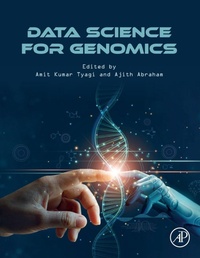
Data Science for Genomics
Published on 2. December 2022
Book
Paperback/Softback
312 pages
978-0-323-98352-5 (ISBN)
Description
Data Science for Genomics presents the foundational concepts of data science as they pertain to genomics, encompassing the process of inspecting, cleaning, transforming, and modeling data with the goal of discovering useful information, suggesting conclusions and supporting decision-making. Sections cover Data Science, Machine Learning, Deep Learning, data analysis, and visualization techniques. The authors then present the fundamentals of Genomics, Genetics, Transcriptomes and Proteomes as basic concepts of molecular biology, along with DNA and key features of the human genome, as well as the genomes of eukaryotes and prokaryotes.
Techniques that are more specifically used for studying genomes are then described in the order in which they are used in a genome project, including methods for constructing genetic and physical maps. DNA sequencing methodology and the strategies used to assemble a contiguous genome sequence and methods for identifying genes in a genome sequence and determining the functions of those genes in the cell. Readers will learn how the information contained in the genome is released and made available to the cell, as well as methods centered on cloning and PCR.
Techniques that are more specifically used for studying genomes are then described in the order in which they are used in a genome project, including methods for constructing genetic and physical maps. DNA sequencing methodology and the strategies used to assemble a contiguous genome sequence and methods for identifying genes in a genome sequence and determining the functions of those genes in the cell. Readers will learn how the information contained in the genome is released and made available to the cell, as well as methods centered on cloning and PCR.
More details
Language
English
Place of publication
Oxford
United Kingdom
Publishing group
Elsevier Science & Technology
Target group
Professional and scholarly
Academics (scientists, researchers, MSc. PhD. students) from the fields of Computer Science and Engineering, Biomedical Engineering, Biology, Chemistry, Genomics, and Information Technology. The audience also includes interested professionals-experts from both public and private industries of biomedical, genomics, computer science, data science, and information technology; The book may be used in Data Science, Medical, Biomedical, Artificial Intelligence, Machine Learning, Deep Learning oriented courses given at especially Health, Biology, Biomedical Engineering, Genetics or similar programs of universities, institutions.
Product notice
Paperback (trade)
Dimensions
Height: 279 mm
Width: 216 mm
Thickness: 17 mm
Weight
733 gr
ISBN-13
978-0-323-98352-5 (9780323983525)
Copyright in bibliographic data and cover images is held by Nielsen Book Services Limited or by the publishers or by their respective licensors: all rights reserved.
Schweitzer Classification
Other editions
Additional editions
Amit Kumar Tyagi | Ajith Abraham
Data Science for Genomics
E-Book
11/2022
Academic Press
€148.00
Available for download
Persons
Amit Kumar Tyagi is an Assistant Professor, at the National Forensic Sciences University, Gandhinagar, Gujarat, India. Previously he worked as an Assistant Professor (Senior Grade 2), and Senior Researcher at Vellore Institute of Technology (VIT), Chennai Campus, India from 2019-2022. He received his Ph.D. Degree (Full-Time) in 2018 from Pondicherry Central University, India. He joined the Lord Krishna College of Engineering, Ghaziabad (LKCE) from 2009 to 2010, and 2012 to 2013. He was an Assistant Professor and head researcher at Lingaya's Vidyapeeth (formerly known as Lingaya's University), India from 2018 to 2019. He supervised one PhD thesis and more than ten Master dissertations. He has contributed to several projects such as "AARIN? and "P3- Block? to address some of the open issues related to privacy breaches in Vehicular Applications (such as Parking) and Medical Cyber-Physical Systems (MCPS). He has published over 200 papers in refereed high-impact journals, conferences, and books, and some of his articles won best paper awards. Also, he has filed more than 25 patents (Nationally and Internationally) in the areas of Deep Learning, Internet of Things, Cyber-Physical Systems, and Computer Vision. He has edited more than 25 books for IET, Elsevier, Springer, CRC Press, etc. Additionally, he has authored 4 Books on Intelligent Transportation Systems, Vehicular Ad-hoc Network, Machine learning and Internet of Things, with IET UK, Springer Germany, and BPB India publisher. He won the Faculty Research Award of the Year for 2020, 2021, and 2022 consecutively, given by Vellore Institute of Technology, Chennai, India. Recently, he was awarded the best paper award for his paper "A Novel Feature Extractor Based on the Modified Approach of Histogram of Oriented Gradient?, in ICCSA 2020, Italy (Europe). His current research focuses on Next Generation Machine Based Communications, Blockchain Technology, Smart and Secure Computing and Privacy. He is a regular member of the ACM, IEEE, MIRLabs, Ramanujan Mathematical Society, Cryptology Research Society, Universal Scientific Education and Research Network, CSI, and ISTE. Dr. Ajith Abraham is the Pro Vice-Chancellor for Academics, Research, Incubation, and International Relations at Bennette University. He is also the Founding Director of Machine Intelligence Research Labs (MIR Labs), a global non-profit scientific network that connects academia and industry to support research and innovation. He is also serving as Vice Chancellor of Sai University, Chennai.
His research interests include artificial intelligence and machine intelligence, cyber-physical systems, the Internet of Things (IoT), network security, Web intelligence, sensor networks, and data mining. He serves as Chair of the IEEE Systems, Man, and Cybernetics Society Technical Committee on Soft Computing and has held editorial leadership roles, including Editor-in-Chief of Engineering Applications of Artificial Intelligence.
Dr. Abraham earned his Ph.D. in Computer Science from Monash University, Australia.
His research interests include artificial intelligence and machine intelligence, cyber-physical systems, the Internet of Things (IoT), network security, Web intelligence, sensor networks, and data mining. He serves as Chair of the IEEE Systems, Man, and Cybernetics Society Technical Committee on Soft Computing and has held editorial leadership roles, including Editor-in-Chief of Engineering Applications of Artificial Intelligence.
Dr. Abraham earned his Ph.D. in Computer Science from Monash University, Australia.
Content
1. Introduction to Data Science
2. Toolboxes for Data Scientists
3. Machine Learning and Deep Learning: A Concise Overview
4. Artificial Intelligence
5. Data Privacy and Data Trust
6. Visual Data Analysis and Complex Data Analysis
7. Big Data programming with Apache Spark and Hadoop
8. Information Retrieval and Recommender Systems
9. Statistical Natural Language Processing for Sentiment Analysis
10. Parallel Computing and High-Performance Computing
11. Data Science, Genomics, Genomes, and Genetics
12. Blockchain Technology for securing Genomic data
13. Cloud, edge, fog, etc., for communicating and storing data for Genome
14. Open Issues, Challenges and Future Research Directions towards Data science and Genomics
15. Privacy Laws
16. Ethical Concerns
17. Self-study questions
18. Problem-based learning
19. Key Terms/ Glossary
20. Appendix - Keeping up to Date
21. Bibliography
2. Toolboxes for Data Scientists
3. Machine Learning and Deep Learning: A Concise Overview
4. Artificial Intelligence
5. Data Privacy and Data Trust
6. Visual Data Analysis and Complex Data Analysis
7. Big Data programming with Apache Spark and Hadoop
8. Information Retrieval and Recommender Systems
9. Statistical Natural Language Processing for Sentiment Analysis
10. Parallel Computing and High-Performance Computing
11. Data Science, Genomics, Genomes, and Genetics
12. Blockchain Technology for securing Genomic data
13. Cloud, edge, fog, etc., for communicating and storing data for Genome
14. Open Issues, Challenges and Future Research Directions towards Data science and Genomics
15. Privacy Laws
16. Ethical Concerns
17. Self-study questions
18. Problem-based learning
19. Key Terms/ Glossary
20. Appendix - Keeping up to Date
21. Bibliography