

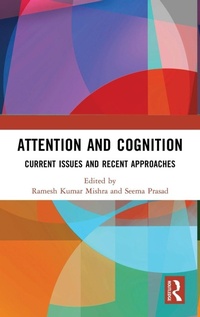
Attention and Cognition
Current Issues and Recent Approaches
1st Edition
Published on 24. February 2025
Book
Hardback
122 pages
978-1-032-29179-6 (ISBN)
Description
This volume explores the psychology of attention and discusses the various cognitive processes that determine what we pay attention to.
Much of our conscious moments are spent interacting with visual objects that we attend to and integrate into our consciousness. This book examines how we navigate this complex world of real and virtual objects and provides a comprehensive overview of the concept of attention and cognition. It focuses on themes related to different aspects of attention such as visual cognition and spatial orienting, selection history, priority map, the role of consciousness in attention research, and distractor suppression. It also discusses issues related to forming a comprehensive taxonomy of attention, emerging trends in attention research today and how they are being consolidated into the existing knowledge.
Based on empirical research, this book will be of interest to students, researchers and teachers of cognitive psychology, cognitive science, cognitive and computational neuroscience, and computer sciences. It will also be useful to academicians, psychologists, neuroscientists, mental health professionals and counsellors.
Much of our conscious moments are spent interacting with visual objects that we attend to and integrate into our consciousness. This book examines how we navigate this complex world of real and virtual objects and provides a comprehensive overview of the concept of attention and cognition. It focuses on themes related to different aspects of attention such as visual cognition and spatial orienting, selection history, priority map, the role of consciousness in attention research, and distractor suppression. It also discusses issues related to forming a comprehensive taxonomy of attention, emerging trends in attention research today and how they are being consolidated into the existing knowledge.
Based on empirical research, this book will be of interest to students, researchers and teachers of cognitive psychology, cognitive science, cognitive and computational neuroscience, and computer sciences. It will also be useful to academicians, psychologists, neuroscientists, mental health professionals and counsellors.
More details
Language
English
Place of publication
London
United Kingdom
Publishing group
Taylor & Francis Ltd
Target group
College/higher education
Professional and scholarly
Postgraduate
Illustrations
12 s/w Abbildungen, 12 s/w Photographien bzw. Rasterbilder, 3 s/w Tabellen
3 Tables, black and white; 12 Halftones, black and white; 12 Illustrations, black and white
Dimensions
Height: 240 mm
Width: 161 mm
Thickness: 12 mm
Weight
373 gr
ISBN-13
978-1-032-29179-6 (9781032291796)
Copyright in bibliographic data and cover images is held by Nielsen Book Services Limited or by the publishers or by their respective licensors: all rights reserved.
Schweitzer Classification
Other editions
Additional editions
Book
05/2026
1st Edition
Routledge India
€57.00
Shipment within 10-20 days
E-Book
02/2025
1st Edition
CRC Press
€60.49
Available for download
E-Book
02/2025
1st Edition
CRC Press
€60.49
Available for download
Persons
Ramesh Kumar Mishra is a Professor at the Centre for Neural and Cognitive Sciences, School of Medical Sciences, University of Hyderabad, India.
Seema Prasad is a postdoctoral fellow in the Cognitive Neurophysiology group, Department of Child and Adolescent Psychiatry, Faculty of Medicine, TU Dresden, Germany.
Seema Prasad is a postdoctoral fellow in the Cognitive Neurophysiology group, Department of Child and Adolescent Psychiatry, Faculty of Medicine, TU Dresden, Germany.
Content
1. Introduction 2. Thinking about Attention: Successive Approximations to a Productive Taxonomy 3. Fractionating Selection History: Dissociable Components of Experience-Driven Attention 4. Attentional guidance and the priority map 5. Role of Consciousness in Distractor Avoidance 6. The functional role of the oculomotor system in spatial short term memory 7. Why psychology is not (yet) a science. Index