

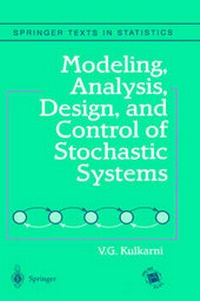
Modeling, Analysis, Design, and Control of Stochastic Systems
Published on 15. December 2000
Book
Mixed media product
XIV, 375 pages
978-0-387-98725-5 (ISBN)
Description
An introductory level text on stochastic modelling, suited for undergraduates or graduates in actuarial science, business management, computer science, engineering, operations research, public policy, statistics, and mathematics. It employs a large number of examples to show how to build stochastic models of physical systems, analyse these models to predict their performance, and use the analysis to design and control them. The book provides a self-contained review of the relevant topics in probability theory: In discrete and continuous time Markov models it covers the transient and long term behaviour, cost models, and first passage times; under generalised Markov models, it covers renewal processes, cumulative processes and semi-Markov processes. All the material is illustrated with many examples, and the book emphasises numerical answers to the problems. A software package called MAXIM, which runs on MATLAB, is available for downloading.
More details
Series
Edition
1st Corrected ed. 1999. Corr. 2nd printing 2000
Language
English
Place of publication
New York
United States
Target group
College/higher education
Lower undergraduate
Edition type
New edition
Product notice
Laminated cover
Illustrations
biography
Dimensions
Height: 23.5 cm
Width: 15.5 cm
Thickness: 23 mm
Weight
1610 gr
ISBN-13
978-0-387-98725-5 (9780387987255)
DOI
10.1007/978-1-4757-3098-2
Schweitzer Classification
Other editions
New editions
V. G. Kulkarni
Introduction to Modeling and Analysis of Stochastic Systems
Book
11/2010
2nd Edition
Springer
€160.49
Shipment within 15-20 days
Additional editions
E-Book
01/2014
Springer
€85.59
Available for download
Book
02/2012
Springer
€85.59
Article exhausted; check for reprint
Content
Probability.- Univariate Random Variables.- Multivariate Random Variables.- Conditional Probability and Expectations.- Discrete Time Markov Models.- Continuous Time Markov Models.- Generalized Markov Models.- Queuing Models.- Optimal Design.- Optimal Control.