

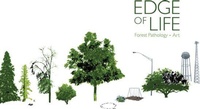
The Edge of Life
Forest Pathology. Art
Will be published approx. on 30. December 2011
Book
Hardback
108 pages
978-1-936205-31-8 (ISBN)
Description
""The concept behind The Edge of Life began with a simple observation by Dr. David Kulhavy, who perceived the delight artists experienced when they were introduced to the Forest Pathology lab in the Arthur Temple College of Forestry and Agriculture at SFASU. They were intrigued not only by the forms of the pathogens, but also how the pathogens affect their hosts and are influenced by their environment. When Dr. Kulhavy shared his observations with the university's art faculty, and in particular with Michelle Rozic, whose recent work incorporates ecological ideas, the concept of a collaborative art and science, Edge of Life took root.
The arts and sciences are linked in a long, interdependent tradition. Art delves into humanity's internal questions about our understanding of our place within nature. Science delves into the external mechanics of nature in search of similar knowledge and understanding of these problems. Art imaginatively makes visible intangible ideas by placing abstract concepts into concrete form. Forest pathology makes evident forest diseases through identifying signs and symptoms of forest pathogens. The Edge of Life pairs art work and specimen and provides the catalyst for discussion regarding how pathogens and invasive species affect the health of our forests, and how artists communicate concerns about contemporary ecological issues, translating their ideas through their media. Pathogens and invasive species have an inherent allure. The forms can be beautiful and repulsive, elegant in simplicity and complexity. Awareness of pathogens leads to understanding their mechanics, which develops cognisance on how our actions affect global, natural health. Forest pathologists study the unseen microscopic diseases through the visible symptoms-such as shelf fungi, known as conks or sporophores-learning to read the health of a forest ecosystem through the health of individual trees. The disease triangle illustrates the intrinsically linked co-dependency of Host-Pathogen-Environment. Pathogens transfer between and depend on host/s for survival and reproduction. Environment enables rapid spread of pathogens. Transference of pathogens is fertile ground for lessons of human behaviuor through artistically illuminated metaphor.""
The arts and sciences are linked in a long, interdependent tradition. Art delves into humanity's internal questions about our understanding of our place within nature. Science delves into the external mechanics of nature in search of similar knowledge and understanding of these problems. Art imaginatively makes visible intangible ideas by placing abstract concepts into concrete form. Forest pathology makes evident forest diseases through identifying signs and symptoms of forest pathogens. The Edge of Life pairs art work and specimen and provides the catalyst for discussion regarding how pathogens and invasive species affect the health of our forests, and how artists communicate concerns about contemporary ecological issues, translating their ideas through their media. Pathogens and invasive species have an inherent allure. The forms can be beautiful and repulsive, elegant in simplicity and complexity. Awareness of pathogens leads to understanding their mechanics, which develops cognisance on how our actions affect global, natural health. Forest pathologists study the unseen microscopic diseases through the visible symptoms-such as shelf fungi, known as conks or sporophores-learning to read the health of a forest ecosystem through the health of individual trees. The disease triangle illustrates the intrinsically linked co-dependency of Host-Pathogen-Environment. Pathogens transfer between and depend on host/s for survival and reproduction. Environment enables rapid spread of pathogens. Transference of pathogens is fertile ground for lessons of human behaviuor through artistically illuminated metaphor.""
More details
Edition
New
Language
English
Place of publication
College Station
United States
Target group
Professional and scholarly
Illustrations
64 colour images
Dimensions
Height: 185 mm
Width: 259 mm
Thickness: 15 mm
Weight
590 gr
ISBN-13
978-1-936205-31-8 (9781936205318)
Copyright in bibliographic data and cover images is held by Nielsen Book Services Limited or by the publishers or by their respective licensors: all rights reserved.
Schweitzer Classification
Person
MICHELLE ROZIC has exhibited her artwork throughout the U.S. and abroad. DAVID KULHAVY received the Distinguished Teaching Award in Entomology from the Entomological Society of America in 1993 and has been awarded the regional National Association of Interpretation award for his interpretations of Dr. Dave's Bugs.