

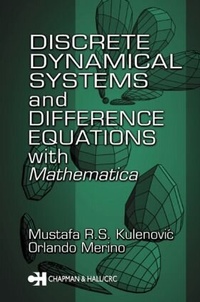
Discrete Dynamical Systems and Difference Equations with Mathematica
1st Edition
Published on 27. February 2002
Book
Hardback
362 pages
978-1-58488-287-9 (ISBN)
Description
Following the work of Yorke and Li in 1975, the theory of discrete dynamical systems and difference equations developed rapidly. The applications of difference equations also grew rapidly, especially with the introduction of graphical-interface software that can plot trajectories, calculate Lyapunov exponents, plot bifurcation diagrams, and find basins of attraction.
Modern computer algebra systems have opened the door to the use of symbolic calculation for studying difference equations. This book offers an introduction to discrete dynamical systems and difference equations and presents the Dynamica software. Developed by the authors and based on Mathematica, Dynamica provides an easy-to-use collection of algebraic, numerical, and graphical tools and techniques that allow users to quickly gain the ability to:
Find and classify the stability character of equilibrium and periodic points
Perform semicycle analysis of solutions
Calculate and visualize invariants
Calculate and visualize Lyapunov functions and numbers
Plot bifurcation diagrams
Visualize stable and unstable manifolds
Calculate Box Dimension
While it presents the essential theoretical concepts and results, the book's emphasis is on using the software. The authors present two sets of Dynamica sessions: one that serves as a tutorial of the different techniques, the other features case studies of well-known difference equations. Dynamica and notebooks corresponding to particular chapters are available for download from the Internet.
Modern computer algebra systems have opened the door to the use of symbolic calculation for studying difference equations. This book offers an introduction to discrete dynamical systems and difference equations and presents the Dynamica software. Developed by the authors and based on Mathematica, Dynamica provides an easy-to-use collection of algebraic, numerical, and graphical tools and techniques that allow users to quickly gain the ability to:
Find and classify the stability character of equilibrium and periodic points
Perform semicycle analysis of solutions
Calculate and visualize invariants
Calculate and visualize Lyapunov functions and numbers
Plot bifurcation diagrams
Visualize stable and unstable manifolds
Calculate Box Dimension
While it presents the essential theoretical concepts and results, the book's emphasis is on using the software. The authors present two sets of Dynamica sessions: one that serves as a tutorial of the different techniques, the other features case studies of well-known difference equations. Dynamica and notebooks corresponding to particular chapters are available for download from the Internet.
More details
Language
English
Place of publication
Oxford
United States
Publishing group
Taylor & Francis Inc
Target group
College/higher education
Professional and scholarly
Professional Practice & Development
Illustrations
50 s/w Abbildungen
50 Illustrations, black and white
Dimensions
Height: 234 mm
Width: 156 mm
Weight
830 gr
ISBN-13
978-1-58488-287-9 (9781584882879)
Copyright in bibliographic data and cover images is held by Nielsen Book Services Limited or by the publishers or by their respective licensors: all rights reserved.
Schweitzer Classification
Other editions
Additional editions
Mustafa R.S. Kulenovic | Orlando Merino
Discrete Dynamical Systems and Difference Equations with Mathematica
Book
06/2019
1st Edition
Chapman & Hall/CRC
€79.22
Shipment within 15-20 days
Mustafa R.S. Kulenovic | Orlando Merino
Discrete Dynamical Systems and Difference Equations with Mathematica
E-Book
02/2002
Chapman & Hall/CRC
€89.99
Available for download
Mustafa R.S. Kulenovic | Orlando Merino
Discrete Dynamical Systems and Difference Equations with Mathematica
E-Book
02/2002
Chapman and Hall
€89.99
Available for download
Persons
Kulenovic, Mustafa R.S.; Merino, Orlando
Content
Dynamics for One-Dimensional Difference Equations. Dynamics for Two-Dimensional Difference Equations. Systems of Difference Equations, Stability, and Semicycles. Invariants and Related Lyapunov Functions. Dynamics for Three-Dimensional Difference Equations. Fractals Generated by Iterated Functions Systems. Bibliography.