

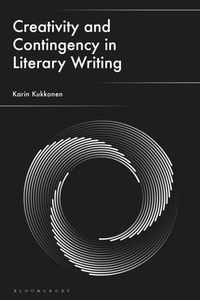
Creativity and Contingency in Literary Writing
Will be published approx. on 8. January 2026
Book
Hardback
272 pages
978-1-350-52266-4 (ISBN)
Description
The first book to investigate, analyze and theorize the creative processes of literary writers, Creativity and Contingency in Literary Writing uses author interviews, manuscript genetics and textual evidence to explore creativity from the authorial perspective.
Studying an author's practice, literary form and contextual contingencies as elements that affect literary creativity, Karin Kukkoken develops theoretical models for examining the age-old problem of artistic creation and how it has been put to works by authors from the nineteenth century to the age of digital fiction, across a range of languages. With insights from the cognitive sciences, anthropology and philosophy of mind as well as literary studies, the book calls upon interviews with Siri Hustvedt, Marina Warner, Anne Weber, Camille Laurens, Gwenaelle Aubry, Kate Pullinger, Gunnhild Oyehaug, Maria Stepanova and Gyoergy Dragoman and studies the manuscripts of Charlotte Bronte, Cora Sandel, Elsa Morante and Italo Calvino.
Overcoming the traditional distinction between creative agent, process and creative product, Creativity and Contingency in Literary Writing is as accessible and illuminating as it is important to understandings of human creativity.
Studying an author's practice, literary form and contextual contingencies as elements that affect literary creativity, Karin Kukkoken develops theoretical models for examining the age-old problem of artistic creation and how it has been put to works by authors from the nineteenth century to the age of digital fiction, across a range of languages. With insights from the cognitive sciences, anthropology and philosophy of mind as well as literary studies, the book calls upon interviews with Siri Hustvedt, Marina Warner, Anne Weber, Camille Laurens, Gwenaelle Aubry, Kate Pullinger, Gunnhild Oyehaug, Maria Stepanova and Gyoergy Dragoman and studies the manuscripts of Charlotte Bronte, Cora Sandel, Elsa Morante and Italo Calvino.
Overcoming the traditional distinction between creative agent, process and creative product, Creativity and Contingency in Literary Writing is as accessible and illuminating as it is important to understandings of human creativity.
Reviews / Votes
Creativity and Contingency in Literary Writing offers an engaging and insightful exploration of literary creativity, showing how authorial practice, literary form, and contingency combine in the making of literature. This book is a must-read for anyone interested in how great literature comes to life. * Ana Margarida Abrantes, Universidade Catolica Portuguesa, Portugal * Read this book only if you are prepared to have your mind changed, for Karin Kukkonen turns a core idea of literary studies upside down. She shows that the form literary works take, far from being necessary, is riddled with contingency, a contingency essential to creativity. * Michel Chaouli, Author of Something Speaks to Me: Where Criticism Begins * How much of what you create is due to your own intentions, and how much down to chance happenings and coincidences? In this ground-breaking treatment, Karin Kukonnen reveals the many ways human practices and the materiality of textenable us to curate (and sometimes actively provoke) chance itself. A thrilling journey, highly recommended to all those interested in mind, creativity, and literary practice. * Andy Clark, Author of The Experience Machine: How Our Minds Predict and Shape Reality * This book not only shows how authors experiment with the contingencies of the writing process itself, but also follows their practices over time. It provides insights into how an author's creativity responds to its material settings, and how a work is continuously shaped by the ways an author is working. This book offers new analytical tools with which to understand an author's individuality and takes a completely new approach to examining the relationship between manuscripts and writing practices. * Juliane Vogel, University of Konstanz, Germany *More details
Language
English
Place of publication
London
United Kingdom
Publishing group
Bloomsbury Publishing PLC
Target group
College/higher education
Illustrations
5 bw illus
Dimensions
Height: 240 mm
Width: 161 mm
Thickness: 19 mm
Weight
570 gr
ISBN-13
978-1-350-52266-4 (9781350522664)
Copyright in bibliographic data and cover images is held by Nielsen Book Services Limited or by the publishers or by their respective licensors: all rights reserved.
Schweitzer Classification
Other editions
Additional editions
Karin Kukkonen
Creativity and Contingency in Literary Writing
E-Book
12/2025
1st Edition
Bloomsbury Academic
€94.49
Available for download
Karin Kukkonen
Creativity and Contingency in Literary Writing
E-Book
12/2025
1st Edition
Bloomsbury Academic
€94.49
Available for download
Person
Karin Kukkonen is Professor in Comparative Literature at the University of Oslo, Norway. She has published several monographs, including Probability Designs (2020). Having previously held positions in Finland and the UK, she now leads the interdisciplinary centre "LCE - Literature, Cognition and Emotions", where she established the LCE podcast which explores how literature shapes thoughts and feelings.
Content
Preface
Acknowledgements
A Note on Translations
Introduction: The Second Book Problem
Chapter 1: Contingency Traps: Form to Contingency
Chapter 2: Contingent Selves: Contingency to Form
Chapter 3: Why One Form and Not Another? Form to Practice
Chapter 4: Paper, Type-Writers and Screens: Practice to Form
Chapter 5: Provoking Chance: Practice to Contingency
Chapter 6: Found Objects, Lives and Words: Contingency to Practice
Conclusion: When It's Finished
Appendix I: Overview of Interviews
Appendix II: Overview of Manuscripts
Appendix III: Citations in the Original Languages
Bibliography
Index
Acknowledgements
A Note on Translations
Introduction: The Second Book Problem
Chapter 1: Contingency Traps: Form to Contingency
Chapter 2: Contingent Selves: Contingency to Form
Chapter 3: Why One Form and Not Another? Form to Practice
Chapter 4: Paper, Type-Writers and Screens: Practice to Form
Chapter 5: Provoking Chance: Practice to Contingency
Chapter 6: Found Objects, Lives and Words: Contingency to Practice
Conclusion: When It's Finished
Appendix I: Overview of Interviews
Appendix II: Overview of Manuscripts
Appendix III: Citations in the Original Languages
Bibliography
Index