

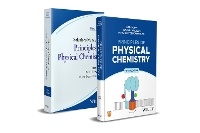
Principles of Physical Chemistry, Multi-Volume
Multi-Volume
3rd Edition
Published on 28. November 2024
Book
Hardback
978-1-119-85265-0 (ISBN)
Description
This book provides a unique approach to introduce undergraduate students to the concepts and methods of physical chemistry, which are the foundational principles of Chemistry. The book introduces the student to the principles underlying the essential sub-fields of quantum mechanics, atomic and molecular structure, atomic and molecular spectroscopy, statistical thermodynamics, classical thermodynamics, solutions and equilibria, electrochemistry, kinetics and reaction dynamics, macromolecules, and organized molecular assemblies. Importantly, the book develops and applies these principles to supramolecular assemblies and supramolecular machines, with many examples from biology and nanoscience. In this way, the book helps the student to see the frontier of modern physical chemistry developments.
The book begins with a discussion of wave-particle duality and proceeds systematically to more complex chemical systems in order to relate the story of physical chemistry in an intellectually coherent manner. The topics are organized to correspond with those typically given in each of a two course semester sequence. The first 13 chapters present quantum mechanics and spectroscopy to describe and predict the structure of matter: atoms, molecules, and solids. Chapters 14 to 29 present statistical thermodynamics and kinetics and applies their principles to understanding equilibria, chemical transformations, macromolecular properties and supramolecular machines. Each chapter of the book begins with a simplified view of a topic and evolves to more rigorous description, in order to provide the student (and instructor) flexibility to choose the level of rigor and detail that suits them best. The textbook treats important new directions in physical chemistry research, including chapters on macromolecules, principles of interfaces and films for organizing matter, and supramolecular machines -- as well as including discussions of modern nanoscience, spectroscopy, and reaction dynamics throughout the text.
The book begins with a discussion of wave-particle duality and proceeds systematically to more complex chemical systems in order to relate the story of physical chemistry in an intellectually coherent manner. The topics are organized to correspond with those typically given in each of a two course semester sequence. The first 13 chapters present quantum mechanics and spectroscopy to describe and predict the structure of matter: atoms, molecules, and solids. Chapters 14 to 29 present statistical thermodynamics and kinetics and applies their principles to understanding equilibria, chemical transformations, macromolecular properties and supramolecular machines. Each chapter of the book begins with a simplified view of a topic and evolves to more rigorous description, in order to provide the student (and instructor) flexibility to choose the level of rigor and detail that suits them best. The textbook treats important new directions in physical chemistry research, including chapters on macromolecules, principles of interfaces and films for organizing matter, and supramolecular machines -- as well as including discussions of modern nanoscience, spectroscopy, and reaction dynamics throughout the text.
More details
Edition
3rd edition
Language
English
Place of publication
New York
United States
Target group
College/higher education
Dimensions
Height: 285 mm
Width: 224 mm
Thickness: 97 mm
Weight
3697 gr
ISBN-13
978-1-119-85265-0 (9781119852650)
Copyright in bibliographic data and cover images is held by Nielsen Book Services Limited or by the publishers or by their respective licensors: all rights reserved.
Schweitzer Classification