

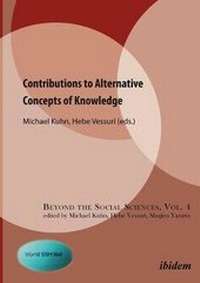
Contributions to Alternative Concepts of Knowledge
Published on 4. October 2016
Book
Paperback/Softback
272 pages
978-3-8382-0974-6 (ISBN)
Description
In the past, the European social sciences labelled and discredited knowledge that did not conform to their own definition of scientific knowledge as an alternative kind of knowledge, as 'indigenous' knowledge. Perception has changed with time: not only has indigenous knowledge become an entrance ticket to the world of European social science, but the indigenization of European theories is seen by some as the contribution of peripheral social sciences to join the theories of the centers. This book offers contributions to the conversation on alternative concepts of knowledge, inviting the reader to decide if they are truly alternative, indigenous, or European types of knowledge.
More details
Language
English
Place of publication
Stuttgart
Germany
Target group
Professional and scholarly
Product notice
Paperback (trade)
Illustrations
tab.: 3, b&w
Dimensions
Height: 210 mm
Width: 148 mm
Thickness: 15 mm
Weight
666 gr
ISBN-13
978-3-8382-0974-6 (9783838209746)
Copyright in bibliographic data and cover images is held by Nielsen Book Services Limited or by the publishers or by their respective licensors: all rights reserved.
Schweitzer Classification
Other editions
Additional editions
Hebe Vessuri | Michael Kuhn
Contributions to Alternative Concepts of Knowledge
E-Book
09/2016
ibidem
€22.99
Available for download
Persons
Michael Kuhn is the president of the World Social Sciences and Humanities Network. He has published several books on social science. Hebe Vessuri is a social anthropologist at the Center of Science Studies of the Venezuelan Institute of Scientific Research. Vessuri's interests include the sociology and contemporary history of science in Latin America, science policy, and sociology of technology.
Content
Acknowledgements 1. The misery of defining what scientific knowledge is-and what not, by Michael Kuhn and Hebe Vessuri Section I: Alternative concepts of knowledge 2. Towards a dialogue between knowledge systems Learning experiences in indigenous contexts in Mexico, by Juan Pablo Vazquez Gutierrez and Pablo Reyna Esteves 3. Alternatives to Nostalgia for Colonial Ethnology in the African Postcolonial Theory, by Leon-Marie Nkolo Ndjodo 4. The Interlinkages between Western and Indigenous Psychology in 20th- and early 21st-century India, by Christiane Hartnack 5. Knowledge as Interaction. An Alternative Epistemology from Rural Mexico, by Roger Magazine 6. Indigenous knowledge in the social sciences. comunalidad and the challenge to Western categories, by Claudia Magallanes-Blanco and Leandro Rodriguez-Medina 7. What can Science and Technology Studies do with and for Latin America?, by Ivan da Costa Marques 8. Decolonising social sciences in remote Australia, by Michael Christie 9. Culturalising Social Knowledges as a Critique of Euro-American Social Sciences: Learning from Deconstructing Poverty in the Shadow of Gandhian Social Theory, by Kumaran Rajagopal 10. Rereading of Metaphysical Foundations of Humanities in the Light of the Qur'an's Teachings, by Qodratullah Qorbani Section II: Contributions to the discourse about alternative concepts of knowledge 11. What is foreign knowledge?, by Leandro Rodriguez Medina 12. Alternatives to the Globalising Humanities and Social Sciences: Comments to the ideas presented at the Mexico WSSHNetwork workshop, by Michael Christie 13. Some comments about spatiological thinking-the final universalisation of the "European" social sciences, by Michael Kuhn Biographical Notes