

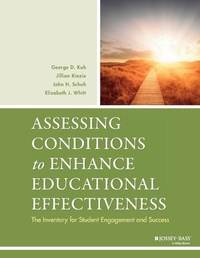
Assessing Conditions to Enhance Educational Effectiveness
The Inventory for Student Engagement and Success
1st Edition
Will be published approx. on 21. October 2005
Book
Paperback/Softback
112 pages
978-0-7879-8220-1 (ISBN)
Description
From the authors of Student Success in College-the book that describes the policies, programs, and practices of twenty colleges and universities that have created success-oriented campus cultures and learning environments-comes the next-step resource to help an institution assess whether these conditions exist. The authors present the Inventory for Student Engagement and Success (ISES), a self-guided framework for conducting a comprehensive, systematic, institutionwide analysis. The process also can be applied to areas within an institution, such as a school or college within a university, an academic or student affairs division, or a department or program. The ISES includes sets of diagnostic queries that focus on the six properties and conditions common to high-performing schools as well as the five clusters of effective educational practices featured on the National Survey of Student Engagement. Suggestions are offered to illustrate how the information generated from the ISES process can be used for various purposes including accreditation self-studies, program reviews, staff development, faculty and governing board retreats, and strategic planning.
More details
Language
English
Place of publication
New York
United States
Publishing group
John Wiley & Sons Inc
Target group
Professional and scholarly
Product notice
Paperback (trade)
Unsewn / adhesive bound
Dimensions
Height: 280 mm
Width: 216 mm
Thickness: 7 mm
Weight
314 gr
ISBN-13
978-0-7879-8220-1 (9780787982201)
Copyright in bibliographic data and cover images is held by Nielsen Book Services Limited or by the publishers or by their respective licensors: all rights reserved.
Schweitzer Classification
Persons
George D. Kuh is Chancellor's Professor of Higher Education and director of the Center for Postsecondary Research at Indiana University Bloomington, home to the National Survey of Student Engagement (NSSE), the NSSE Institute for Effective Educational Practice, and the College Student Experiences Questionnaire Research Program.
Jillian Kinzie is associate director of the NSSE Institute for Effective Educational Practice and project manager of the Documenting Effective Educational Practice (DEEP) initiative.
John H. Schuh is distinguished professor of educational leadership at Iowa State University.
Elizabeth J. Whitt is professor in the College of Education and coordinator of Graduate Programs in Student Affairs Administration at the University of Iowa.
Jillian Kinzie is associate director of the NSSE Institute for Effective Educational Practice and project manager of the Documenting Effective Educational Practice (DEEP) initiative.
John H. Schuh is distinguished professor of educational leadership at Iowa State University.
Elizabeth J. Whitt is professor in the College of Education and coordinator of Graduate Programs in Student Affairs Administration at the University of Iowa.
Content
PREFACE. ABOUT THE AUTHORS.
PART ONE: Student Success in College: Why It Matters and What Institutions Can Do About It.
CHAPTER 1: Why Focus on Student Success?
Student Engagement: A Key to Student Success.
Project DEEP: A Window into Effective Educational Practice.
Putting DEEP to Work.
Are You Ready for ISES?
CHAPTER 2: Guiding Principles for Using the Inventory for Student Engagement and Success.
Context Is Everything.
The Whole Is Greater than the Sum of the Parts.
Evidence Is Essential: The More, the Better.
Test Prevailing Assumptions.
Cast a Wide Net.
Use Outsiders to Ask Hard Questions.
Focus on What Matters to Student Success.
Stay the Course.
PART TWO: Inventory for Student Engagement and Success.
CHAPTER 3: Using ISES to Assess the Properties and Conditions Common to Educationally Effective Colleges.
A "Living" Mission and "Lived" Educational Philosophy.
Unshakeable Focus on Student Learning.
Environments Adapted for Educational Enrichment.
Clear Pathways to Student Success.
Improvement-Oriented Ethos.
Shared Responsibility for Educational Quality and Student Success.
"Ultimately, It's About the Culture".
CHAPTER 4: Using ISES to Assess Effective Educational Practices.
Academic Challenge.
Active and Collaborative Learning.
Student-Faculty Interaction.
Enriching Educational Experiences.
Supportive Campus Environment.
CHAPTER 5: Using ISES for Institutional Improvement.
Logistical Issues.
Applications of ISES.
A Last Word.
REFERENCES.
APPENDIX A: ISES: Suggested Interview Protocols.
APPENDIX B: DEEP Site Visit Report Timeline.
INDEX.
PART ONE: Student Success in College: Why It Matters and What Institutions Can Do About It.
CHAPTER 1: Why Focus on Student Success?
Student Engagement: A Key to Student Success.
Project DEEP: A Window into Effective Educational Practice.
Putting DEEP to Work.
Are You Ready for ISES?
CHAPTER 2: Guiding Principles for Using the Inventory for Student Engagement and Success.
Context Is Everything.
The Whole Is Greater than the Sum of the Parts.
Evidence Is Essential: The More, the Better.
Test Prevailing Assumptions.
Cast a Wide Net.
Use Outsiders to Ask Hard Questions.
Focus on What Matters to Student Success.
Stay the Course.
PART TWO: Inventory for Student Engagement and Success.
CHAPTER 3: Using ISES to Assess the Properties and Conditions Common to Educationally Effective Colleges.
A "Living" Mission and "Lived" Educational Philosophy.
Unshakeable Focus on Student Learning.
Environments Adapted for Educational Enrichment.
Clear Pathways to Student Success.
Improvement-Oriented Ethos.
Shared Responsibility for Educational Quality and Student Success.
"Ultimately, It's About the Culture".
CHAPTER 4: Using ISES to Assess Effective Educational Practices.
Academic Challenge.
Active and Collaborative Learning.
Student-Faculty Interaction.
Enriching Educational Experiences.
Supportive Campus Environment.
CHAPTER 5: Using ISES for Institutional Improvement.
Logistical Issues.
Applications of ISES.
A Last Word.
REFERENCES.
APPENDIX A: ISES: Suggested Interview Protocols.
APPENDIX B: DEEP Site Visit Report Timeline.
INDEX.