

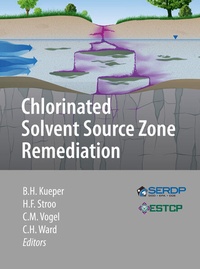
Chlorinated Solvent Source Zone Remediation
1st Edition
Published on 23. April 2014
Book
Hardback
LIII, 713 pages
978-1-4614-6921-6 (ISBN)
Description
The purpose of this book is to help engineers and scientists better understand dense nonaqueous phase liquid (DNAPL) contamination of groundwater and the methods and technology used for characterization and remediation. Remediation of DNAPL source zones is very difficult and controversial and must be based on state-of-the-art knowledge of the behavior (transport and fate) of nonaqueous phase liquids in the subsurface and site specific geology, chemistry and hydrology. This volume is focused on the characterization and remediation of nonaqueous phase chlorinated solvents and it is hoped that mid-level engineers and scientists will find this book helpful in understanding the current state-of-practice of DNAPL source zone management and remediation.
More details
Series
Language
English
Place of publication
New York
United States
Target group
Professional and scholarly
Research
Illustrations
203 farbige Abbildungen, 11 s/w Abbildungen
LIII, 713 p. 214 illus., 203 illus. in color.
Dimensions
Height: 266 mm
Width: 198 mm
Thickness: 36 mm
Weight
1983 gr
ISBN-13
978-1-4614-6921-6 (9781461469216)
DOI
10.1007/978-1-4614-6922-3
Schweitzer Classification
Other editions
Additional editions
Bernard H. Kueper | Hans F. Stroo | Catherine M. Vogel
Chlorinated Solvent Source Zone Remediation
E-Book
04/2014
1st Edition
Springer
€149.79
Available for download
Content
Preface.- State of the Practice.- The Source Zone Remediation Challenge.- DNAPL Source Zone Characterization and Delineation for Remediation.- Advanced Diagnostics.- Modeling Source Zone Remediation.- Modeling Plume Responses to Source Treatment.- Flux-Based Site Assessment and Management.- Hydraulic Displacement.- In Situ Chemical Oxidation.- In Situ Chemical Reduction.- Surfactant and Cosolvent Flushing.- In Situ Bioremediation of Sources.- Natural Attenuation of Sources.- In Situ Thermal Treatment of Sources.- Combining Remedies.- Cost Considerations for Source Treatment Technologies.- Alternative Management Strategies.- Research and Development Needs.- Index.