

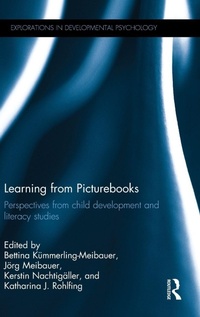
Learning from Picturebooks
Perspectives from child development and literacy studies
1st Edition
Published on 17. February 2015
Book
Hardback
246 pages
978-0-415-72079-3 (ISBN)
Description
Picturebooks, understood as a series of meaningful text-picture relations, are increasingly acknowledged as an autonomous sub-genre of children's literature. Being highly complex aesthetic products, their use is deeply embedded in specific situations of joint attention between a caregiver and a child. This volume focuses on the question of what children may learn from looking at picturebooks, whether printed in a book format, created in a digital format, or self-produced by educationalists and researchers.
Interest in the relationship between cognitive processes and children's literature is growing rapidly, and in this book, theoretical frameworks such as cognitive linguistics, cognitive narratology, cognitive poetics, and cognitive psychology, have been applied to the analysis of children's literature. Chapters gather empirical research from the fields of literary studies, linguistics and cognitive psychology together for the first time to build a cohesive understanding of how picturebooks assist learning and development.
International contributions explore:
language acquisition
the child's cognitive development
emotional development
literary acquisition ("literary literacy")
visual literacy.
Divided into three parts considering symbol-based learning, co-constructed learning, and learning language skills, this cross-disciplinary volume will appeal to researchers, students and professionals engaged in children's literature and literacy studies, as well as those from the fields of cognitive and developmental psychology, linguistics, and education.
Interest in the relationship between cognitive processes and children's literature is growing rapidly, and in this book, theoretical frameworks such as cognitive linguistics, cognitive narratology, cognitive poetics, and cognitive psychology, have been applied to the analysis of children's literature. Chapters gather empirical research from the fields of literary studies, linguistics and cognitive psychology together for the first time to build a cohesive understanding of how picturebooks assist learning and development.
International contributions explore:
language acquisition
the child's cognitive development
emotional development
literary acquisition ("literary literacy")
visual literacy.
Divided into three parts considering symbol-based learning, co-constructed learning, and learning language skills, this cross-disciplinary volume will appeal to researchers, students and professionals engaged in children's literature and literacy studies, as well as those from the fields of cognitive and developmental psychology, linguistics, and education.
Reviews / Votes
"With chapter contributors coming from fields such as developmental psychology, optometry and vision science, early-years education, clinical linguistics, international children's literature, multimodal literacy, linguistics, philosophy, and preschool education - this scholarly work is a compendium of interdisciplinary approaches which looks into how children acquire language as well as develop cognitive, emotional, and emergent literacy skills through picturebooks... The editors have done a remarkable job of structuring each chapter in such a way that the core connecting thread of how children learn from picturebooks runs through this academic text that features empirical investigations conducted or reviewed extensively but hay chapter contributors." - Rhoda Myra Garces-Bascal, Bookbird: A Journal of International Children's LiteratureMore details
Series
Language
English
Place of publication
London
United Kingdom
Publishing group
Taylor & Francis Ltd
Target group
College/higher education
Professional and scholarly
Postgraduate and Professional
Illustrations
22 s/w Abbildungen, 12 s/w Photographien bzw. Rasterbilder, 10 s/w Zeichnungen, 9 s/w Tabellen
9 Tables, black and white; 10 Line drawings, black and white; 12 Halftones, black and white; 22 Illustrations, black and white
Dimensions
Height: 240 mm
Width: 161 mm
Thickness: 18 mm
Weight
540 gr
ISBN-13
978-0-415-72079-3 (9780415720793)
Copyright in bibliographic data and cover images is held by Nielsen Book Services Limited or by the publishers or by their respective licensors: all rights reserved.
Schweitzer Classification
Other editions
Additional editions
Bettina Kuemmerling-Meibauer | Joerg Meibauer | Kerstin Nachtigaeller
Learning from Picturebooks
Perspectives from child development and literacy studies
Book
04/2017
1st Edition
Routledge
€68.40
Shipment within 10-20 days
Bettina Kuemmerling-Meibauer | Joerg Meibauer | Kerstin Nachtigaeller
Learning from Picturebooks
Perspectives from child development and literacy studies
E-Book
02/2015
1st Edition
Routledge
€61.99
Available for download
Bettina Kuemmerling-Meibauer | Joerg Meibauer | Kerstin Nachtigaeller
Learning from Picturebooks
Perspectives from child development and literacy studies
E-Book
02/2015
1st Edition
Routledge
€61.99
Available for download
Persons
Bettina Kuemmerling-Meibauer is Professor in the German Department at the University of Tuebingen, Germany.
Joerg Meibauer is Chair for German Linguistics at the Johannes Gutenberg University of Mainz, Germany.
Kerstin Nachtigaeller is a member of the Emergentist Semantics Group at the Center of Excellence Cognitive Interaction Technology, Bielefeld University, Germany.
Katharina J. Rohlfing is Head of the Emergentist Semantics Group at the Center of Excellence Cognitive Interaction Technology, Bielefeld University, Germany.
Joerg Meibauer is Chair for German Linguistics at the Johannes Gutenberg University of Mainz, Germany.
Kerstin Nachtigaeller is a member of the Emergentist Semantics Group at the Center of Excellence Cognitive Interaction Technology, Bielefeld University, Germany.
Katharina J. Rohlfing is Head of the Emergentist Semantics Group at the Center of Excellence Cognitive Interaction Technology, Bielefeld University, Germany.
Content
Understanding Learning from Picturebooks: an Introduction. Part 1: Symbol-based Learning in Picturebooks Picturebooks and Early Literacy. How Do Picturebooks Support Early Conceptual and Narrative Development?. An Examination of Factors that Affect Young Children's Learning and Transfer from Picturebooks. What the Child Can Learn from Simple Descriptive Picturebooks. An Inquiry into Lastwagen/Trucks by Paul Stickland. The Development of Color Vision and of the Ability to Appreciate Color in Picturebooks. Part 2: Co-constructed Learning from Picturebooks Gesturing in Joint Book Reading. Growing Vocabulary in the Context of Shared Book Reading. The Role of Distributed Cognition in Early Explorations of Symbolic Expression. Affective Interaction During Classroom Picturebook Reading. Part 3: Learning Language Skills from Picturebooks Word Learning via Shared Storybook Reading. What Good is a Picturebook? Developing Children's Oral Language and Literacy Through Shared Picturebook Reading. Tense Acquisition with Picturebooks.