

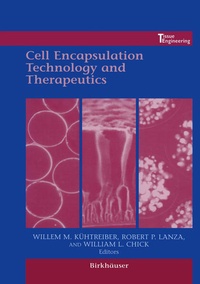
Cell Encapsulation Technology and Therapeutics
Published on 15. October 2012
Book
Paperback/Softback
XVIII, 450 pages
978-1-4612-7205-2 (ISBN)
Description
The concept of using encapsulation for the immunoprotection of transplanted cells was introduced for the first time in the 1960s. "[Microencapsulated cells] might be protected from destruction and from partici- pation in immunological processes, while the enclosing membrane would be permeable to small molecules of specific cellular product which could then enter the general extracellular compartment of the recipient. For instance, encapsulated endocrine cells might survive and maintain an effective supply of hormone." (Chang, Ph.D. Thesis, McGill University, 1965; Chang et aI., Can J Physiol PharmacoI44:115-128, 1966). We asked Connaught Laboratories, Ltd., in Toronto to put this concept into practice. In 1980, Lim and Sun from Connaught Laboratories reported on the successful implantation of poly-I-Iysine-alginate encapsu- lated rat islets into a foreign host. [Lim and Sun, Science 210:908-909, 1980]. Now many groups around the world are making tremendous progress in the encapsulation of a multitude of cell types. Kiihtreiber, Lanza, and Chick have invited many cell encapsulation groups from around the world to contribute to this book.
The result is a very useful reference book in this rapidly growing area. With so many excellent au- thors describing in detail the different areas of cell encapsulation, my role here will be to briefly discuss a few points.
The result is a very useful reference book in this rapidly growing area. With so many excellent au- thors describing in detail the different areas of cell encapsulation, my role here will be to briefly discuss a few points.
More details
Edition
Softcover reprint of the original 1st ed. 1999
Language
English
Place of publication
Boston
United States
Target group
Professional and scholarly
Research
Illustrations
XVIII, 450 p.
Dimensions
Height: 254 mm
Width: 178 mm
Thickness: 26 mm
Weight
880 gr
ISBN-13
978-1-4612-7205-2 (9781461272052)
DOI
10.1007/978-1-4612-1586-8
Schweitzer Classification
Other editions
Additional editions
Willem_M. Kühtreiber | Robert P. Lanza | William L. Chick
Cell Encapsulation Technology and Therapeutics
E-Book
12/2013
Birkhäuser
€53.49
Available for download
Willem_M. Kühtreiber | Robert P. Lanza | William L. Chick
Cell Encapsulation Technology and Therapeutics
Book
07/1999
1st Edition
Birkhauser Boston Inc
€96.00
Article exhausted; check different version
Persons
Content
I Fundamentals of Cell Encapsulation.- 1. Encapsulation and Immoblization Techniques.- 2. Mass Transfer in Immobilized Cell Systems.- 3. Polymer Membranes for Cell Encapsulation.- 4. Biocompatible Encapsulation Materials: Fundamentals and Application.- 5. Modulation of Membrane Permeability.- 6. Biocompatibility Issues.- II Encapsulation Systems Section 1 Microencapsulation.- 7. Calcium Alginate.- 8. Immunoprotection of Islets of Langerhans by Microencapsulation in Barium Alginate Beads.- 9. Agarose.- 10. Poly (ethylene glycol).- 11. Long-Term Survival of Poly-L-Lysine-Alginate Microencapsulated Islet Xenografts in Spontaneously Diabetic NOD Mice.- 12. Alginate/Poly-L-Ornithine Microcapsules for Pancreatic Islet Cell Immunoprotection
Giuseppe.- 13. Chitosan.- 14. Polyacrylates.- Section 2 Macroencapsulation.- 15. Diffusion Chambers.- 16. Vascular Devices.- 17. Macrocapsules Based on Ultrafiltration and Diffusion.- III Applications of Encapsulated Cell Systems Section 1 Primary Cells.- 18. Artificial Pancreas.- 19. Microencapsulated Islets in Type I Diabetics: Clinical Experience.- 20. Transplantation of Microencapsulated Parathyroid Tissue: Clinical Background, Methods, and Current Status of Research.- 21. Bioartificial Livers.- 22. Renal Replacement Devices: The Development of the Bioartificial Kidney.- 23. Encapsulation of Mammalian Embryos.- 24. Encapsulated Plant Cells: Techniques and Applications.- Section 2 Genetically Engineered Cells.- 25. Implantable Microcapsules for Gene Therapy for Hemophilia.- 26. Microencapsulation: A Novel Gene Therapy for Lysosomal Storage Diseases.- 27. Growth Hormone Gene Therapy Using Encapsulated Myoblasts.- 28. Transplantation of Encapsulated Cells into the Central Nervous System.- 29. Removal of Urea in Uremia and Ammonia in LiverFailure with Emphasis on the Use of Artificial Cells for Encapsulation of Genetically Engineered Cells.- Section 3 Bioreactor Culture.- 30. Principles of Bioreactor Design for Encapsulated Cells.- 31. Culture of Anchorage-Dependent Cells.