

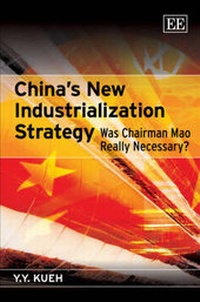
China's New Industrialization Strategy
Was Chairman Mao Really Necessary?
Will be published approx. on 30. April 2008
Book
Hardback
296 pages
978-1-84720-232-1 (ISBN)
Description
Deng Xiaoping's economic strategy is widely regarded as a complete anathema to Mao's, but this study strongly argues that without the material foundations laid by Mao, it would have been very difficult for Deng to launch his reform and open-door policy. Deng basically shared Mao's aspirations and approach in pursuit of China's industrialization, and this had in fact helped to condition him to the successful gradualist methodology. Deng lost patience at times and resorted to the 'big bang' strategy, only to fail miserably. Taken together, the book tells a new story about the economics of China's transition.This is a highly thought-provoking study, blending institutional and convincing statistical analysis. It will appeal to scholars and academics interested in the background and process of China emerging as an economic giant and especially to students of economics, politics, international business and globalization studies who aspire to an alternative, 'non-Left' re-interpretation of Mao's legacy.
Reviews / Votes
'The book is a scholarly attempt to place the post-Mao reforms in China in the context of developments in the Soviet Union and the Eastern European countries. The essays, written in different periods, have mostly been thoroughly rewritten, extended, updated and refocused in the light of recent developments, and demonstrate conclusively that Dengist reforms were not a clean break from the past, as many ideologically blinkered Western Sinologists readily assume; the reforms succeeded mainly because the post-Mao regime had inherited a solid economic and political edifice created during the Mao era.' -- Radha Sinha, Glasgow University, UK 'Professor Kueh is one of the most original and prolific scholars in the field of communist Chinese studies. In this collection we can read fully updated versions of many of his most important contributions to our understanding of the Chinese economy in both its domestic and foreign dimensions. Most of these articles are now hard to get hold of and this new volume is therefore a most welcome addition to the literature.' -- Christopher Howe, University of Sheffield, UK 'Y.Y. Kueh, in this stimulating collection of essays written over a career studying China's economy spanning more than three decades, argues the proposition that there were important elements of continuity in the transition of economic thinking from Mao Zedong to Deng Xiaoping. The argument is controversial, but scholars and students alike will gain insight into the economic development strategies of China from reading these carefully reasoned studies. They will challenge many of the common assumptions about the nature of China's transition from central planning to the market.' -- Dwight H. Perkins, Harvard University, USMore details
Language
English
Place of publication
Cheltenham
United Kingdom
Target group
College/higher education
Dimensions
Height: 234 mm
Width: 156 mm
ISBN-13
978-1-84720-232-1 (9781847202321)
Copyright in bibliographic data and cover images is held by Nielsen Book Services Limited or by the publishers or by their respective licensors: all rights reserved.
Schweitzer Classification
Person
Y.Y. Kueh, Chair Professor of Economics and Business Administration, Chu Hai College of Higher Education, Hong Kong
Content
Contents: Preface Part I: Economics of Maoism Revisited 1. Interpreting the Economics of the Cultural Revolution Part II: Deng Xiaoping in Mao's Mantle 2. Was Mao Really Necessary? An Economist's Perspective 3. Dengonomics and the Tiananmen Square Incident Part III: Agriculture in China's Industrialization 4. The Rise of Agricultural Dengonomics 5. The Economics of the 'Second Land Reform' 6. Peasant Consumption and Incomes in Critical Turn 7. Mao and Agriculture in China's Industrialization: Three Antitheses in a 50-year Perspective Part IV: The New Industrialization Strategy 8. The Three Industrial Imbalances 9. Growth Imperatives, Economic Efficiency and 'Optimum Decentralization' 10. Bureaucratization, Property Rights and Economic Reforms 11. Inflation and Industrial Deregulation: The Twin Travellers Part V: From Autarky to the WTO 12. Foreign Economic Relations Readjusted, 1979-84 13. The Quest for WTO Entry References Index