

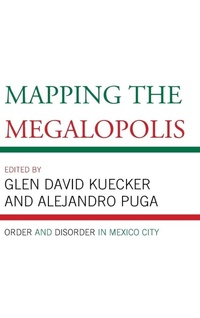
Mapping the Megalopolis
Order and Disorder in Mexico City
Published on 22. December 2017
Book
Hardback
304 pages
978-1-4985-5978-2 (ISBN)
Description
Mapping the Megalopolis: Order and Disorder in Mexico City brings the humanities and the social sciences into a conversation about Mexico City in its social, political, and aesthetic manifestations. Through a shared exploration of the order and disorder that mutually constitute the city, contributing authors engage topics such as the privatization of public space, challenges to existing conceptualizations of the urban form, and variations on the flaneur and other urban actors. Mexico City is truly a city of versions, and Mapping the Megalopolis celebrates the intersection of the image of the city and the lived experience of it. Readers will find substantive entries on a great variety of Mexico City's monumental and counter-monumental spaces, as well as some of its pivotal contemporary debates and cultural products. The volume serves both as supplemental reading on the world city or the Latin American city, and as a central text in a multidisciplinary study of Mexico City.
Reviews / Votes
Mapping the Megalopolis is a most valuable contribution to the ever-challenging task of reading Mexico City, its spaces, and its cultures. The collective reflection on order and disorder provides new directions to think and theorize urban space in the grand Megalopolis of Latin America, in ways that help us think about the city as a problem in the global era. -- Ignacio M. Sanchez Prado, Professor of Spanish and Latin American Studies, Washington University in St. Louis This exceptionally timely and coherent collection of essays maps out one of the most unmappable cities of the world. The reader comes away not only with a deeper appreciation of Mexico City as a place where elite visions of progress are repeatedly undermined by quotidian disorder, but of the "deliriousness" of the modern megalopolis itself-the twenty-first century city teetering precariously on a ledge between modernity and a dystopian future. -- Eric Zolov, Stony Brook University This delightful compilation will give students, scholars, and travelers a good sense of present-day Mexico City, and its historic roots, from many disciplinary angles. It offers readers a fair consideration of the challenges which chilangos face; but more importantly it reveals the artistry, persistence, and resilience with which they confront life in the big city. -- Anne Rubenstein, York UniversityMore details
Language
English
Place of publication
United States
Publishing group
Bloomsbury Publishing Plc
Target group
Professional and scholarly
Illustrations
26 b/w photos;
Dimensions
Height: 235 mm
Width: 157 mm
Thickness: 21 mm
Weight
596 gr
ISBN-13
978-1-4985-5978-2 (9781498559782)
Copyright in bibliographic data and cover images is held by Nielsen Book Services Limited or by the publishers or by their respective licensors: all rights reserved.
Schweitzer Classification
Other editions
Additional editions
Mapping the Megalopolis
Order and Disorder in Mexico City
E-Book
12/2017
1st Edition
Lexington Books
€124.99
Available for download
E-Book
12/2017
1st Edition
Bloomsbury eBooks US
€124.99
Available for download
Persons
Glen David Kuecker is professor of history at DePauw University.
Alejandro Puga is associate professor, Laurel H. Turk professor of modern languages, and chair of modern languages at DePauw University.
Alejandro Puga is associate professor, Laurel H. Turk professor of modern languages, and chair of modern languages at DePauw University.
Content
Contents
Introduction: Mapping the Megalopolis
Glen David Kuecker and Alejandro Puga
Chapter One: Mapping Subjectivities: The Body-City of Porfirian Mexico City
Marta Sierra
Chapter Two: Carlos Slim's Urban Imaginary: Plaza Carso and the Privatization of Public Space
Glen David Kuecker
Chapter Three: Bunuel's Fictional Geographies
V. Daniel Rogers
Chapter Four: Novelistic Cartographies of the Mexico City Flaneur
Alejandro Puga and Patricia Tovar
Chapter Five: Securing the City in Santa Fe: Privatization and Preservation
Shannan Mattiace and Jennifer Johnson
Chapter Six: Muralism, Graffiti, and Urban Art: Visual Politics in Contemporary Mexico City
Maria Claudia Andre
Chapter Seven: La Polvorilla: Seeking Self-Sufficiency in Iztapalapa, Mexico D.F.
Jennifer Johnson and Shannan Mattiace
Chapter Eight: Porous Urbanism: Order and Disorder in Colonia Santo Domingo
Charlotte Blair
Chapter Nine: Sense-Making in the Megalopolis: Navigating Korean Signs in Pequeno Seul
Karen Velasquez
Chapter Ten: Riding a Tandem Bicycle: Valeria Luiselli Maps the Sidewalks of Mexico City
Patrick O'Connor
Conclusion: From DF to CDMX: The (Dis)order of Becoming a World City
Alejandro Puga and Glen David Kuecker
Bibliography
About the Contributors
Introduction: Mapping the Megalopolis
Glen David Kuecker and Alejandro Puga
Chapter One: Mapping Subjectivities: The Body-City of Porfirian Mexico City
Marta Sierra
Chapter Two: Carlos Slim's Urban Imaginary: Plaza Carso and the Privatization of Public Space
Glen David Kuecker
Chapter Three: Bunuel's Fictional Geographies
V. Daniel Rogers
Chapter Four: Novelistic Cartographies of the Mexico City Flaneur
Alejandro Puga and Patricia Tovar
Chapter Five: Securing the City in Santa Fe: Privatization and Preservation
Shannan Mattiace and Jennifer Johnson
Chapter Six: Muralism, Graffiti, and Urban Art: Visual Politics in Contemporary Mexico City
Maria Claudia Andre
Chapter Seven: La Polvorilla: Seeking Self-Sufficiency in Iztapalapa, Mexico D.F.
Jennifer Johnson and Shannan Mattiace
Chapter Eight: Porous Urbanism: Order and Disorder in Colonia Santo Domingo
Charlotte Blair
Chapter Nine: Sense-Making in the Megalopolis: Navigating Korean Signs in Pequeno Seul
Karen Velasquez
Chapter Ten: Riding a Tandem Bicycle: Valeria Luiselli Maps the Sidewalks of Mexico City
Patrick O'Connor
Conclusion: From DF to CDMX: The (Dis)order of Becoming a World City
Alejandro Puga and Glen David Kuecker
Bibliography
About the Contributors