

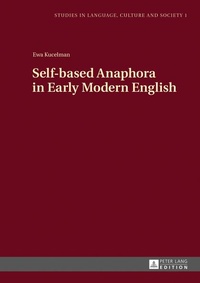
Self-based Anaphora in Early Modern English
Published on 25. September 2013
Book
Hardback
188 pages
978-3-631-64350-1 (ISBN)
Description
This book is a corpus-based study which aims to describe the class of self-pronouns as used in the Early Modern English period. Self-pronouns are presented as a multi-functional class, with two main functions, as emphatic forms and as reflexive markers. The emphatic function is seen as a continuation of an earlier state of affairs, whereas the reflexive function is described as a new, emerging one. As reflexive markers, self-pronouns in Early Modern English compete with personal pronouns. Therefore the book seeks to present the conditions of their distribution ranging from configurational and thematic through discursive to pragmatic factors involved in the choice of the reflexive strategy.
More details
Other editions
Additional editions
Ewa Kucelman
Self-based Anaphora in Early Modern English
Zur Vorgeschichte des Don Juan-Stoffes in der europäischen Volksüberlieferung
E-Book
11/2013
150th Edition
Peter Lang Verlag
€90.99
Available for download
Person
Ewa Kucelman is Research Assistant of West-Germanic Linguistics at the Pedagogical University of Cracow (Poland). Apart from diachronic linguistics, her professional interests include comparative linguistics, in particular the contrastive analysis of English and Polish syntax and morphology.
Content
Inhalt: Self-pronouns as Bound Anaphors - Pragmatic Approaches to Self-Pronouns - The History of Self-Pronouns - Self-Pronouns as Reflexive Markers in Early Modern English - Emphatic Self-Pronouns in Early Modern English.