

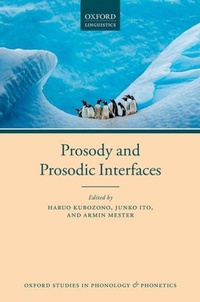
Prosody and Prosodic Interfaces
Published on 12. May 2022
Book
Hardback
566 pages
978-0-19-886974-0 (ISBN)
Description
This volume brings together new work on prosody and prosodic interfaces from international experts in the field. The book is divided into three parts that explore topics in word prosody and phrase prosody, lexical tone and intonation, and the syntax-prosody interface. While many recent studies have focused on prosody and related questions, a significant number of languages, dialects, and varieties remain largely undocumented or understudied in this respect. The chapters in this volume help to fill this empirical gap, with investigations into languages such as Choguita Raramuri (Mexico), Poko (Papua New Guinea), Rere (Sudan), and Uspanteko (Guatemala), alongside more widely studied languages such as Japanese and Serbian. The authors also address a range of important questions pertaining to, for example, the interactions between lexical and postlexical tones and the relationship between prosodic and syntactic structure. The volume as a whole sheds light on how prosody is structured in language and how it functions in human communication.
Reviews / Votes
This is a valuable collection of individual chapters that together shed light on how word-level and sentence-level prosodic and grammatical phenomena interact and influence one another. Most deal with specific topics in a considerable typological and geographical variety of languages, yet the editors have succeeded in fashioning a coherent and empirically rich anthology of some of the best current work. * D. Robert Ladd, University of Edinburgh * This volume on prosody, edited and written by some of the best-known specialists in the field, is a unique source of information from both the theoretical and the data perspective. Students and researchers will find in-depth analyses of known and less-known languages and discussions of important theoretical issues. * Caroline Fery, Goethe University Frankfurt * Prosody and Prosodic Interfaces is an important collection of descriptive and analytical work on prosody. This book is relevant to a wide range of scholars, including syntacticians, morphologists, phonologists, prosodists, typologists and historical linguists. It is more useful as a resource for prosody researchers than as a reference volume, though individual chapters may be useful for students studying prosody at the graduate level. * Hannah Sande, Phonology *More details
Series
Language
English
Place of publication
Oxford
United Kingdom
Target group
Professional and scholarly
Product notice
sewn/stitched
Cloth over boards
Dimensions
Height: 238 mm
Width: 163 mm
Thickness: 38 mm
Weight
1043 gr
ISBN-13
978-0-19-886974-0 (9780198869740)
Copyright in bibliographic data and cover images is held by Nielsen Book Services Limited or by the publishers or by their respective licensors: all rights reserved.
Schweitzer Classification
Other editions
Additional editions
Haruo Kubozono | Junko Ito | Armin Mester
Prosody and Prosodic Interfaces
E-Book
05/2022
1st Edition
OUP eBook
€75.99
Available for download
Persons
Haruo Kubozono is Director of the National Institute for Japanese Language and Linguistics. His research interests range from speech disfluencies to speech prosody (accent and intonation) and its interfaces with syntax and information structure. He is the editor of The Handbook of Japanese Phonetics and Phonology (De Gruyter, 2015), The Phonetics and Phonology of Geminate Consonants (OUP, 2017), and Tonal Change and Neutralization (De Gruyter, 2018).
Junko Ito is Professor in the Department of Linguistics at the University of California, Santa Cruz. Her research in phonology focuses on the morphophonemics and prosody of Japanese as it pertains to word structure and its phonological form. More recently, she has been working on issues surrounding the syntax-phonology interface, and on the structure of the phonological lexicon and its implications for the theory of grammar.
Armin Mester is Research Professor of Linguistics at the University of California, Santa Cruz. His research is concerned with the principles organizing the prosodic structures found in language, as manifested in systems of syllabification, stress, and accent, and the mapping of syntactic and morphological structures onto prosodic form. He is pursuing this work in the context of Optimality Theory, with an additional interest in the basic architecture of the theory.
Junko Ito is Professor in the Department of Linguistics at the University of California, Santa Cruz. Her research in phonology focuses on the morphophonemics and prosody of Japanese as it pertains to word structure and its phonological form. More recently, she has been working on issues surrounding the syntax-phonology interface, and on the structure of the phonological lexicon and its implications for the theory of grammar.
Armin Mester is Research Professor of Linguistics at the University of California, Santa Cruz. His research is concerned with the principles organizing the prosodic structures found in language, as manifested in systems of syllabification, stress, and accent, and the mapping of syntactic and morphological structures onto prosodic form. He is pursuing this work in the context of Optimality Theory, with an additional interest in the basic architecture of the theory.
Editor
Professor and DirectorProfessor and Director, National Institute for Japanese Language and Linguistics
Professor of LinguisticsProfessor of Linguistics, University of California, Santa Cruz
Research Professor of LinguisticsResearch Professor of Linguistics, University of California, Santa Cruz
Content
Preface
List of figures and tables
List of abbreviations
The contributors
Haruo Kubozono, Junko Ito, and Armin Mester: Introduction
Part I: Word prosody and phrase prosody
1: Laura McPherson: Word tone is epiphenomenal: A case study from Poko
2: Jose Ignacio Hualde: Accent shift and the reconstruction of Old Common Basque accentuation
3: Draga Zec and Elizabeth Zsiga: Tone and stress as agents of cross-dialectal variation: The case of Serbian
4: Sara Myrberg: Two-peakedness in South Swedish and the Scandinavian tone accent typology
5: Larry M. Hyman: Prosodic asymmetries in nominal vs verbal phrases in Bantu
6: Carlos Gussenhoven: How metrical is the Autosegmental-Metrical model? Evidence from pitch accents in Nubi, Persian, and English
Part II: Lexical tone and intonation
7: Ryan Bennett, Robert Henderson, and Megan Harvey: Tonal variability and marginal contrast: Lexical pitch in Uspanteko
8: Gabriela Caballero, Yuan Chai, and Marc Garellek: Stress, tone, and intonation in Choguita Raramuri
9: Haruo Kubozono: Interactions between lexical and postlexical tones: Evidence from Japanese vocative prosody
10: Yosuke Igarashi: Prosodic phrasing, long-distance rise, and structural prominence marking in Japanese dialects without lexically constrastive tones
11: Yuan Chai, Titus Kubri Kajo Kunda, Alejandro Rodriguez, and Sharon Rose: Prosody of declaratives and questions in Rere (Koalib)
Part III: The syntax-prosody interface
12: Seunghun J. Lee and Elisabeth Selkirk: Xitsonga tone: The syntax-phonology interface
13: Gorka Elordieta and Elisabeth Selkirk: Unaccentedness and the formation of prosodic structure in Lekeitio Basque
14: Shinichiro Ishihara: On the (lack of) correspondence between syntactic clauses and intonational phrases
15: Jennifer Bellik, Junko Ito, Nick Kalivoda, and Armin Mester: Matching and alignment
References
Index
List of figures and tables
List of abbreviations
The contributors
Haruo Kubozono, Junko Ito, and Armin Mester: Introduction
Part I: Word prosody and phrase prosody
1: Laura McPherson: Word tone is epiphenomenal: A case study from Poko
2: Jose Ignacio Hualde: Accent shift and the reconstruction of Old Common Basque accentuation
3: Draga Zec and Elizabeth Zsiga: Tone and stress as agents of cross-dialectal variation: The case of Serbian
4: Sara Myrberg: Two-peakedness in South Swedish and the Scandinavian tone accent typology
5: Larry M. Hyman: Prosodic asymmetries in nominal vs verbal phrases in Bantu
6: Carlos Gussenhoven: How metrical is the Autosegmental-Metrical model? Evidence from pitch accents in Nubi, Persian, and English
Part II: Lexical tone and intonation
7: Ryan Bennett, Robert Henderson, and Megan Harvey: Tonal variability and marginal contrast: Lexical pitch in Uspanteko
8: Gabriela Caballero, Yuan Chai, and Marc Garellek: Stress, tone, and intonation in Choguita Raramuri
9: Haruo Kubozono: Interactions between lexical and postlexical tones: Evidence from Japanese vocative prosody
10: Yosuke Igarashi: Prosodic phrasing, long-distance rise, and structural prominence marking in Japanese dialects without lexically constrastive tones
11: Yuan Chai, Titus Kubri Kajo Kunda, Alejandro Rodriguez, and Sharon Rose: Prosody of declaratives and questions in Rere (Koalib)
Part III: The syntax-prosody interface
12: Seunghun J. Lee and Elisabeth Selkirk: Xitsonga tone: The syntax-phonology interface
13: Gorka Elordieta and Elisabeth Selkirk: Unaccentedness and the formation of prosodic structure in Lekeitio Basque
14: Shinichiro Ishihara: On the (lack of) correspondence between syntactic clauses and intonational phrases
15: Jennifer Bellik, Junko Ito, Nick Kalivoda, and Armin Mester: Matching and alignment
References
Index