

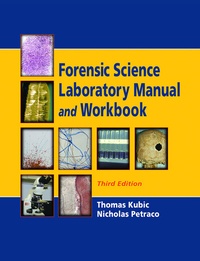
Forensic Science Laboratory Manual and Workbook
3rd Edition
Published on 31. July 2018
Book
Hardback
384 pages
978-1-138-42688-7 (ISBN)
Description
A laboratory companion to Forensic Science: An Introduction to Scientific and Investigative Techniques and other undergraduate texts, Forensic Science Laboratory Manual and Workbook, Third Edition provides a plethora of basic, hands-on experiments that can be completed with inexpensive and accessible instrumentation, making this an ideal workbook for non-science majors and an excellent choice for use at both the high school and college level.
This revised edition of a bestselling lab manual provides numerous experiments in odontology, anthropology, archeology, chemistry, and trace evidence. The experiments cover tests involving body fluid, soil, glass, fiber, ink, and hair. The book also presents experiments in impression evidence, such as fingerprints, bite marks, footwear, and firearms, and it features digital and traditional photography and basic microscopy.
All of the experiments incorporate practical elements to facilitate the learning process. Students must apply the scientific method of reasoning, deduction, and problem-solving in order to complete the experiments successfully and attain a solid understanding of fundamental forensic science. Each of the 39 chapters features a separate experiment and includes teaching goals, offers the requisite background knowledge needed to conduct the experiments, and lists the required equipment and supplies. The book is designed for a cooperative learning setting in which three to five students comprise a group. Using the hands-on learning techniques provided in this manual, students will master the practical application of their theoretical knowledge of forensics.
This revised edition of a bestselling lab manual provides numerous experiments in odontology, anthropology, archeology, chemistry, and trace evidence. The experiments cover tests involving body fluid, soil, glass, fiber, ink, and hair. The book also presents experiments in impression evidence, such as fingerprints, bite marks, footwear, and firearms, and it features digital and traditional photography and basic microscopy.
All of the experiments incorporate practical elements to facilitate the learning process. Students must apply the scientific method of reasoning, deduction, and problem-solving in order to complete the experiments successfully and attain a solid understanding of fundamental forensic science. Each of the 39 chapters features a separate experiment and includes teaching goals, offers the requisite background knowledge needed to conduct the experiments, and lists the required equipment and supplies. The book is designed for a cooperative learning setting in which three to five students comprise a group. Using the hands-on learning techniques provided in this manual, students will master the practical application of their theoretical knowledge of forensics.
More details
Edition
3rd edition
Language
English
Place of publication
London
United Kingdom
Publishing group
Taylor & Francis Ltd
Target group
College/higher education
Undergraduate
Dimensions
Height: 280 mm
Width: 210 mm
Weight
1129 gr
ISBN-13
978-1-138-42688-7 (9781138426887)
Copyright in bibliographic data and cover images is held by Nielsen Book Services Limited or by the publishers or by their respective licensors: all rights reserved.
Schweitzer Classification
Other editions
New editions

Nicholas Petraco | Thomas Kubic | Brooke Weinger Kammrath
Forensic Science Laboratory Manual and Workbook, Fourth Edition
Book
approx. 08/2027
4th Edition
CRC Press
€52.18
Not yet published
Additional editions
Nicholas Petraco | Thomas Kubic
Forensic Science Laboratory Manual and Workbook
E-Book
07/2018
3rd Edition
CRC Press
€60.49
Available for download
Thomas Kubic | Nicholas Petraco
Forensic Science Laboratory Manual and Workbook
E-Book
07/2018
3rd Edition
CRC Press
€60.49
Available for download
Nicholas Petraco | Thomas Kubic
Forensic Science Laboratory Manual and Workbook
Book
04/2009
3rd Edition
CRC Press
€65.50
Shipment within 15-20 days
Previous edition
Thomas Kubic | Nicholas Petraco
Forensic Science Laboratory Manual and Workbook, Revised Edition
Book
04/2005
2nd Edition
CRC Press
€35.89
Article exhausted; check for reprint
Persons
Thomas Kubric and Nicholas Petraco are professors at John Jay College in New York City.
Content
Experiment 1: Introduction to Scientific Measurement and Experimental Error - Determining the Density of Glass. Experiment 2: Understanding Elements of Identification and Individualization. Experiment 3: Use of the Compound Microscope. Experiment 4: Stereomicroscopes and Firing Pin Impressions (Tool Marks). Experiment 5: Acquiring and Classifying Inked and Latent Fingerprints. Experiment 6: Identification and Matching of Fingerprints. Experiment 7: Cyanoacrylate "Super Glue" Fuming Technique to Develop Latent Fingerprints. Experiment 8: Crime Scene Investigation: Safeguarding, Searching, Recognition, Documentation, Collection, Packaging, and Preservation of Physical Evidence Found at the Crime Scene. Experiment 9: Trace Evidence Collection and Sorting. Experiment 10: Sample Preparation for Microscopic Examination. Experiment 11: Examination of Human Hair. Experiment 12: Examination of Mammalian Hair. Experiment 13: Measurement with the Microscope. Experiment 14: Examination of Trace Quantities of Synthetic Fibers. Experiment 15: Basics of Photography. Experiment 16: Black-and-White Film Development. Experiment 17: Collection of Footwear Evidence. Experiment 18: Identification and Comparison of Footware Impressions. Experiment 19: Tool Mark Examination. Experiment 20: Glass Fractures and Direction of Force. Experiment 21: Thin Layer Chromatography: Separation of Dyes in Ballpoint Inks. Experiment 22: Bloodstain Geometry (Part A). Experiment 23: Bloodstain Geometry (Part B). Experiment 24: Forgery Detection. Experiment 25: Soil Examination. Experiment 26: Forensic Odontology 1: Is It a Bite Mark? Experiment 27: Forensic Odontology 2: Who Made the Questioned Bite Mark? Experiment 28: Forensic Archeology: Search for Human Habitation and Remains. Experiment 29: Forensic Anthropology 1: Basic Human Osteology. Experiment 30: Forensic Anthropology 2: Examination of Grave Site Bones. Experiment 31: Digital Photography Image Processing. Experiment 32: Chromatography 2: Ide