

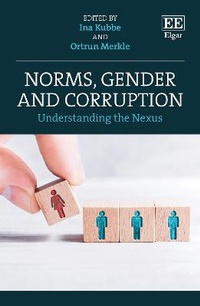
Norms, Gender and Corruption
Understanding the Nexus
Published on 14. October 2022
Book
Hardback
304 pages
978-1-80220-582-4 (ISBN)
Description
Building upon the body of existing literature that has established the importance of norms in understanding why genders interact with social phenomena differently, and how gender plays a role in most aspects of corruption, this cutting-edge book expands the fields to explore the nexus between norms, gender and corruption.
Making a timely and innovative contribution to all three streams of research, the book dives deeper into the role of norms in understanding the relationship between gender and corruption. An international, multidisciplinary group of experts combine global qualitative, in-depth case studies with large scale quantitative analysis to demonstrate the complementary use of different methods in the fields of gender, norms and corruption. Considering gendered differences in attitudes towards, and experiences of, corruption, the chapters examine political and institutional participation in corruption, looking closely at gender representation, stereotypes, and norms-based barriers. Analysing norms from different perspectives, with the main focus on social norms, this forward-thinking book makes a convincing case for why norms should be included in the research agenda on gender and corruption.
Interdisciplinary in scope, this insightful book will prove invaluable to students and scholars of gender politics, social policy and sociology, and law, regulation and governance. It will also prove a useful reference guide to policymakers concerned with the relationship between gender and corruption.
Making a timely and innovative contribution to all three streams of research, the book dives deeper into the role of norms in understanding the relationship between gender and corruption. An international, multidisciplinary group of experts combine global qualitative, in-depth case studies with large scale quantitative analysis to demonstrate the complementary use of different methods in the fields of gender, norms and corruption. Considering gendered differences in attitudes towards, and experiences of, corruption, the chapters examine political and institutional participation in corruption, looking closely at gender representation, stereotypes, and norms-based barriers. Analysing norms from different perspectives, with the main focus on social norms, this forward-thinking book makes a convincing case for why norms should be included in the research agenda on gender and corruption.
Interdisciplinary in scope, this insightful book will prove invaluable to students and scholars of gender politics, social policy and sociology, and law, regulation and governance. It will also prove a useful reference guide to policymakers concerned with the relationship between gender and corruption.
Reviews / Votes
'I highly recommend this book to anyone interested in the complex relationship between gender equality, corruption and good governance. It clearly shows that the inclusion of women in positions of power is no "quick fix" to reduced levels of corruption. The chapters give new insights on how social and political norms specify the room open for women to maneuver in society.' -- Lena Waengnerud, University of Gothenburg, Sweden 'This excellent collection is a much-needed inquiry into still relatively unexplored debates around gender and corruption. Spanning many countries and different types of corruption, and furthering conceptual clarity as well as offering empirical case studies, the book is a must-read for anti-corruption scholars and practitioners.' -- Elizabeth David-Barrett, University of Sussex, UKMore details
Language
English
Place of publication
Cheltenham
United Kingdom
Target group
Professional and scholarly
Dimensions
Height: 234 mm
Width: 156 mm
ISBN-13
978-1-80220-582-4 (9781802205824)
Copyright in bibliographic data and cover images is held by Nielsen Book Services Limited or by the publishers or by their respective licensors: all rights reserved.
Schweitzer Classification
Persons
Edited by Ina Kubbe, Post-Doctoral Researcher, Faculty of Social Sciences, School of Political Science, Government and International Affairs, Tel Aviv University, Israel and Ortrun Merkle, Post-Doctoral Researcher, United Nations University - MERIT and Maastricht University, the Netherlands
Content
Contents:
Preface xvi
1 Introduction. Gender and corruption: the role of norms 1
Ina Kubbe and Ortrun Merkle
2 Type matters! Why we need to stop overgeneralizing
results: a closer look at gender, norms, and corruption 25
M. Jamie-Lee Campbell
3 Gender norms and firms' corruption: evidence from China 45
Chengyu Fu
4 Gender differences in the prioritization of corruption as the
most important problem in the US, 1939-2015 60
T. Murat Yildirim
5 Unpacking the link between gender and injunctive norms
on corruption using survey data: a multilevel analysis of 30
European countries 78
Giulia M. Dotti Sani and Simona Guglielmi
6 Gendering women's political representation and good
governance in the EU? A feminist approach against
informal norms of corruption 99
Digdem Soyaltin-Colella and F. Melis Cin
7 Women held back: the depressing effect of institutional
and norms-based barriers on female representation in
corrupt contexts 120
Gustavo Diaz and Kelly Senters Piazza
8 Gender stereotypes and corruption in devolved systems of
government: evidence from local governments in Kenya 139
Justa Mwangi, Wilson Muna and Gitile Naituli
9 The impact of corruption on gender in Central and Eastern
Europe: how corruption challenges women's life 159
Liljana Cvetanoska and Ina Kubbe
10 Gender perspective in justice systems: comparative
analysis of the Brazilian, Spanish and German realities on
corruption cases 183
Denise Neves Abade and Katharina Miller
11 Sustaining the patriarchal bargain in Morocco: the
normalization of Moroccan gendered judicial corruption 213
Ginger R. Feather
12 Wasta and economic opportunities: the case of Palestinian
men and women in the West Bank 239
Chloe Laurence Cohen
13 Sextortion: corruption shaped by gender norms 253
Elin Bjarnegard, Dolores Calvo, Asa Elden, and Silje Lundgren
14 Moving forward: including norms in the research agenda
on gender and corruption 269
Ortrun Merkle and Ina Kubbe
Index
Preface xvi
1 Introduction. Gender and corruption: the role of norms 1
Ina Kubbe and Ortrun Merkle
2 Type matters! Why we need to stop overgeneralizing
results: a closer look at gender, norms, and corruption 25
M. Jamie-Lee Campbell
3 Gender norms and firms' corruption: evidence from China 45
Chengyu Fu
4 Gender differences in the prioritization of corruption as the
most important problem in the US, 1939-2015 60
T. Murat Yildirim
5 Unpacking the link between gender and injunctive norms
on corruption using survey data: a multilevel analysis of 30
European countries 78
Giulia M. Dotti Sani and Simona Guglielmi
6 Gendering women's political representation and good
governance in the EU? A feminist approach against
informal norms of corruption 99
Digdem Soyaltin-Colella and F. Melis Cin
7 Women held back: the depressing effect of institutional
and norms-based barriers on female representation in
corrupt contexts 120
Gustavo Diaz and Kelly Senters Piazza
8 Gender stereotypes and corruption in devolved systems of
government: evidence from local governments in Kenya 139
Justa Mwangi, Wilson Muna and Gitile Naituli
9 The impact of corruption on gender in Central and Eastern
Europe: how corruption challenges women's life 159
Liljana Cvetanoska and Ina Kubbe
10 Gender perspective in justice systems: comparative
analysis of the Brazilian, Spanish and German realities on
corruption cases 183
Denise Neves Abade and Katharina Miller
11 Sustaining the patriarchal bargain in Morocco: the
normalization of Moroccan gendered judicial corruption 213
Ginger R. Feather
12 Wasta and economic opportunities: the case of Palestinian
men and women in the West Bank 239
Chloe Laurence Cohen
13 Sextortion: corruption shaped by gender norms 253
Elin Bjarnegard, Dolores Calvo, Asa Elden, and Silje Lundgren
14 Moving forward: including norms in the research agenda
on gender and corruption 269
Ortrun Merkle and Ina Kubbe
Index