

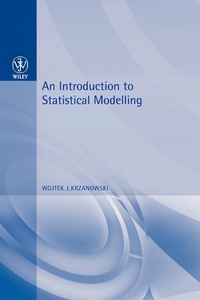
An Introduction to Statistical Modelling
1st Edition
Published on 29. May 1998
Book
Paperback/Softback
272 pages
978-0-470-71101-9 (ISBN)
Description
Statisticians rely heavily on making models of 'causal situations' in order to fully explain and predict events. Modelling therefore plays a vital part in all applications of statistics and is a component of most undergraduate programmes. 'An Introduction to Statistical Modelling' provides a single reference with an applied slant that caters for all three years of a degree course. The book concentrates on core issues and only the most essential mathematical justifications are given in detail. Attention is firmly focused on the statistical aspects of the techniques, in this lively, practical approach.
More details
Language
English
Place of publication
New York
United States
Target group
Professional and scholarly
Product notice
Paperback (trade)
Unsewn / adhesive bound
Dimensions
Height: 234 mm
Width: 156 mm
Thickness: 14 mm
Weight
406 gr
ISBN-13
978-0-470-71101-9 (9780470711019)
Copyright in bibliographic data and cover images is held by Nielsen Book Services Limited or by the publishers or by their respective licensors: all rights reserved.
Schweitzer Classification
Other editions
Previous edition
Wojtek J. Krzanowski
An Introduction to Statistical Modelling
Book
05/1998
Hodder Arnold
€54.61
Article exhausted; check for reprint
Person
W. J. Krzanowski is the author of An Introduction to Statistical Modelling, published by Wiley.
Content
Series preface. Preface.
1. Introduction.
1.1 Models in data analysis.
1.2 Populations and samples.
1.3 Variables and factors.
1.4 Observational and experimental data.
1.5 Statistical models.
2. Distributions and inference.
2.1 Random variables and probability distributions.
2.2 Probability distributions as models.
2.3 Some common distributions.
2.4 Sampling distributions.
2.5 Inference.
2.6 Postscript.
3. Normal response and quantitative explanatory variables: regression.
3.1 Motivation.
3.2 Simple regression.
3.3 Multiple regression.
3.4 Model building.
3.5 Model validation and criticism.
3.6 Comparison of regressions.
3.7 Non-linear models.
4. Normal response and qualitative explanatory variables: analysis of variance.
4.1 Motivation.
4.2 One-way arrangements.
4.3 Cross-classifications.
4.4 Nested classifications.
4.5 A general approach via multiple regression.
4.6 Analysis of covariance.
5. Non-normality: the theory of generalized linear models.
5.1 Introduction.
5.2 The generalized linear model.
5.3 Fitting the model.
5.4 Assessing the fit of a model: deviance.
5.5 Comparing models: analysis of deviance.
5.6 Normal models.
5.7 Inspecting and checking models.
5.8 Software.
6. Binomial response variables: logistic regression and related method.
6.1 Binary response data.
6.2 Modelling binary response probabilities.
6.3 Logistic regression.
6.4 Related methods.
6.5 Ordered polytomous data.
7. Tables of counts and log-linear models.
7.1 Introduction.
7.2 Data mechanisms and distributions.
7.3 Log-linear models for means.
7.4 Models for contingency tables.
7.5 Analysis.
7.6 Applications.
8. Further topics.
8.1 Introduction.
8.2 Continuous non-normal responses.
8.3 Quasi-likelihood.
8.4 Overdispersion.
8.5 Non-parametric models.
8.6 Conclusion: the art of model building.
References.
Index.
1. Introduction.
1.1 Models in data analysis.
1.2 Populations and samples.
1.3 Variables and factors.
1.4 Observational and experimental data.
1.5 Statistical models.
2. Distributions and inference.
2.1 Random variables and probability distributions.
2.2 Probability distributions as models.
2.3 Some common distributions.
2.4 Sampling distributions.
2.5 Inference.
2.6 Postscript.
3. Normal response and quantitative explanatory variables: regression.
3.1 Motivation.
3.2 Simple regression.
3.3 Multiple regression.
3.4 Model building.
3.5 Model validation and criticism.
3.6 Comparison of regressions.
3.7 Non-linear models.
4. Normal response and qualitative explanatory variables: analysis of variance.
4.1 Motivation.
4.2 One-way arrangements.
4.3 Cross-classifications.
4.4 Nested classifications.
4.5 A general approach via multiple regression.
4.6 Analysis of covariance.
5. Non-normality: the theory of generalized linear models.
5.1 Introduction.
5.2 The generalized linear model.
5.3 Fitting the model.
5.4 Assessing the fit of a model: deviance.
5.5 Comparing models: analysis of deviance.
5.6 Normal models.
5.7 Inspecting and checking models.
5.8 Software.
6. Binomial response variables: logistic regression and related method.
6.1 Binary response data.
6.2 Modelling binary response probabilities.
6.3 Logistic regression.
6.4 Related methods.
6.5 Ordered polytomous data.
7. Tables of counts and log-linear models.
7.1 Introduction.
7.2 Data mechanisms and distributions.
7.3 Log-linear models for means.
7.4 Models for contingency tables.
7.5 Analysis.
7.6 Applications.
8. Further topics.
8.1 Introduction.
8.2 Continuous non-normal responses.
8.3 Quasi-likelihood.
8.4 Overdispersion.
8.5 Non-parametric models.
8.6 Conclusion: the art of model building.
References.
Index.