

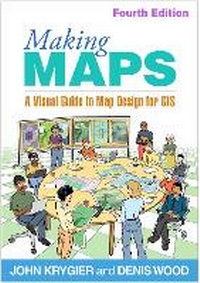
Making Maps, Fourth Edition
A Visual Guide to Map Design for GIS
4th Edition
Published on 1. January 2025
Book
Paperback/Softback
306 pages
978-1-4625-5606-9 (ISBN)
Description
Prized for its creative design, original art, and playful, accessible writing, Making Maps is now in a thoroughly updated fourth edition. The text is restructured to emphasize the importance of the map making process. All components of map making are covered and are brought to life in the expanded graphic novella threaded through the text. Updates include new coverage of data aggregation, artificial intelligence, feminist and Indigenous perspectives, map making workflow, and more. Design choices are emphasized and linked to the reasons for making a map. Featuring more than 80 color illustrations and a unique layout, the book includes an annotated map exemplar used throughout the text, extensive map examples, and a companion website.
New to This Edition
*New or expanded topics: graduated symbol maps, multivariate choropleth maps, visual storytelling, maps and gerrymandering, artificial intelligence, workflow, and more.
*Integration of practical ideas from Indigenous and feminist perspectives.
*Coverage of color and type is shifted earlier in the book, and the chapters on map symbolization and abstraction now conclude the book, with many compelling new maps.
New to This Edition
*New or expanded topics: graduated symbol maps, multivariate choropleth maps, visual storytelling, maps and gerrymandering, artificial intelligence, workflow, and more.
*Integration of practical ideas from Indigenous and feminist perspectives.
*Coverage of color and type is shifted earlier in the book, and the chapters on map symbolization and abstraction now conclude the book, with many compelling new maps.
Reviews / Votes
"Making Maps explains the power of cartographic design through a visually engaging style that encourages critical thinking and reflection. It provides a source of inspiration, motivation, and practical knowledge, empowering map makers with the essential guidance they need to make maps, as well as key examples that demonstrate when conventions should be set aside. Because the authors do not hew to any specific software or technology, the book has broad, lasting utility for map makers at all levels."--Anthony C. Robinson, PhD, Department of Geography, The Pennsylvania State University"The advantage of this text is that the variety of examples and mapped data allow you to engage students in conversations about different cultural or philosophical approaches to mapping. It is an excellent introductory resource for students who are new to mapping. The book covers all the essential topics, with excellent visual examples, consideration of different map audiences and map purposes, and an emphasis on map design that makes it relevant no matter what mapping software you use."--Melinda Shimizu, PhD, Department of Geography, State University of New York at Cortland
"Making Maps is a gorgeous introduction to cartographic design and geovisual storytelling. Its quality means that I have a difficult time deciding which class gets the pleasure to read it. Making Maps is compelling for a cartography class, but also outside of a class for anyone who wants to learn how best to make and understand maps."--Nathan Burtch, PhD, Department of Geography and Geoinformation Science, George Mason University
"This book is very useful for helping students understand the driving questions behind communicating geographic information, such as 'Who is my audience?' and 'What is my message?' It also addresses questions about how to design and style maps--for example, 'Which projection should I use?' Students find the playful tone and interesting examples to be quite engaging--I have not heard a single complaint about the text."--Blake Walker, PhD, Institute of Geography, Friedrich-Alexander-Universitaet Erlangen-Nuernberg, Germany
"Krygier and Wood's text encourages critical thinking rather than absorbing information--and that made it by far the best choice for my cartographic design course. The mix of visual approaches, including the graphic novella, appeals to a broad mix of students."--Barbara Trapido-Lurie, MA, Research Professional Emerita, School of Geographical Sciences and Urban Planning, Arizona State University-
More details
Edition
4th edition
Language
English
Place of publication
New York
United States
Publishing group
Guilford Publications
Product notice
Paperback (trade)
Unsewn / adhesive bound
Dimensions
Height: 249 mm
Width: 174 mm
Thickness: 16 mm
Weight
736 gr
ISBN-13
978-1-4625-5606-9 (9781462556069)
Copyright in bibliographic data and cover images is held by Nielsen Book Services Limited or by the publishers or by their respective licensors: all rights reserved.
Schweitzer Classification
Other editions
Previous edition
Book
10/2016
3rd Edition
Guilford Press
€81.89
Article exhausted; check for reprint
Persons
John Krygier, PhD, is Professor in the Department of Environment and Sustainability at Ohio Wesleyan University, with teaching and research specializations in cartography, geographic information systems (GIS), and environmental and human geography. He has made lots of maps and published on map design, educational technology, cultural geography, multimedia in cartography, planning, the history of cartography, and participatory GIS.
Denis Wood, PhD, is an independent scholar living in Raleigh, North Carolina. He curated the award-winning Power of Maps exhibition for the Smithsonian and writes widely about maps. He is a former professor of design at North Carolina State University.
Denis Wood, PhD, is an independent scholar living in Raleigh, North Carolina. He curated the award-winning Power of Maps exhibition for the Smithsonian and writes widely about maps. He is a former professor of design at North Carolina State University.
Content
1. How to Make a Map
2. What's Your Map For?
3. Mappable Data
4. Map Making Tools
5. Geographic Framework
6. The Big Picture of Map Design
7. The Inner Workings of Map Design
8. Color on Maps
9. Words on Maps
10. Map Generalization and Classification
11. Map Symbolization
12. Map Symbol Abstraction
A Note to the Users of Making Maps
Acknowledgments / About the Authors
Index
2. What's Your Map For?
3. Mappable Data
4. Map Making Tools
5. Geographic Framework
6. The Big Picture of Map Design
7. The Inner Workings of Map Design
8. Color on Maps
9. Words on Maps
10. Map Generalization and Classification
11. Map Symbolization
12. Map Symbol Abstraction
A Note to the Users of Making Maps
Acknowledgments / About the Authors
Index