

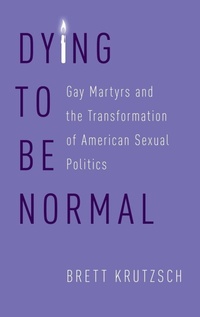
Dying to Be Normal
Gay Martyrs and the Transformation of American Sexual Politics
Published on 4. April 2019
Book
Hardback
264 pages
978-0-19-068521-8 (ISBN)
Description
Finalist, Best LGBTQ Nonfiction Book, Lambda Literary Awards 2020
On October 14, 1998, five thousand people gathered on the steps of the U.S. Capitol to mourn the death of Matthew Shepard, a gay college student who had been murdered in Wyoming eight days earlier. Politicians and celebrities addressed the crowd and the televised national audience to share their grief with the country. Never before had a gay citizen's murder elicited such widespread outrage or concern from straight Americans.
In Dying to Be Normal, Brett Krutzsch argues that gay activists memorialized people like Shepard as part of a political strategy to present gays as similar to the country's dominant class of white, straight Christians. Through an examination of publicly mourned gay deaths, Krutzsch counters the common perception that LGBT politics and religion have been oppositional and reveals how gay activists used religion to bolster the argument that gays are essentially the same as straights, and therefore deserving of equal rights.
Krutzsch's analysis turns to the memorialization of Shepard, Harvey Milk, Tyler Clementi, Brandon Teena, and F. C. Martinez, to campaigns like the It Gets Better Project, and national tragedies like the Pulse nightclub shooting to illustrate how activists used prominent deaths to win acceptance, influence political debates over LGBT rights, and encourage assimilation. Throughout, Krutzsch shows how, in the fight for greater social inclusion, activists relied on Christian values and rhetoric to portray gays as upstanding Americans. As Krutzsch demonstrates, gay activists regularly reinforced a white Protestant vision of acceptable American citizenship that often excluded people of color, gender-variant individuals, non-Christians, and those who did not adhere to Protestant Christianity's sexual standards.
The first book to detail how martyrdom has influenced national debates over LGBT rights, Dying to Be Normal establishes how religion has shaped gay assimilation in the United States and the mainstreaming of particular gays as "normal" Americans.
On October 14, 1998, five thousand people gathered on the steps of the U.S. Capitol to mourn the death of Matthew Shepard, a gay college student who had been murdered in Wyoming eight days earlier. Politicians and celebrities addressed the crowd and the televised national audience to share their grief with the country. Never before had a gay citizen's murder elicited such widespread outrage or concern from straight Americans.
In Dying to Be Normal, Brett Krutzsch argues that gay activists memorialized people like Shepard as part of a political strategy to present gays as similar to the country's dominant class of white, straight Christians. Through an examination of publicly mourned gay deaths, Krutzsch counters the common perception that LGBT politics and religion have been oppositional and reveals how gay activists used religion to bolster the argument that gays are essentially the same as straights, and therefore deserving of equal rights.
Krutzsch's analysis turns to the memorialization of Shepard, Harvey Milk, Tyler Clementi, Brandon Teena, and F. C. Martinez, to campaigns like the It Gets Better Project, and national tragedies like the Pulse nightclub shooting to illustrate how activists used prominent deaths to win acceptance, influence political debates over LGBT rights, and encourage assimilation. Throughout, Krutzsch shows how, in the fight for greater social inclusion, activists relied on Christian values and rhetoric to portray gays as upstanding Americans. As Krutzsch demonstrates, gay activists regularly reinforced a white Protestant vision of acceptable American citizenship that often excluded people of color, gender-variant individuals, non-Christians, and those who did not adhere to Protestant Christianity's sexual standards.
The first book to detail how martyrdom has influenced national debates over LGBT rights, Dying to Be Normal establishes how religion has shaped gay assimilation in the United States and the mainstreaming of particular gays as "normal" Americans.
Reviews / Votes
A remarkably multifaceted study, of value to Queer Studies and the study of Christianity, American religion to comparative study of religion and politics, work on martyrdom generally, and-urgently-scholarship probing ethical questions about representation, this book should be widely taught. * Spencer Dew, Denison University / the Ohio State University, Religious Studies Review * Dying to Be Normal is a powerhouse text that I would highly recommend to scholars interested in queer theory, LGBT studies, or religion studies. The book is additionally helpful for scholars of media or activist history, as the author provides rich historic recollections of the media narratives and activist responses surrounding these figures. * Jimmy Hamill, Reading Religion * A provocative blend of religion studies, LGBT studies, and media studies, Dying to Be Normal provides an expansive overview of the relationship between LGBT activists and religious discourses in America.... [A] powerhouse text. * Reading Religion * A must-read for scholars and activists alike, Krutzsch's agile and far-reaching analysis demonstrates the tactics and the consequences of assimilationist gay politics: veneration of white, cisgender gay men through sanitized, semi-fictionalized, and Christianized versions of their lives that erase their own realities and those of their communities. Krutzsch reminds us that there have always been other options, and challenges us to reject assimilationist tactics that are ultimately rooted in exclusion. * Melissa M. Wilcox, author of Queer Nuns: Religion, Activism, and Serious Parody * Dying to Be Normal offers a fascinating and heartbreaking history of the memorialization and martyrdom of gay figures in the United States. Krutzsch reveals how religious and secular narratives work in this history - often in unexpected ways - to make some gays appear normal, a process that all too often transubstantiates complicated queer lives into suitable Christian narratives, while leaving others, especially queer people of color, outside the circuit of memory. This moving, unflinching analysis raises the bar for how we talk about religion and sexuality in American politics. * Anthony Petro, author of After the Wrath of God: AIDS, Sexuality, and American Religion * Brett Krutzsch's Dying to Be Normal is a brilliant study of martyrdom and memorialization as central to gay activism in the United States. Although religiosity and sexuality are often thought to be opposing forces, the book shows that religion and sex are powerfully entwined. Christian nationalism and Protestant secularism may form the current parameters of political possibility, but Krutzsch provides an expansive, alternative analysis that opens toward a diverse sexual democracy. * Janet R. Jakobsen, Claire Tow Professor of Women's, Gender and Sexuality Studies, Barnard College, Columbia University *More details
Language
English
Place of publication
New York
United States
Dimensions
Height: 240 mm
Width: 161 mm
Thickness: 19 mm
Weight
564 gr
ISBN-13
978-0-19-068521-8 (9780190685218)
Copyright in bibliographic data and cover images is held by Nielsen Book Services Limited or by the publishers or by their respective licensors: all rights reserved.
Schweitzer Classification
Other editions
Additional editions
E-Book
02/2019
1st Edition
OUP eBook
€16.49
Available for download
E-Book
02/2019
1st Edition
OUP eBook
€16.49
Available for download
Person
Brett Krutzsch is Coordinator of the Center for Religion and Media and Instructor in the Department of Religious Studies at New York University. His scholarship examines intersections of religion, sexuality, gender, race, and politics in the United States.
Content
- Dedication
- List of illustrations
- Acknowledgments
- Introduction: Memorialization, Gay Assimilation, and American Religion
- Chapter One: The "Gay M.L.K.": Harvey Milk
- Chapter Two: The "Crucifixion" of "Anyone's Gay Son": Matthew Shepard
- Chapter Three: The "Epidemic of Bullying and Gay Teen Suicides": Tyler Clementi and It Gets Better
- Chapter Four: "The Place Where Two Discriminations Meet": Race, Gender, and the Threat of Violence
- Epilogue: The Pulse Nightclub Massacre and the Queer Potential of Memorialization
- Notes
- Selected Bibliography
- Index