

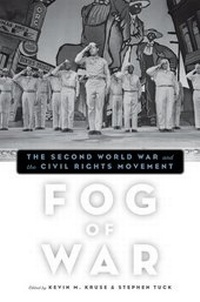
Fog of War
The Second World War and the Civil Rights Movement
1st Edition
Published on 1. March 2012
Book
Hardback
256 pages
978-0-19-538241-9 (ISBN)
Description
This collection is a timely reconsideration of the intersection between two of the dominant events of twentieth-century American history, the upheaval wrought by the Second World War and the social revolution brought about by the African American struggle for equality. Scholars from a wide range of fields explore the impact of war on the longer history of African American protest from many angles: from black veterans to white segregationists, from the rural South to northern cities, from popular culture to federal politics, and from the American confrontations to international connections.
It is well known that World War II gave rise to human rights rhetoric, discredited a racist regime abroad, and provided new opportunities for African Americans to fight, work, and demand equality at home. It would be all too easy to assume that the war was a key stepping stone to the modern civil rights movement. But the authors show that in reality the momentum for civil rights was not so clear cut, with activists facing setbacks as well as successes and their opponents finding ways to establish more rigid defenses for segregation. While the war set the scene for a mass movement, it also narrowed some of the options for black activists.
It is well known that World War II gave rise to human rights rhetoric, discredited a racist regime abroad, and provided new opportunities for African Americans to fight, work, and demand equality at home. It would be all too easy to assume that the war was a key stepping stone to the modern civil rights movement. But the authors show that in reality the momentum for civil rights was not so clear cut, with activists facing setbacks as well as successes and their opponents finding ways to establish more rigid defenses for segregation. While the war set the scene for a mass movement, it also narrowed some of the options for black activists.
Reviews / Votes
raises key questions and will certainly act as a starting point for further (re)examinations of the struggle for black civil rights in a local, national, and global context. * Christine Knauer, H-Soz-u-Kult31/10/2012 *More details
Language
English
Place of publication
New York
United States
Target group
College/higher education
Professional and scholarly
Students, scholars, and general readers of World War II, African American history, and civil rights
Dimensions
Height: 160 mm
Width: 236 mm
Thickness: 25 mm
Weight
454 gr
ISBN-13
978-0-19-538241-9 (9780195382419)
Copyright in bibliographic data and cover images is held by Nielsen Book Services Limited or by the publishers or by their respective licensors: all rights reserved.
Schweitzer Classification
Other editions
Additional editions
Book
03/2012
1st Edition
Oxford University Press Inc
€52.90
Shipment within 15-20 days
E-Book
01/2012
1st Edition
OUP eBook
€23.99
Available for download
E-Book
03/2011
1st Edition
OUP eBook
€23.99
Available for download
Persons
KK: Associate Professor of History, Princeton University. Author of White Flight: Atlanta and the Making of Modern Conservatism (Princeton UP, 2005) and co-editor of The New Suburban History (University of Chicago Press, 2006). ST: University Lecturer in History, University of Oxford. Author of We Ain''t What We Ought To Be: The Black Freedom Struggle from Emancipation to Obama (Harvard UP, 2010)and Beyond Atlanta: The Struggle for Racial Equality in Georgia, 1940-1980 (University of Georgia, 2003).
Content
Contributors ; Introduction: The Second World War and the Civil Rights Movement- Kevin M. Kruse and Stephen Tuck ; Chapter 1: Freedom to Want: The Federal Government and Politicized Consumption in World War II- James T. Sparrow ; Chapter 2: Confronting the Roadblock: Congress, Civil Rights and World War II- Julian E. Zelizer ; Chapter 3: Segregation and the City: White Supremacy in Alabama in the Mid-Twentieth Century- J. Mills Thornton III ; Chapter 4: Movement Building during the World War II Era: The NAACP's Legal Insurgency in the South- Patricia Sullivan ; Chapter 5: Hillburn, Hattiesburg, and Hitler: Wartime Activists Think Globally and Act Locally- Thomas Sugrue ; Chapter 6: "You can sing and punch EL but you can't be a soldier or a man": African American Struggles for a New Place in Popular Culture- Stephen Tuck ; Chapter 7: "A War for States' Rights": The White Supremacist Vision of Double Victory- Jason Morgan Ward ; Chapter 8: The Sexual Politics of Race in WWII America- Jane Dailey ; Chapter 9: Civil Rights and World War II in a Global Frame: Shape-shifting Racial Formations and the U.S. Encounter with European and Japanese Colonialism- Penny Von Eschen ; Chapter 10: Race, Rights, and Non-Governmental Organizations at the UN San Francisco Conference: A Contested History of "Human Rights ... without discrimination"- Elizabeth Borgwardt ; Chapter 11: "Did the Battlefield Kill Jim Crow?": The Cold War Military, Civil Rights, and Black Freedom Struggles- Kimberley L. Phillips