

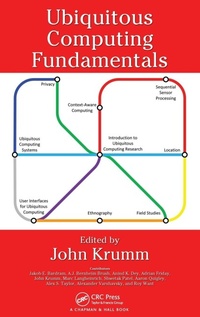
Ubiquitous Computing Fundamentals
1st Edition
Published on 21. September 2009
Book
Hardback
408 pages
978-1-4200-9360-5 (ISBN)
Description
"...a must-read text that provides a historical lens to see how ubicomp has matured into a multidisciplinary endeavor. It will be an essential reference to researchers and those who want to learn more about this evolving field."
-From the Foreword, Professor Gregory D. Abowd, Georgia Institute of Technology
First introduced two decades ago, the term ubiquitous computing is now part of the common vernacular. Ubicomp, as it is commonly called, has grown not just quickly but broadly so as to encompass a wealth of concepts and technology that serves any number of purposes across all of human endeavor. While such growth is positive, the newest generation of ubicomp practitioners and researchers, isolated to specific tasks, are in danger of losing their sense of history and the broader perspective that has been so essential to the field's creativity and brilliance.
Under the guidance of John Krumm, an original ubicomp pioneer, Ubiquitous Computing Fundamentals brings together eleven ubiquitous computing trailblazers who each report on his or her area of expertise. Starting with a historical introduction, the book moves on to summarize a number of self-contained topics. Taking a decidedly human perspective, the book includes discussion on how to observe people in their natural environments and evaluate the critical points where ubiquitous computing technologies can improve their lives. Among a range of topics this book examines:
How to build an infrastructure that supports ubiquitous computing applications
Privacy protection in systems that connect personal devices and personal information
Moving from the graphical to the ubiquitous computing user interface
Techniques that are revolutionizing the way we determine a person's location and understand other sensor measurements
While we needn't become expert in every sub-discipline of ubicomp, it is necessary that we appreciate all the perspectives that make up the field and understand how our work can influence and be influenced by those perspectives. This is important, if we are to encourage future generations to be as successfully innovative as the field's originators.
-From the Foreword, Professor Gregory D. Abowd, Georgia Institute of Technology
First introduced two decades ago, the term ubiquitous computing is now part of the common vernacular. Ubicomp, as it is commonly called, has grown not just quickly but broadly so as to encompass a wealth of concepts and technology that serves any number of purposes across all of human endeavor. While such growth is positive, the newest generation of ubicomp practitioners and researchers, isolated to specific tasks, are in danger of losing their sense of history and the broader perspective that has been so essential to the field's creativity and brilliance.
Under the guidance of John Krumm, an original ubicomp pioneer, Ubiquitous Computing Fundamentals brings together eleven ubiquitous computing trailblazers who each report on his or her area of expertise. Starting with a historical introduction, the book moves on to summarize a number of self-contained topics. Taking a decidedly human perspective, the book includes discussion on how to observe people in their natural environments and evaluate the critical points where ubiquitous computing technologies can improve their lives. Among a range of topics this book examines:
How to build an infrastructure that supports ubiquitous computing applications
Privacy protection in systems that connect personal devices and personal information
Moving from the graphical to the ubiquitous computing user interface
Techniques that are revolutionizing the way we determine a person's location and understand other sensor measurements
While we needn't become expert in every sub-discipline of ubicomp, it is necessary that we appreciate all the perspectives that make up the field and understand how our work can influence and be influenced by those perspectives. This is important, if we are to encourage future generations to be as successfully innovative as the field's originators.
Reviews / Votes
"... a must-read text that provides a historical lens to see how ubicomp has matured into a multidisciplinary endeavor. It will be an essential reference to researchers and those who want to learn more about this evolving field."-Professor Gregory D. Abowd, Georgia Institute of Technology
More details
Language
English
Place of publication
Oxford
United Kingdom
Publishing group
Taylor & Francis Ltd
Target group
Professional and scholarly
Professional and Professional Practice & Development
Product notice
Paper over boards
Illustrations
93 s/w Abbildungen, 6 s/w Tabellen
6 Tables, black and white; 93 Illustrations, black and white
Dimensions
Height: 240 mm
Width: 161 mm
Thickness: 27 mm
Weight
778 gr
ISBN-13
978-1-4200-9360-5 (9781420093605)
Copyright in bibliographic data and cover images is held by Nielsen Book Services Limited or by the publishers or by their respective licensors: all rights reserved.
Schweitzer Classification
Other editions
Additional editions
John Krumm
Ubiquitous Computing Fundamentals
E-Book
10/2018
1st Edition
Chapman & Hall/CRC
€178.99
Available for download
John Krumm
Ubiquitous Computing Fundamentals
E-Book
10/2018
1st Edition
Chapman & Hall/CRC
€178.99
Available for download
Person
Content
An Introduction to Ubiquitous Computing. Ubiquitous Computing Systems. Privacy in Ubiquitous Computing. Ubiquitous Computing Field Studies. Ethnography in Ubiquitous Computing. From GUI to UUI: Interfaces for Ubiquitous Computing. Location in Ubiquitous Computing. Context-Aware Computing. Processing Sequential Sensor.