

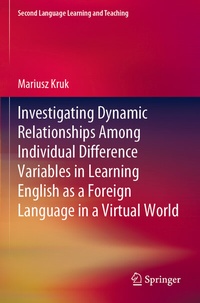
Investigating Dynamic Relationships Among Individual Difference Variables in Learning English as a Foreign Language in a Virtual World
Published on 20. January 2022
Book
Paperback/Softback
XIV, 148 pages
978-3-030-65271-5 (ISBN)
Description
This book focuses on the dynamic relationships among individual difference (ID) variables (i.e., willingness to communicate, motivation, language anxiety and boredom) in learning English as a foreign language in the virtual world Second Life. The theoretical part provides an overview of selected issues related to the four ID factors in question (e.g., definitions, models, sources, types, empirical investigations). The empirical part reports the findings of a research project which aimed to examine the changing nature of WTC, motivation, boredom and language anxiety experienced by six English majors during their visits to the said virtual world, the main contributors to the changes in the levels of the constructs under investigation, as well as their relationships. The book closes with the discussion of directions for further research as well as pedagogical implications.
More details
Series
Edition
2021 ed.
Language
English
Place of publication
Cham
Switzerland
Publishing group
Springer International Publishing
Target group
Professional and scholarly
Illustrations
6 s/w Abbildungen, 12 farbige Abbildungen
XIV, 148 p. 18 illus., 12 illus. in color.
Dimensions
Height: 235 mm
Width: 155 mm
Thickness: 10 mm
Weight
260 gr
ISBN-13
978-3-030-65271-5 (9783030652715)
DOI
10.1007/978-3-030-65269-2
Schweitzer Classification
Other editions
Additional editions
Book
01/2021
Springer
€117.69
Shipment within 7-9 days
Person
Mariusz Kruk, University of Zielona Góra, Zielona Góra, Poland.
Content
1. The constructs of willingness to communicate, motivation, boredom and language anxiety: Overview of selected issues.- 2. Empirical investigations into WTC, motivation, boredom and language anxiety in traditional and digital contexts.- 3. Design of the study.- 4.Findings of the study.- 5. Conclusions, pedagogical implications and directions for future research.