

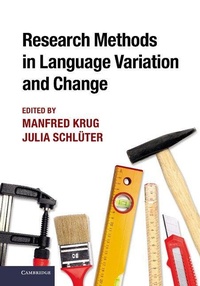
Research Methods in Language Variation and Change
Published on 24. October 2013
Book
Hardback
538 pages
978-1-107-00490-0 (ISBN)
Description
Methodological know-how has become one of the key qualifications in contemporary linguistics, which has a strong empirical focus. Containing 23 chapters, each devoted to a different research method, this volume brings together the expertise and insight of a range of established practitioners. The chapters are arranged in three parts, devoted to three different stages of empirical research: data collection, analysis and evaluation. In addition to detailed step-by-step introductions and illustrative case studies focusing on variation and change in English, each chapter addresses the strengths and weaknesses of the methodology and concludes with suggestions for further reading. This systematic, state-of-the-art survey is ideal for both novice researchers and professionals interested in extending their methodological repertoires. The book also has a companion website which provides readers with further information, links, resources, demonstrations, exercises and case studies related to each chapter.
Reviews / Votes
'This comprehensive and clear volume constitutes a 'one-stop shop' for anyone embarking on a research project in language variation and change and will be essential reading for graduate and advanced undergraduate students.' Joan Beal, University of Sheffield 'This is a very important book providing concrete, useful, and important information on the major research methodologies employed by those doing empirical research in the areas of language variation and change.' Charles F. Meyer, University of Massachusetts, BostonMore details
Language
English
Place of publication
Cambridge
United Kingdom
Target group
Professional and scholarly
Illustrations
69 Tables, black and white; 7 Maps; 61 Halftones, unspecified; 40 Line drawings, unspecified
Dimensions
Height: 250 mm
Width: 175 mm
Thickness: 33 mm
Weight
1097 gr
ISBN-13
978-1-107-00490-0 (9781107004900)
Copyright in bibliographic data and cover images is held by Nielsen Book Services Limited or by the publishers or by their respective licensors: all rights reserved.
Schweitzer Classification
Other editions
Additional editions
Manfred Krug | Julia Schlueter
Research Methods in Language Variation and Change
Book
10/2013
Cambridge University Press
€56.50
Shipment within 15-20 days
Manfred Krug | Julia Schlueter
Research Methods in Language Variation and Change
E-Book
10/2013
1st Edition
Cambridge University Press
€23.49
Available for download
Manfred Krug
Research Methods in Language Variation and Change
E-Book
10/2013
Cambridge University Press
€20.99
Available for download
Persons
Manfred Krug is Chair of English and Historical Linguistics in the Department of English and American Studies at the University of Bamberg. Julia Schlueter is Associate Professor of English and Historical Linguistics in the Department of English and American Studies at the University of Bamberg.
Content
Introduction: investigating language variation and change Manfred Krug, Julia Schlueter and Anette Rosenbach; Part I. Collecting Empirical Data: Section 1. Fieldwork and Linguistic Mapping: 1. Collecting ethnographic and sociolinguistic data Daniel Schreier; 2. Using participant observation and social network analysis Lynn Clark and Graeme Trousdale; 3. Computer mapping of language data William A. Kretzschmar, Jr; Section 2. Eliciting Linguistic Data: 4. Designing and conducting interviews and questionnaires Manfred Krug and Katrin Sell; 5. Obtaining introspective acceptability judgements Thomas Hoffmann; Section 3. Alternatives to Standard Reference Corpora: 6. Using historical literature databases as corpora Julia Schlueter; 7. Using the OED quotations database as a diachronic corpus Guenter Rohdenburg; 8. Using web-based data for the study of global English Marianne Hundt; Part II. Analysing Empirical Data: Section 4. Corpus Analysis: 9. Using 'small' corpora to document ongoing grammatical change Christian Mair; 10. Using tag sequences to retrieve grammatical structures Sebastian Hoffmann; 11. Categorizing syntactic constructions in a corpus Nicholas Smith and Elena Seoane; Section 5. Phonetic and Phonological Analysis: 12. Analysing phonetic and phonological variation on the segmental level Ulrike Gut; 13. Analysing phonetic and phonological variation on the suprasegmental level Ulrike Gut; 14. Reconstructing stress in Old and Middle English Donka Minkova; Section 6. Combinations of Multiple Types of Data: 15. Combining elicitation data with corpus data Anette Rosenbach; 16. Using convergent evidence from psycholinguistics and usage Marilyn Ford and Joan Bresnan; 17. Applying typological methods in dialectology Lieselotte Anderwald and Bernd Kortmann; Part III. Evaluating Empirical Data: Section 7. Basic Statistical Analysis: 18. Quantifying variation and estimating the effects of sample size on the frequencies of linguistic variables Heikki Mannila, Terttu Nevalainen and Helena Raumolin-Brunberg; 19. Elementary statistical testing with R Stefan Th. Gries; Section 8. Multifactorial Analysis: 20. Analysing and interpreting variation in the sociolinguistic tradition Sali A. Tagliamonte; 21. Identifying multidimensional patterns of variation across registers Douglas Biber and Bethany Gray; 22. Computing linguistic distances between varieties April McMahon and Warren Maguire; 23. Analysing aggregated linguistic data Benedikt Szmrecsanyi.