

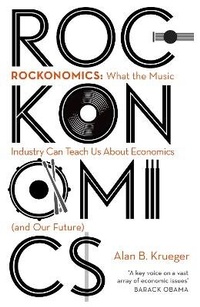
Rockonomics
What the Music Industry Can Teach Us About Economics (and Our Future)
Published on 4. June 2019
Book
Hardback
336 pages
978-1-4736-6788-4 (ISBN)
Description
'A cheerful and illuminating read, full of delicious anecdotes and valuable nuggets. It does what Krueger did best - brings economics to life, and life to economics.' The Times, Books of the Year
'A key voice on a vast array of economic issues for more than two decades' Barack Obama
'A cheerful and illuminating read, full of delicious anecdotes and valuable nuggets. It does what Krueger did best - brings economics to life, and life to economics' The Times
Alan Krueger, the former chairman of the president's Council of Economic Advisers, uses the music industry, from rock artists to music executives, from managers to promoters, as a way in to explain the principles of economics, and the forces shaping our economic lives.
As economists recognize, the music industry is often a leading indicator of today's economy; it is among the first to be disrupted by the latest wave of technology, and examining the ins and outs of how musicians create and sell new songs and plan concert tours offers valuable lessons for what is in store for businesses and employees in other industries that are struggling to adapt.
Drawing on interviews with leading band members, music executives, managers, promoters, and using the latest data on revenues, royalties, tour dates, and merchandise, Rockonomics takes readers backstage to show how the music industry really works--who makes money and how much, and how the economics of the music industry has undergone a radical transformation during the last twenty years.
Before digitalization and the ability to stream music over the Internet, rock musicians made the bulk of their income from record sales. Today, income from selling songs has plummeted, even for superstars like Taylor Swift; the real money nowadays is derived from concert sales. In 2016, for example, Billy Joel earned $212.4 million from his live performances, and less than $1 million from record sales and streaming. Even Paul McCartney, who has written and recorded more number one songs than anyone in music history, today, earns 93 percent of his income from live concerts. Krueger tackles common questions: How does a song become popular? And how does a new artist break out in today's winner-take-all economy?
'A key voice on a vast array of economic issues for more than two decades' Barack Obama
'A cheerful and illuminating read, full of delicious anecdotes and valuable nuggets. It does what Krueger did best - brings economics to life, and life to economics' The Times
Alan Krueger, the former chairman of the president's Council of Economic Advisers, uses the music industry, from rock artists to music executives, from managers to promoters, as a way in to explain the principles of economics, and the forces shaping our economic lives.
As economists recognize, the music industry is often a leading indicator of today's economy; it is among the first to be disrupted by the latest wave of technology, and examining the ins and outs of how musicians create and sell new songs and plan concert tours offers valuable lessons for what is in store for businesses and employees in other industries that are struggling to adapt.
Drawing on interviews with leading band members, music executives, managers, promoters, and using the latest data on revenues, royalties, tour dates, and merchandise, Rockonomics takes readers backstage to show how the music industry really works--who makes money and how much, and how the economics of the music industry has undergone a radical transformation during the last twenty years.
Before digitalization and the ability to stream music over the Internet, rock musicians made the bulk of their income from record sales. Today, income from selling songs has plummeted, even for superstars like Taylor Swift; the real money nowadays is derived from concert sales. In 2016, for example, Billy Joel earned $212.4 million from his live performances, and less than $1 million from record sales and streaming. Even Paul McCartney, who has written and recorded more number one songs than anyone in music history, today, earns 93 percent of his income from live concerts. Krueger tackles common questions: How does a song become popular? And how does a new artist break out in today's winner-take-all economy?
Reviews / Votes
A key voice on a vast array of economic issues for more than two decades * Barack Obama * Does what Krueger did best - brings economics to life, and life to economics * The Times * The music business keeps re-inventing itself (from records, to tape, to CDs to streaming) and Alan Krueger covers all the bases. As one former LSE student once sang: 'its only rock and roll but I like it, like it, yes I do.' That applies to this book too * Richard Thaler, author of 'Nudge' * An eye-opening and entertaining read * The Economist * An absolutely brilliant mind. The definition of left and right brain balance * Quincy Jones * An intriguing read for those who want to understand how their favourite bands are - or aren't, as the case may be - staying afloat in the streaming era * Mojo * The author's sparkling intelligence and lively prose make for a thought-provoking and enjoyable read ... [a] vivid, human portrait provided of the broader music ecosystem * New York Times * Rockonomics is entertaining, educational and enlightening. Alan Krueger gives us a backstage tour of the music industry - and in doing so, he creates a brilliant metaphor for our entire economy. Highly recommended * Harlan Coben * Krueger's book does a fine job describing the financial underpinnings of the music trade and pulling together the many still-shifting strands which will determine its future * Reuters * [A] highly readable book...It is Krueger's meticulous attention to detail that makes his work so compelling -- John Meagher * Irish Independent Review * 'A key voice on a vast array of economic issues for more than two decades' * Barack Obama *More details
Language
English
Place of publication
United Kingdom
Publishing group
John Murray Press
Target group
College/higher education
Professional and scholarly
Dimensions
Height: 237 mm
Width: 159 mm
Thickness: 35 mm
Weight
558 gr
ISBN-13
978-1-4736-6788-4 (9781473667884)
Copyright in bibliographic data and cover images is held by Nielsen Book Services Limited or by the publishers or by their respective licensors: all rights reserved.
Schweitzer Classification
Other editions
Additional editions
E-Book
06/2019
1st Edition
John Murray
€3.99
Available for download
Person
Alan Krueger was the Bendheim Professor of Economics and Public Affairs at Princeton University and Research Associate at the National Bureau of Economic Research. Formerly President Barack Obama's chairman of the White House Council of Economic Advisers, he was widely published on issues related to education, labour markets and income distribution.