

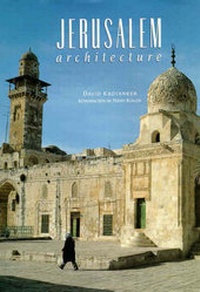
Jerusalem Architecture
Published on 31. December 1994
Book
Hardback
210 pages
978-1-85043-873-1 (ISBN)
Description
Jerusalem has captivated the world for over 2000 years. This book surveys the revered city's architecture, from the earliest remnants of old Judea, Rome, and Byzantium, through the glories of Islam and the Crusader kingdom, to the pragmatically conceived neighbourhoods built outside Suleiman the Magnificent's 16th-century ramparts, in the years since World War I. The author dwells at length on the city's chronological development, with detailed analyses of the great temples constructed by King David and King Herod, the Romanesque/Gothic Church of the Holy Sepulcher, the Dome of the Rock shrine, the Al-Aqsa Mosque, the circle of magnificent fortifications erected by Sinan (Suleiman's favourite architect), and the colourful, tiled palaces of the Mamluks. Also explored are the old Jewish, Christian, Armenian and Arab quarters inside the old walls of the city and, in particular, the harmony and simplicity of Arab domestic architecture.
More details
Language
English
Place of publication
United Kingdom
Publishing group
Bloomsbury Publishing PLC
Target group
College/higher education
Professional and scholarly
Illustrations
400 colour illustrations, 300 b&w illustrations, glossary, chronology, index
Dimensions
Height: 325 mm
Width: 270 mm
ISBN-13
978-1-85043-873-1 (9781850438731)
Copyright in bibliographic data and cover images is held by Nielsen Book Services Limited or by the publishers or by their respective licensors: all rights reserved.
Schweitzer Classification
Persons
Content
3000 years of history and urban development, Ralph Mandel; the old city, urban structure and texture - dense and introspective architecture; the old city from 1000 BC to the Ottoman Empire - a study of remnants; the old city in modern times - preservation and reconstruction; Jewish, Arab and European Christian building in the new city - architecture with ethnic identity; building a new Jerusalem, the British mandate - the emergence of new architectural styles and technologies; modern architecture, 1948-1993 - from the international to the neo-oriental style; epilogue - stone, the unifying element.