

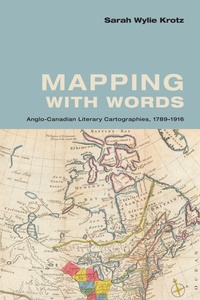
Mapping with Words
Anglo-Canadian Literary Cartographies, 1789-1916
Published on 30. November 2018
Book
Hardback
272 pages
978-1-4426-5012-1 (ISBN)
Description
Mapping with Words re-conceptualizes settler writing as literary cartography. The topographical descriptions of early Canadian settler writers generated not only picturesque and sublime landscapes, but also verbal maps. These worked to orient readers, reinforcing and expanding the cartographic order of the emerging colonial dominion.
Drawing upon the work of critical and cultural geographers as well as literary theorists, Sarah Wylie Krotz opens up important aesthetic and political dimensions of both familiar and obscure texts from the nineteenth century, including Thomas Cary's Abram's Plains, George Monro Grant's Ocean to Ocean, and Susanna Moodie's Roughing it in the Bush. Highlighting the complex territoriality that emerges from their cartographic aesthetics, Krotz offers fresh readings of these texts, illuminating their role in an emerging spatial imaginary that was at once deeply invested in the production of colonial spaces and at the same time enmeshed in the realities of confronting Indigenous sovereignties.
Drawing upon the work of critical and cultural geographers as well as literary theorists, Sarah Wylie Krotz opens up important aesthetic and political dimensions of both familiar and obscure texts from the nineteenth century, including Thomas Cary's Abram's Plains, George Monro Grant's Ocean to Ocean, and Susanna Moodie's Roughing it in the Bush. Highlighting the complex territoriality that emerges from their cartographic aesthetics, Krotz offers fresh readings of these texts, illuminating their role in an emerging spatial imaginary that was at once deeply invested in the production of colonial spaces and at the same time enmeshed in the realities of confronting Indigenous sovereignties.
Reviews / Votes
"What can geographers learn from Mapping with Words? Through carefully selected texts, analyzed through a literary cartographic approach, Krotz helps us understand geographical change in particular places in Canada, as the land was being colonized. She shows what happens on the ground, in lived experience and observation, as new people and new forces arrive and disrupt existing Indigenous society. She draws out a deeper geographical life in particular regions, which leads to a fuller understanding of their geography of today." - John Warkentin (The Canadian Geographer) "Mapping with Words is so engaging that the blurbs by Jenny Kerber and Christoph Irmscher rightly call it a 'pleasure' and 'fun to read.'"- Tracy Ware, Queen's University (University of Toronto Quarterly: Letters in Canada 2018) "The most appealing aspect of Mapping with Words is that Krotz acknowledges the messiness, terror and labour involved in producing early maps - the result of the efforts not only of the explorers who drew them, but of many others, including voyageurs, Indigenous advisors and guides, women, and even children."
- Brigid Magner, RMIT University (Literary Geographies)
More details
Language
English
Place of publication
Toronto
Canada
Target group
College/higher education
Professional and scholarly
Product notice
sewn/stitched
Cloth over boards
With dust jacket
Dimensions
Height: 231 mm
Width: 160 mm
Thickness: 28 mm
Weight
544 gr
ISBN-13
978-1-4426-5012-1 (9781442650121)
Copyright in bibliographic data and cover images is held by Nielsen Book Services Limited or by the publishers or by their respective licensors: all rights reserved.
Schweitzer Classification
Other editions
Additional editions
E-Book
12/2018
1st Edition
University of Toronto Press
€56.95
Available for download
Person
Sarah Wylie Krotz is an assistant professor in the Department of English and Film Studies at the University of Alberta.
Content
Preface
Introduction: Maps and Text-Maps
1. Illuminating the Horizon:
The Cartographic Aesthetics of Two Early Long Poems
2. The Land Up Close:
Mapping Disorder in Roughing It in the Bush
3. The Intimate Geography of Wilderness:
The Spatiality of Catharine Parr Traill's Botanical Inventories
4. Writing and Reading the Northwest:
George Monro Grant and the Palimpsest of Settler Space
5. The Poet in Treaty Territory:
The Literary Cartography of "The Height of Land"
Conclusion: Maps and Counter-Maps (On Getting Lost)
Appendix of Figures
Introduction: Maps and Text-Maps
1. Illuminating the Horizon:
The Cartographic Aesthetics of Two Early Long Poems
2. The Land Up Close:
Mapping Disorder in Roughing It in the Bush
3. The Intimate Geography of Wilderness:
The Spatiality of Catharine Parr Traill's Botanical Inventories
4. Writing and Reading the Northwest:
George Monro Grant and the Palimpsest of Settler Space
5. The Poet in Treaty Territory:
The Literary Cartography of "The Height of Land"
Conclusion: Maps and Counter-Maps (On Getting Lost)
Appendix of Figures