

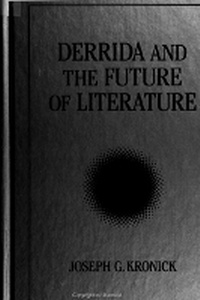
Derrida and the Future of Literature
Published on 30. September 1999
Book
Hardback
216 pages
978-0-7914-4335-4 (ISBN)
Description
Confirms the importance of literature in Derrida's development of a postmodern ethics.
Presented here is the fullest account to date of Derrida's unconventional understanding of literature and its importance to the development of a poststructural ethics. Kronick explains why Derrida has had such a great impact upon literary studies, and at the same time, he demonstrates how different Derrida's conception of literature is from the literary critic's. Focusing on such key topics as singularity, justice, law, aporia, and the event, this book explores the unexpected ways literature appears in Derrida's works and is tied to his major concepts.
Presented here is the fullest account to date of Derrida's unconventional understanding of literature and its importance to the development of a poststructural ethics. Kronick explains why Derrida has had such a great impact upon literary studies, and at the same time, he demonstrates how different Derrida's conception of literature is from the literary critic's. Focusing on such key topics as singularity, justice, law, aporia, and the event, this book explores the unexpected ways literature appears in Derrida's works and is tied to his major concepts.
Reviews / Votes
"I like this book for at least three reasons. First of all, it is the first book-length study of Derrida's understanding of literature. This alone is an achievement. Second, Kronick shows, in the most convincing ways, to what extent Derrida's terms, concepts, issues, etc., hang together. Third, he proceeds patiently and cautiously, steering clear of all simplification. As a result, this study provides a number of very well wrought formulations that illuminate some very difficult issues in significant ways." - Rodolphe Gasche, author of Inventions of Difference: On Jacques Derrida"This is an important and mature assessment of the role of the literary in Derrida's work. Two aspects are particularly valuable: first, Kronick's excellent discussion of the event as the structure of iteration, or singularity marked by the difference of its repetition; second, his careful analysis of literature's 'invention' of its referent, of the double bind of literature: necessary referentiality and, equally important, its undermining of representation." - Krzysztof Ziarek, author of Inflected Language: Toward a Hermeneutics of Nearness: Heidegger, Levinas, Stevens, Celan
More details
Series
Language
English
Place of publication
Albany, NY
United States
Target group
College/higher education
US School Grade: College Graduate Student and over
Weight
445 gr
ISBN-13
978-0-7914-4335-4 (9780791443354)
Copyright in bibliographic data and cover images is held by Nielsen Book Services Limited or by the publishers or by their respective licensors: all rights reserved.
Schweitzer Classification
Person
Joseph G. Kronick is Professor of English at Louisiana State University. He is the author of American Poetics of History: From Emerson to the Moderns and coeditor (with Bainard Cowan) of Theorizing American Literature: Hegel, the Sign, and History.
Content
Acknowledgments
Abbreviations of Derrida's Works
Introduction: On the Secret
1. "Aporetic Conclusion": The Law of the Name
2. Edmond Jabes and the Question of the Jewish Unhappy Consciousness: Reflections on Deconstruction
3. Deconstruction and the Future of Literature (or, Writing in the Nuclear Age)
4. Monstrous Writing: The Gift of Literature
Notes
Index
Abbreviations of Derrida's Works
Introduction: On the Secret
1. "Aporetic Conclusion": The Law of the Name
2. Edmond Jabes and the Question of the Jewish Unhappy Consciousness: Reflections on Deconstruction
3. Deconstruction and the Future of Literature (or, Writing in the Nuclear Age)
4. Monstrous Writing: The Gift of Literature
Notes
Index