

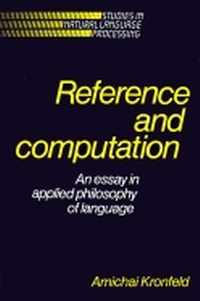
Reference and Computation
An Essay in Applied Philosophy of Language
Published on 31. August 1990
Book
Hardback
206 pages
978-0-521-36636-6 (ISBN)
Description
This book deals with a major problem in the study of language: the problem of reference. The ease with which we refer to things in conversation is deceptive. Upon closer scrutiny, it turns out that we hardly ever tell each other explicitly what object we mean, although we expect our interlocutor to discern it. Amichai Kronfeld provides an answer to two questions associated with this: how do we successfully refer, and how can a computer be programmed to achieve this? Beginning with the major theories of reference, Dr Kronfeld provides a consistent philosophical view which is a synthesis of Frege's and Russell's semantic insights with Grice's and Searle's pragmatic theories. This leads to a set of guiding principles, which are then applied to a computational model of referring. The discussion is made accessible to readers from a number of backgrounds: in particular, students and researchers in the areas of computational linguistics, artificial intelligence and the philosophy of language will want to read this book.
More details
Series
Language
English
Place of publication
Cambridge
United Kingdom
Target group
Professional and scholarly
Dimensions
Height: 228 mm
Width: 152 mm
Thickness: 11 mm
Weight
415 gr
ISBN-13
978-0-521-36636-6 (9780521366366)
Copyright in bibliographic data and cover images is held by Nielsen Book Services Limited or by the publishers or by their respective licensors: all rights reserved.
Schweitzer Classification
Other editions
New editions
Book
08/1990
Cambridge University Press
€54.30
Shipment within 15-20 days
Additional editions
Book
08/1990
Cambridge University Press
€54.30
Shipment within 15-20 days
Persons
Content
List of figures; Foreword; Preface; 1. Methods and scope; 2. The descriptive approach; 3. First steps; 4. Referring intentions and goals; 5. Conversationally relevant descriptions; 6. Thoughts and objects; 7. Computational models; References; Index.