

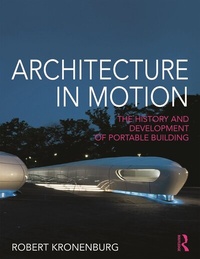
Architecture in Motion
The history and development of portable building
1st Edition
Published on 4. September 2013
Book
Paperback/Softback
328 pages
978-0-415-67638-0 (ISBN)
Description
The idea that architecture can be portable is one that grabs the imagination of both designers and the people who use it, perhaps because it so often forecasts a dynamic and creative solution to the complex problems of our contemporary mobile society, while at the same time dealing with issues of practicality, economy and sustainability.
Architecture in Motion examines the development of portable, transportable, demountable and temporary architecture from prehistory to the present day. From familiar vernacular models such as the tent, mobile home and houseboat, to ambitious developments in military and construction engineering, all aspects of portable building are considered.
Building on his earlier works Portable Architecture and Houses in Motion, Robert Kronenburg compares traditional forms of building, current commercial products and the work of innovative designers, and examines key contemporary portable buildings to reveal surprising, exciting and imaginative examples. He explores the philosophical and technological issues raised by these experimental and futuristic prototypes.
By understanding the nature of transitory architecture, a new ecologically aware design strategy can be developed to prioritise buildings that 'tread lightly on the earth' and still convey the sense of identity and community necessary for an established responsible society. This book provides a unique insight into this pivotal field of design.
Architecture in Motion examines the development of portable, transportable, demountable and temporary architecture from prehistory to the present day. From familiar vernacular models such as the tent, mobile home and houseboat, to ambitious developments in military and construction engineering, all aspects of portable building are considered.
Building on his earlier works Portable Architecture and Houses in Motion, Robert Kronenburg compares traditional forms of building, current commercial products and the work of innovative designers, and examines key contemporary portable buildings to reveal surprising, exciting and imaginative examples. He explores the philosophical and technological issues raised by these experimental and futuristic prototypes.
By understanding the nature of transitory architecture, a new ecologically aware design strategy can be developed to prioritise buildings that 'tread lightly on the earth' and still convey the sense of identity and community necessary for an established responsible society. This book provides a unique insight into this pivotal field of design.
More details
Language
English
Place of publication
London
United Kingdom
Publishing group
Taylor & Francis Ltd
Target group
College/higher education
Illustrations
176 Farbfotos bzw. farbige Rasterbilder, 69 farbige Zeichnungen
69 Line drawings, color; 176 Halftones, color
Dimensions
Height: 246 mm
Width: 189 mm
Weight
912 gr
ISBN-13
978-0-415-67638-0 (9780415676380)
Copyright in bibliographic data and cover images is held by Nielsen Book Services Limited or by the publishers or by their respective licensors: all rights reserved.
Schweitzer Classification
Other editions
Additional editions
Book
09/2013
1st Edition
Routledge
€282.26
Shipment within 15-20 days
E-Book
08/2013
1st Edition
Routledge
€86.99
Available for download
E-Book
08/2013
1st Edition
Routledge
€86.99
Available for download
Person
Robert Kronenburg holds the Roscoe Chair of Architecture at the University of Liverpool, UK. His long-standing research into innovative forms of architectural design is renowned internationally. His books include Houses in Motion, Spirit of the Machine, Portable Architecture, Flexible: Architecture that Responds to Change and Live Architecture: Venues, Stages and Arenas for Popular Music.
Content
Foreword Introduction 1. Prehistoric and Traditional Portable Building 2. Bio-Structures and Vehicles 3. The Age of Invention: Technological Change Before 1900 4. The Innovators: Fuller, Eames and Otto 5. Military Design 6. Industries and Engineering 7. Shelter After Disaster 8. Experimental Architecture 9. Portable Architectural Applications 10. The Value of Portable Architecture Selected Bibliography