

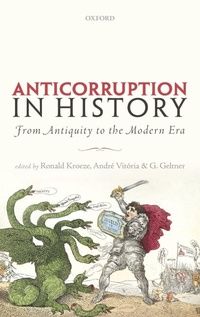
Anticorruption in History
From Antiquity to the Modern Era
Published on 7. December 2017
Book
Hardback
464 pages
978-0-19-880997-5 (ISBN)
Description
Anticorruption in History is a timely and urgent book: corruption is widely seen today as a major problem we face as a global society, undermining trust in government and financial institutions, economic efficiency, the principle of equality before the law and human wellbeing in general. Corruption, in short, is a major hurdle on the "path to Denmark" a feted blueprint for stable and successful statebuilding. The resonance of this view explains why efforts to promote anticorruption policies have proliferated in recent years. But while the subject of corruption and anticorruption has captured the attention of politicians, scholars, NGOs and the global media, scant attention has been paid to the link between corruption and the change of anticorruption policies over time and place, with the attendant diversity in how to define, identify and address corruption.
Economists, political scientists and policy-makers in particular have been generally content with tracing the differences between low-corruption and high-corruption countries in the present and enshrining them in all manner of rankings and indices. The long-term trends-social, political, economic, cultural-potentially undergirding the position of various countries plays a very small role. Such a historical approach could help explain major moments of change in the past as well as reasons for the success and failure of specific anticorruption policies and their relation to a country's image (of itself or as construed from outside) as being more or less corrupt. It is precisely this scholarly lacuna that the present volume intends to begin to fill.
The book addresses a wide range of historical contexts: Ancient Greece and Rome, Medieval Eurasia, Italy, France, Great Britain and Portugal as well as studies on anticorruption in the Early Modern and Modern era in Romania, the Ottoman Empire, the Netherlands, Germany, Denmark, Sweden and the former German Democratic Republic.
Economists, political scientists and policy-makers in particular have been generally content with tracing the differences between low-corruption and high-corruption countries in the present and enshrining them in all manner of rankings and indices. The long-term trends-social, political, economic, cultural-potentially undergirding the position of various countries plays a very small role. Such a historical approach could help explain major moments of change in the past as well as reasons for the success and failure of specific anticorruption policies and their relation to a country's image (of itself or as construed from outside) as being more or less corrupt. It is precisely this scholarly lacuna that the present volume intends to begin to fill.
The book addresses a wide range of historical contexts: Ancient Greece and Rome, Medieval Eurasia, Italy, France, Great Britain and Portugal as well as studies on anticorruption in the Early Modern and Modern era in Romania, the Ottoman Empire, the Netherlands, Germany, Denmark, Sweden and the former German Democratic Republic.
Reviews / Votes
a cohesive and stimulating investigation of the shifting perceptions of corruption in moral, civic and political terms and the strategies and alternative modes of public behaviour that have been attempted to deal with this ongoing problem of modern societies of all political hues. * Ian Cawood, English Historical Review * The insights are many and readers will no doubt find their own amid this rich array of case studies; but arguably the greatest service performed by this book is to bring some much needed analytical pressure to bear on the divide between the modern, post-1800 era and that which went before. This is also where the book will be of most interest to historians and scholars of liberalism, which, however we might define it, is distinguished by a commitment to open and accountable government and the enactment of public office in a disinterested fashion, above the fray of financial, personal and political interests-at least in theory. * Tom Crook, Liberal History * the merit of a work that has managed to gather such a large number of specialists working on such different periods in history. All the more so when the result is a fresh perspective on the study of corruption. * Pol Dalmau, European History Quarterly * the analytical and conceptual rigour of the volume's chapters is high. This book provides a profound and rich historical analysis of a topical problem. * David De Ruysscher, BMGN - Low Countries Historical Review * offers unique detail and insights ... Highly recommended. * Jay Albanese, CHOICE *More details
Language
English
Place of publication
Oxford
United Kingdom
Target group
College/higher education
Professional and scholarly
Dimensions
Height: 240 mm
Width: 161 mm
Thickness: 29 mm
Weight
851 gr
ISBN-13
978-0-19-880997-5 (9780198809975)
Copyright in bibliographic data and cover images is held by Nielsen Book Services Limited or by the publishers or by their respective licensors: all rights reserved.
Schweitzer Classification
Other editions
Additional editions
Ronald Kroeze | André Vitória | Guy Geltner
Anticorruption in History
From Antiquity to the Modern Era
E-Book
12/2017
1st Edition
OUP eBook
€21.99
Available for download
Ronald Kroeze | André Vitória | Guy Geltner
Anticorruption in History
From Antiquity to the Modern Era
E-Book
12/2017
1st Edition
OUP eBook
€21.99
Available for download
Persons
Ronald Kroeze is Assistant Professor in History at the Free University of Amsterdam and was a Postdoctoral Researcher and member of Anticorrp's Work Package 2. He has published extensively on the history of corruption.
Andre Vitoria is a Postdoctoral Researcher and a member of Anticorrp's Work Package 2. His PhD research focused on the impact of the Romano-canonical ius commune on the administration of justice, litigation and the relationship between different jurisdictions and political powers in medieval Portugal. He specializes in legal and political history in the high and late Middle Ages and is particularly interested in the intersection of juristic and publicistic thought and legal and political practice.
Guy Geltner is Professor of Medieval History and Director of the Center for Medieval and Renaissance Studies at the University of Amsterdam. He has published widely on the history of Italian city-states in the later Middle Ages, especially on urban dis/order, as reflected in municipal approaches to punishment, dispute settlement, and public health.
Andre Vitoria is a Postdoctoral Researcher and a member of Anticorrp's Work Package 2. His PhD research focused on the impact of the Romano-canonical ius commune on the administration of justice, litigation and the relationship between different jurisdictions and political powers in medieval Portugal. He specializes in legal and political history in the high and late Middle Ages and is particularly interested in the intersection of juristic and publicistic thought and legal and political practice.
Guy Geltner is Professor of Medieval History and Director of the Center for Medieval and Renaissance Studies at the University of Amsterdam. He has published widely on the history of Italian city-states in the later Middle Ages, especially on urban dis/order, as reflected in municipal approaches to punishment, dispute settlement, and public health.
Content
I - ANTIQUITY; II - THE MIDDLE AGES; III - EARLY MODERNITY; IV - FROM EARLY MODERN TO MODERN TIMES; V - MODERN AND CONTEMPORARY HISTORY