

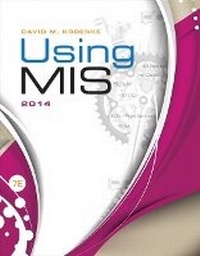
Using MIS
7th Edition
Published on 6. August 2014
Book
Paperback/Softback
576 pages
978-0-13-354643-9 (ISBN)
Description
For undergraduate Introductory Management Information Systems courses
This engaging introduction to how people use IS to solve business problems explains why MIS is the most important course in the business school by showing students how businesses use information systems and technology to accomplish their goals, objectives, and competitive strategy. Included are three unique Guides per chapter focusing on the themes of ethics, security, and other timely topics; plus a number of illustrative cases, exercises, projects, and other aids to ensure that students connect the knowledge in the text to everyday life. With a new edition now publishing each year, Using MIS contains fresh, new, and current material to help keep your students up to date.
Teaching and Learning Experience
This program will provide a better teaching and learning experience-for you and your students. Here's how:
Personalize learning with MyMISLab-the online homework, tutorial, and assessment program that fosters learning within and beyond the classroom.
Focus on important themes of ethics, security, and other timely topics through the text's Guides, designed to help students improve their skills as future business professionals.
Connect classroom knowledge to everyday life with illustrative cases and a number of exercises and other interactive features.
Keep content current to help keep your students up to date with the most recent events.
Note: You are purchasing a standalone product; MyMISLab does not come packaged with this content. If you would like to purchase both the physical text and MyMISLab search for ISBN-10: 0133806898/ISBN-13: 9780133806892. That package includes ISBN-10: 0133546438/ISBN-13: 9780133546439 and ISBN-10: 0133548511/ISBN-13: 9780133548518.
MyMISLab is not a self-paced technology and should only be purchased when required by an instructor.
This engaging introduction to how people use IS to solve business problems explains why MIS is the most important course in the business school by showing students how businesses use information systems and technology to accomplish their goals, objectives, and competitive strategy. Included are three unique Guides per chapter focusing on the themes of ethics, security, and other timely topics; plus a number of illustrative cases, exercises, projects, and other aids to ensure that students connect the knowledge in the text to everyday life. With a new edition now publishing each year, Using MIS contains fresh, new, and current material to help keep your students up to date.
Teaching and Learning Experience
This program will provide a better teaching and learning experience-for you and your students. Here's how:
Personalize learning with MyMISLab-the online homework, tutorial, and assessment program that fosters learning within and beyond the classroom.
Focus on important themes of ethics, security, and other timely topics through the text's Guides, designed to help students improve their skills as future business professionals.
Connect classroom knowledge to everyday life with illustrative cases and a number of exercises and other interactive features.
Keep content current to help keep your students up to date with the most recent events.
Note: You are purchasing a standalone product; MyMISLab does not come packaged with this content. If you would like to purchase both the physical text and MyMISLab search for ISBN-10: 0133806898/ISBN-13: 9780133806892. That package includes ISBN-10: 0133546438/ISBN-13: 9780133546439 and ISBN-10: 0133548511/ISBN-13: 9780133548518.
MyMISLab is not a self-paced technology and should only be purchased when required by an instructor.
More details
Edition
7th edition
Language
English
Place of publication
United States
Publishing group
Pearson Education (US)
Target group
College/higher education
Professional and scholarly
Dimensions
Height: 276 mm
Width: 216 mm
Weight
1010 gr
ISBN-13
978-0-13-354643-9 (9780133546439)
Copyright in bibliographic data and cover images is held by Nielsen Book Services Limited or by the publishers or by their respective licensors: all rights reserved.
Schweitzer Classification
Other editions
Previous edition
David M. Kroenke
Using MIS
Book
04/2013
6th Edition
Pearson
€164.64
Article exhausted; check for reprint
Person
David Kroenke has many years of teaching experience at Colorado State University, Seattle University, and the University of Washington. He has led dozens of seminars for college professors on the teaching of information systems and technology; in 1991, the International Association of Information Systems named him Computer Educator of the Year. In 2009, David was named Educator of the Year by the Association of Information Technology Professionals-Education Special Interest Group (AITP-EDSIG).
David worked for the U.S. Air Force and Boeing Computer Services. He was a principal in the startup of three companies, serving as the vice president of product marketing and development for the Microrim Corporation and as chief of database technologies for Wall Data, Inc. He is the father of the semantic object data model. David's consulting clients have included IBM, Microsoft, and Computer Sciences Corporations, as well as numerous smaller companies. Recently, David has focused on using information systems for teaching collaboration and teamwork.
His text Database Processing was first published in 1977 and is now in its 13th edition. He has authored and coauthored many other textbooks, including Database Concepts, 6th ed. (2013), Experiencing MIS, 5th ed. (2015), MIS Essentials, 4th ed. (2015), SharePoint for Students (2012), Office 365 in Business (2012), and Processes, Systems, and Information: An Introduction to MIS, 2nd ed. (2015). David lives on Whidbey Island, Washington, and has two children and three grandchildren. He enjoys woodworking, making both furniture and small sailboats.
David worked for the U.S. Air Force and Boeing Computer Services. He was a principal in the startup of three companies, serving as the vice president of product marketing and development for the Microrim Corporation and as chief of database technologies for Wall Data, Inc. He is the father of the semantic object data model. David's consulting clients have included IBM, Microsoft, and Computer Sciences Corporations, as well as numerous smaller companies. Recently, David has focused on using information systems for teaching collaboration and teamwork.
His text Database Processing was first published in 1977 and is now in its 13th edition. He has authored and coauthored many other textbooks, including Database Concepts, 6th ed. (2013), Experiencing MIS, 5th ed. (2015), MIS Essentials, 4th ed. (2015), SharePoint for Students (2012), Office 365 in Business (2012), and Processes, Systems, and Information: An Introduction to MIS, 2nd ed. (2015). David lives on Whidbey Island, Washington, and has two children and three grandchildren. He enjoys woodworking, making both furniture and small sailboats.
Content
Part 1: Why MIS? 1
1 The Importance of MIS 3
2 Collaboration Information Systems 35
3 Strategy and Information Systems 81
Part 2: Information Technology 109
4 Hardware, Software, and Mobile Systems 111
5 Database Processing 157
6 The Cloud 197
Part 3: Using IS for Competitive Advantage 239
7 Processes, Organizations, and Information Systems 241
8 Social Media Information Systems 283
9 Business Intelligence Systems 323
Part 4: Information Systems Management 373
10 Development Processes 375
11 Information Systems Management 423
12 Information Security Management 451
The International Dimension 489
Application Exercises 506
Glossary 523
Index 53
1 The Importance of MIS 3
2 Collaboration Information Systems 35
3 Strategy and Information Systems 81
Part 2: Information Technology 109
4 Hardware, Software, and Mobile Systems 111
5 Database Processing 157
6 The Cloud 197
Part 3: Using IS for Competitive Advantage 239
7 Processes, Organizations, and Information Systems 241
8 Social Media Information Systems 283
9 Business Intelligence Systems 323
Part 4: Information Systems Management 373
10 Development Processes 375
11 Information Systems Management 423
12 Information Security Management 451
The International Dimension 489
Application Exercises 506
Glossary 523
Index 53