

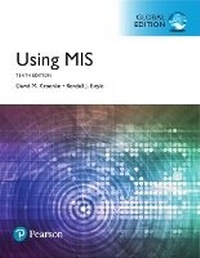
Using MIS, Global Edition + MyLab MIS with Pearson eText (Package)
10th Edition
Published on 6. February 2018
Book
Mixed media product
978-1-292-22261-5 (ISBN)
More details
Edition
10th edition
Language
English
Place of publication
Harlow
United Kingdom
Target group
Professional and scholarly
College/higher education
Dimensions
Height: 275 mm
Width: 220 mm
Thickness: 20 mm
Weight
1295 gr
ISBN-13
978-1-292-22261-5 (9781292222615)
Copyright in bibliographic data and cover images is held by Nielsen Book Services Limited or by the publishers or by their respective licensors: all rights reserved.
Schweitzer Classification
Other editions
Previous edition
David M. Kroenke | Randall J. Boyle
Using MIS plus MyMISLab with Pearson eText, Global Edition
Book
12/2016
9th Edition
Pearson Education Limited
€80.45
Article exhausted; check for reprint
Persons
David Kroenke has many years of teaching experience at Colorado State University, Seattle University, and the University of Washington. He has led dozens of seminars for college professors on the teaching of information systems and technology; in 1991, the International Association of Information Systems named him Computer Educator of the Year. In 2009, David was named Educator of the Year by the Association of Information Technology Professionals-Education Special Interest Group (AITP-EDSIG).
David worked for the U.S. Air Force and Boeing Computer Services. He was a principal in the startup of three companies, serving as the vice president of product marketing and development for the Microrim Corporation and as chief of database technologies for Wall Data, Inc. He is the father of the semantic object data model. David's consulting clients have included IBM, Microsoft, and Computer Sciences Corporations, as well as numerous smaller companies. Recently, David has focused on using information systems for teaching collaboration and teamwork.
His text Database Processing was first published in 1977 and is now in its 14th edition. He has authored and coauthored many other textbooks, including Database Concepts, 7th ed. (2015), Experiencing MIS, 7th ed. (2017), SharePoint for Students (2012), Office 365 in Business (2012), and Processes, Systems, and Information: An Introduction to MIS, 2nd ed. (2015).
Randall J . Boyle received his Ph.D. in Management Information Systems from Florida State University in 2003. He also has a master's degree in Public Administration and a B.S. in Finance. He has received university teaching awards at Longwood University, the University of Utah, and the University of Alabama in Huntsville. He has taught a wide variety of classes, including Introduction to MIS, Cyber Security, Networking & Servers, System Analysis and Design, Telecommunications, Advanced Cyber Security, Decision Support Systems, and Web Servers.
His research areas include deception detection in computer-mediated environments, secure information systems, the effects of IT on cognitive biases, the effects of IT on knowledge work- ers, and e-commerce. He has published in several academic journals and has authored several textbooks, including Experiencing MIS, 7th ed., Corporate Computer and Network Security, 4th ed., Applied Information Security, 2nd ed., and Applied Networking Labs, 2nd ed.
David worked for the U.S. Air Force and Boeing Computer Services. He was a principal in the startup of three companies, serving as the vice president of product marketing and development for the Microrim Corporation and as chief of database technologies for Wall Data, Inc. He is the father of the semantic object data model. David's consulting clients have included IBM, Microsoft, and Computer Sciences Corporations, as well as numerous smaller companies. Recently, David has focused on using information systems for teaching collaboration and teamwork.
His text Database Processing was first published in 1977 and is now in its 14th edition. He has authored and coauthored many other textbooks, including Database Concepts, 7th ed. (2015), Experiencing MIS, 7th ed. (2017), SharePoint for Students (2012), Office 365 in Business (2012), and Processes, Systems, and Information: An Introduction to MIS, 2nd ed. (2015).
Randall J . Boyle received his Ph.D. in Management Information Systems from Florida State University in 2003. He also has a master's degree in Public Administration and a B.S. in Finance. He has received university teaching awards at Longwood University, the University of Utah, and the University of Alabama in Huntsville. He has taught a wide variety of classes, including Introduction to MIS, Cyber Security, Networking & Servers, System Analysis and Design, Telecommunications, Advanced Cyber Security, Decision Support Systems, and Web Servers.
His research areas include deception detection in computer-mediated environments, secure information systems, the effects of IT on cognitive biases, the effects of IT on knowledge work- ers, and e-commerce. He has published in several academic journals and has authored several textbooks, including Experiencing MIS, 7th ed., Corporate Computer and Network Security, 4th ed., Applied Information Security, 2nd ed., and Applied Networking Labs, 2nd ed.
Content
I. Why MIS?
1. The Importance of MIS
2. Collaboration Information Systems
3. Strategy and Information Systems
II. Information Technology
4. Hardware, Software, and Mobile Systems
5. Database Processing
6. The Cloud
III. Using IS for Competitive Advantage
7. Processes, Organizations, and Information Systems
8. Social Media Information Systems
9. Business Intelligence Systems
IV. Information Systems Management
10. Information Systems Security
11. Information Systems Management
12. Information Systems Development
The International Dimension Application
Exercises
Glossary
1. The Importance of MIS
2. Collaboration Information Systems
3. Strategy and Information Systems
II. Information Technology
4. Hardware, Software, and Mobile Systems
5. Database Processing
6. The Cloud
III. Using IS for Competitive Advantage
7. Processes, Organizations, and Information Systems
8. Social Media Information Systems
9. Business Intelligence Systems
IV. Information Systems Management
10. Information Systems Security
11. Information Systems Management
12. Information Systems Development
The International Dimension Application
Exercises
Glossary