

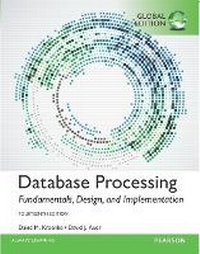
Database Processing: Fundamentals, Design, and Implementation, Global Edition
14th Edition
Published on 18. December 2015
Book
Paperback/Softback
640 pages
978-1-292-10763-9 (ISBN)
Description
For undergraduate database management courses.
Get Students Straight to the Point of Database Processing
Database Processing: Fundamentals, Design, and Implementation reflects a new teaching and professional workplace environment and method that gets students straight to the point with its thorough and modern presentation of database processing fundamentals.
Get Students Straight to the Point of Database Processing
Database Processing: Fundamentals, Design, and Implementation reflects a new teaching and professional workplace environment and method that gets students straight to the point with its thorough and modern presentation of database processing fundamentals.
More details
Edition
14th edition
Language
English
Place of publication
Harlow
United Kingdom
Target group
College/higher education
Professional and scholarly
Dimensions
Height: 275 mm
Width: 215 mm
Thickness: 20 mm
Weight
1246 gr
ISBN-13
978-1-292-10763-9 (9781292107639)
Copyright in bibliographic data and cover images is held by Nielsen Book Services Limited or by the publishers or by their respective licensors: all rights reserved.
Schweitzer Classification
Other editions
Additional editions
David M. Kroenke | David J. Auer
Database Processing: Fundamentals, Design, and Implementation, Global Edition
Fundamentals, Design, and Implementation, Global Edition
E-Book
02/2016
14th Edition
Pearson
from
€56.89
Available for download
Previous edition
David M. Kroenke | David Auer
Database Processing, International Edition
Book
10/2013
13th Edition
Pearson Education Limited
€77.98
Article exhausted; check for reprint
Persons
David Kroenke has many years of teaching experience at Colorado State University, Seattle University, and the University of Washington. He has led dozens of seminars for college professors on the teaching of information systems and technology; in 1991, the International Association of Information Systems named him Computer Educator of the Year. In 2009, David was named Educator of the Year by the Association of Information Technology Professionals-Education Special Interest Group (AITP-EDSIG).
David worked for the US Air Force and Boeing Computer Services. He was a principal in the startup of three companies, serving as the vice president of product marketing and development for the Microrim Corporation and as chief of database technologies for Wall Data, Inc. He is the father of the semantic object data model. David's consulting clients have included IBM, Microsoft, and Computer Sciences Corporations, as well as numerous smaller companies. Recently, David has focused on using information systems for teaching collaboration and teamwork.
David J. Auer is a senior instructor emeritus at the College of Business (CBE) of Western Washington University in Bellingham, WA. He served as Director of Information Systems and Technology Services at CBE from 1994 to 2014 and taught in CBE's Department of Decision Sciences from 1981 to 2015. Auer has taught CBE courses in quantitative methods, production and operations management, statistics, finance, and management information systems. Besides managing CBE's computer, network, and other technology resources, he also teaches management information systems courses. He has taught the principles of management information systems and business database development courses, and he was responsible for developing CBE's network infrastructure courses, including Computer Hardware and Operating Systems, Telecommunications, and Network Administration.
He holds a bachelor's degree in English literature from the University of Washington, and three degrees from Western Washington University?-?a bachelor's degree in mathematics and economics, a master's degree in economics, and a master's degree in counselling psychology. He served as a commissioned officer in the US Air Force, and he has also worked as an organisational development specialist and therapist for an employee assistance program (EAP).
David worked for the US Air Force and Boeing Computer Services. He was a principal in the startup of three companies, serving as the vice president of product marketing and development for the Microrim Corporation and as chief of database technologies for Wall Data, Inc. He is the father of the semantic object data model. David's consulting clients have included IBM, Microsoft, and Computer Sciences Corporations, as well as numerous smaller companies. Recently, David has focused on using information systems for teaching collaboration and teamwork.
David J. Auer is a senior instructor emeritus at the College of Business (CBE) of Western Washington University in Bellingham, WA. He served as Director of Information Systems and Technology Services at CBE from 1994 to 2014 and taught in CBE's Department of Decision Sciences from 1981 to 2015. Auer has taught CBE courses in quantitative methods, production and operations management, statistics, finance, and management information systems. Besides managing CBE's computer, network, and other technology resources, he also teaches management information systems courses. He has taught the principles of management information systems and business database development courses, and he was responsible for developing CBE's network infrastructure courses, including Computer Hardware and Operating Systems, Telecommunications, and Network Administration.
He holds a bachelor's degree in English literature from the University of Washington, and three degrees from Western Washington University?-?a bachelor's degree in mathematics and economics, a master's degree in economics, and a master's degree in counselling psychology. He served as a commissioned officer in the US Air Force, and he has also worked as an organisational development specialist and therapist for an employee assistance program (EAP).
Content
Part I: Getting Started
1. Introduction
2. Introduction to Structured Query Language
Part II: Database Design
3.The Relational Model and Normalization
4. Database Design Using Normalization
5. Data Modeling and the Entity-Relationship Model
6. Transforming Data Models in Database Designs
Part III: Database Implementation
7.SQL for Database Construction and Application Processing
8. Database Redesign
Part IV: Multiuser Database Processing
9. Managing Multiuser Databases
10.Managing Databases with SQL Server 2014, Oracle Database 12c, and MySQL 5.7
Online Chapter: 10A.Managing Databases with SQL Server 2014
Online Chapter: 10B.Managing Databases with Oracle 12c
Online Chapter: 10C.Managing Databases with MySQL 5.7
Part V: Database Access Standards
11. The Web Server Environment
12. Big Data, Data Warehouses, and Business Intelligence Systems
Online Appendix A. Getting Started with Microsoft Access 2013
Online Appendix B. Getting Started in Systems Analysis and Design
Online Appendix C. E-R Diagrams and the IDEF1X Standard
Online Appendix D. E-R Diagrams and the UML Standard
Online Appendix E. Getting Started with MySQL Workbench Data Modeling Tools
Online Appendix F. Getting Started with Microsoft Vision 2013
Online Appendix G. Data Structures for Database Processing
Online Appendix H. The Semantic Object Model
Online Appendix I. Getting Started with Web Servers, PHP and the Eclipse PDT
Online Appendix J. Business Intelligence Systems
Online Appendix K. Big Data
1. Introduction
2. Introduction to Structured Query Language
Part II: Database Design
3.The Relational Model and Normalization
4. Database Design Using Normalization
5. Data Modeling and the Entity-Relationship Model
6. Transforming Data Models in Database Designs
Part III: Database Implementation
7.SQL for Database Construction and Application Processing
8. Database Redesign
Part IV: Multiuser Database Processing
9. Managing Multiuser Databases
10.Managing Databases with SQL Server 2014, Oracle Database 12c, and MySQL 5.7
Online Chapter: 10A.Managing Databases with SQL Server 2014
Online Chapter: 10B.Managing Databases with Oracle 12c
Online Chapter: 10C.Managing Databases with MySQL 5.7
Part V: Database Access Standards
11. The Web Server Environment
12. Big Data, Data Warehouses, and Business Intelligence Systems
Online Appendix A. Getting Started with Microsoft Access 2013
Online Appendix B. Getting Started in Systems Analysis and Design
Online Appendix C. E-R Diagrams and the IDEF1X Standard
Online Appendix D. E-R Diagrams and the UML Standard
Online Appendix E. Getting Started with MySQL Workbench Data Modeling Tools
Online Appendix F. Getting Started with Microsoft Vision 2013
Online Appendix G. Data Structures for Database Processing
Online Appendix H. The Semantic Object Model
Online Appendix I. Getting Started with Web Servers, PHP and the Eclipse PDT
Online Appendix J. Business Intelligence Systems
Online Appendix K. Big Data