

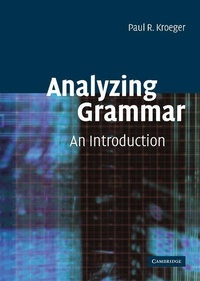
Analyzing Grammar
An Introduction
Published on 5. May 2005
Book
Hardback
384 pages
978-0-521-81622-9 (ISBN)
Description
Analyzing Grammar is a clear introductory textbook on grammatical analysis, designed for students beginning to study the discipline. Covering both syntax (the structure of phrases and sentences) and morphology (the structure of words), it equips them with the tools and methods needed to analyze grammatical patterns in any language. Students are shown how to use standard notational devices such as phrase structure trees and word-formation rules, as well as prose descriptions. Emphasis is placed on comparing the different grammatical systems of the world's languages, and students are encouraged to practice the analyses through a diverse range of problem sets and exercises. Topics covered include word order, constituency, case, agreement, tense, gender, pronoun systems, inflection, derivation, argument structure and grammatical relations, and a useful glossary provides a clear explanation of each term. Accessibly written and comprehensive, Analyzing Grammar is set to become a key text for all courses in grammatical analysis.
More details
Language
English
Place of publication
Cambridge
United Kingdom
Target group
College/higher education
Professional and scholarly
Illustrations
Worked examples or Exercises; 28 Line drawings, unspecified
Dimensions
Height: 250 mm
Width: 175 mm
Thickness: 25 mm
Weight
840 gr
ISBN-13
978-0-521-81622-9 (9780521816229)
Copyright in bibliographic data and cover images is held by Nielsen Book Services Limited or by the publishers or by their respective licensors: all rights reserved.
Schweitzer Classification
Other editions
Additional editions
E-Book
07/2005
1st Edition
Cambridge University Press
€41.49
Available for download
Person
Paul R. Kroeger is Associate Professor and Head of the Department of Linguistics at the Graduate Institute of Applied Linguistics, Dallas.
Content
1. Grammatical form; 2. Analyzing word structure; 3. Constituent structure; 4. Semantic roles and grammatical relations; 5. Lexical entries and well-formed clauses; 6. Noun phrases; 7. Case and agreement; 8. Noun classes and pronouns; 9. Tense, aspect and modality; 10. N on-verbal predicates; 11. Special sentences types; 12. Subordinate clauses; 13. Derivational morphology; 14. Valence-changing morphology; 15. Allomorphy; 16. Non-linear morphology; 17. Clitics.