

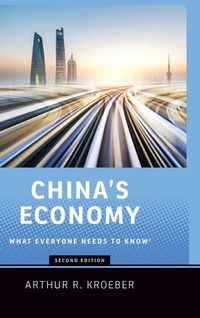
China's Economy
What Everyone Needs to Know (R)
2nd Edition
Published on 8. September 2020
Book
Hardback
454 pages
978-0-19-094647-0 (ISBN)
Description
China's economic growth has been revolutionary, and is the foundation of its increasingly prominent role in world affairs. It is the world's second biggest economy, the largest manufacturing and trading nation, the consumer of half the world's steel and coal, the biggest source of international tourists, and one of the most influential investors in developing countries from southeast Asia to Africa to Latin America. Multinational companies make billions of dollars in profits in China each year, while traders around the world shudder at every gyration of the country's unruly stock markets. Perhaps paradoxically, its capitalist economy is governed by an authoritarian Communist Party that shows no sign of loosening its grip.
China is frequently in the news, whether because of trade disputes, the challenges of its Belt and Road initiative for global infrastructure, or its increasing military strength. China's political and technological challenges, created by a country whose political system and values differ dramatically from most of the other major world economies, creates uncertainty and even fear.
China's Economy: What Everyone Needs to Know is a concise introduction to the most astonishing economic and political story of the last three decades. Arthur Kroeber enhances our understanding of China's changes and their implications. Among the essential questions he answers are: How did China grow so fast for so long? Can it keep growing and still solve its problems of environmental damage, fast-rising debt and rampant corruption? How long can its vibrant economy co-exist with the repressive one-party state? How do China's changes affect the rest of the world?
This thoroughly revised and updated second edition includes a comprehensive discussion of the origins and development of the US-China strategic rivalry, including Trump's trade war and the race for technological supremacy. It also explores the recent changes in China's political system, reflecting Xi Jinping's emergence as the most powerful leader since Mao Zedong. It includes insights on changes in China's financial sector, covering the rise and fall of the shadow banking sector, and China's increasing integration with global financial markets. And it covers China's rapid technological development and the rise of its global Internet champions such as Alibaba and Tencent.
China is frequently in the news, whether because of trade disputes, the challenges of its Belt and Road initiative for global infrastructure, or its increasing military strength. China's political and technological challenges, created by a country whose political system and values differ dramatically from most of the other major world economies, creates uncertainty and even fear.
China's Economy: What Everyone Needs to Know is a concise introduction to the most astonishing economic and political story of the last three decades. Arthur Kroeber enhances our understanding of China's changes and their implications. Among the essential questions he answers are: How did China grow so fast for so long? Can it keep growing and still solve its problems of environmental damage, fast-rising debt and rampant corruption? How long can its vibrant economy co-exist with the repressive one-party state? How do China's changes affect the rest of the world?
This thoroughly revised and updated second edition includes a comprehensive discussion of the origins and development of the US-China strategic rivalry, including Trump's trade war and the race for technological supremacy. It also explores the recent changes in China's political system, reflecting Xi Jinping's emergence as the most powerful leader since Mao Zedong. It includes insights on changes in China's financial sector, covering the rise and fall of the shadow banking sector, and China's increasing integration with global financial markets. And it covers China's rapid technological development and the rise of its global Internet champions such as Alibaba and Tencent.
Reviews / Votes
(This) Updated second edition explains how China's economy rose to its position today and where it might be headed in the coming years, highlighting China's increased relevance to the world since 2016. * Journal of Economic Literature * If the notion of a middle way sounds intuitively appealing, Arthur Kroeber's book brings rigour to the debate to show why it is also the most likely outcome. A longtime China analyst now managing an independent research firm, he launches an assault, albeit courteously worded, on conventional wisdom from the two opposing camps. What emerges is a nuanced take on an economy facing serious challenges, ones that do not spell its collapse but could prove intractable all the same. * The Economist* Thankfully Arthur Kroeber has [condensed] many years of studying and writing about the Chinese economy into a single-volume portrait accessible to the generalist. Aside from the clear descriptive prose and judicious organisation this book achieves two things. On the one hand it lays out a detailed framework of how China works that will be recognisable to experts, and accessible to newcomers, breaking the whole into a series of digestible parts. On the other hand it offers a layer of measured assessment aimed at addressing the full range of pressing issues affecting China. * Forbes
* Few have watched the development of the Chinese economy as closely as Arthur Kroeber. [China's Economy] is a wide-ranging and authoritative primer on the history and development of China's unique blend of decentralized economic authoritarianism. * Quartz
*
More details
Series
Edition
2nd Revised edition
Language
English
Place of publication
New York
United States
Edition type
Revised edition
Dimensions
Height: 235 mm
Width: 157 mm
Thickness: 29 mm
Weight
803 gr
ISBN-13
978-0-19-094647-0 (9780190946470)
Copyright in bibliographic data and cover images is held by Nielsen Book Services Limited or by the publishers or by their respective licensors: all rights reserved.
Schweitzer Classification
Other editions
Additional editions
Book
09/2020
2nd Edition
Oxford University Press Inc
€22.00
Shipment within 15-20 days
E-Book
06/2020
1st Edition
Oxford University Press
€131.87
Available for download
E-Book
06/2020
2nd Edition
OUP USA
€11.99
Available for download
Person
Arthur R. Kroeber is founding partner and managing director of Gavekal Dragonomics, a research firm focusing on China with offices in Hong Kong and Beijing. Before establishing Dragonomics in 2002, he spent 15 years as a financial and economic journalist in China and South Asia. He is senior non-resident fellow at the Brookings-Tsinghua Center in Beijing, adjunct professor at the Columbia University School of International and Public Affairs and at the NYU Stern School of Business, and a member of the National Committee on US-China Relations.
Content
Preface
Acknowledgments
1. Why China Matters
2. Population, Geography, and History
3. China's Political Economy
4. Agriculture, Land, and the Rural Economy
5. Industry, Exports, and Technology
6. Urbanization and Infrastructure
7. The Enterprise System
8. The Government Finance System
9. The Financial System
10. Energy and the Environment
11. Demographics and the Labor Market
12. The Emerging Consumer Economy
13. The Social Compact
14. Changing the Growth Model
15. China and the World: Is Conflict Inevitable?
For Further Reading
Notes
Index
Acknowledgments
1. Why China Matters
2. Population, Geography, and History
3. China's Political Economy
4. Agriculture, Land, and the Rural Economy
5. Industry, Exports, and Technology
6. Urbanization and Infrastructure
7. The Enterprise System
8. The Government Finance System
9. The Financial System
10. Energy and the Environment
11. Demographics and the Labor Market
12. The Emerging Consumer Economy
13. The Social Compact
14. Changing the Growth Model
15. China and the World: Is Conflict Inevitable?
For Further Reading
Notes
Index