

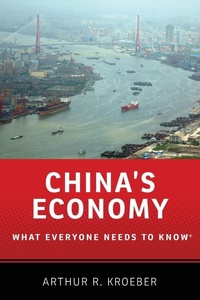
China's Economy
What Everyone Needs to Know (R)
Published on 28. April 2016
Book
Paperback/Softback
336 pages
978-0-19-023903-9 (ISBN)
Description
China is on track to exceed the United States as the world's largest economy in the next several years. It is already the leading global trading nation. Even though its growth rate has recently slowed from years past, China has had the fastest yearly growth rate of any country for much of the last three decades.
In China's Economy: What Everyone Needs to Know, Arthur Kroeber offers an overview of the highlights of China's development since economic reforms were initiated under Deng Xiaoping in 1979. He argues that manufacturing, agricultural change, and construction reoriented the economy in the 1980s and 1990s through state-owned enterprises, private entrepreneurship, and foreign investment. Those shifts unleashed perhaps the largest migration ever in world history from rural areas to urban
centers, accompanied by a no less unprecedented expansion of infrastructure. Changes in the country's fiscal and financial systems vastly increased China's monetary holdings from the 1990s onwards, leading to the country's strategic holding of more U.S. debt than any other nation. Kroeber also examines
economic growth as it has been experienced by Chinese workers and consumers, including the mounting problems of income and wealth inequality, corruption, and environmental degradation. Kroeber ultimately turns to the consequences of Chinese economic growth: its decisive impact on the world economy, its visible and challenging resource extraction from Africa and Latin America, and its increasing engagement with global economic institutions.
In China's Economy: What Everyone Needs to Know, Arthur Kroeber offers an overview of the highlights of China's development since economic reforms were initiated under Deng Xiaoping in 1979. He argues that manufacturing, agricultural change, and construction reoriented the economy in the 1980s and 1990s through state-owned enterprises, private entrepreneurship, and foreign investment. Those shifts unleashed perhaps the largest migration ever in world history from rural areas to urban
centers, accompanied by a no less unprecedented expansion of infrastructure. Changes in the country's fiscal and financial systems vastly increased China's monetary holdings from the 1990s onwards, leading to the country's strategic holding of more U.S. debt than any other nation. Kroeber also examines
economic growth as it has been experienced by Chinese workers and consumers, including the mounting problems of income and wealth inequality, corruption, and environmental degradation. Kroeber ultimately turns to the consequences of Chinese economic growth: its decisive impact on the world economy, its visible and challenging resource extraction from Africa and Latin America, and its increasing engagement with global economic institutions.
Reviews / Votes
For everyone who is interested in China as the biggest story of economic growth of all times or deoes business there, Kroeber provides an excellent, factual and often surprising presentation of China's development * TreasuryLog * Arthur Kroeber's book brings rigour to the debate ... A longtime China analyst now managing an independent research firm, he launches an assault, albeit courteously worded, on conventional wisdom from the two opposing camps. What emerges is a nuanced take on an economy facing serious challenges, ones that do not spell its collapse but could prove intractable all the same * Economist *More details
Series
Language
English
Place of publication
New York
United States
Target group
Professional and scholarly
Dimensions
Height: 210 mm
Width: 140 mm
Thickness: 18 mm
Weight
408 gr
ISBN-13
978-0-19-023903-9 (9780190239039)
Copyright in bibliographic data and cover images is held by Nielsen Book Services Limited or by the publishers or by their respective licensors: all rights reserved.
Schweitzer Classification
Other editions
Additional editions
Book
04/2016
Oxford University Press Inc
€59.41
Article exhausted; check different version
E-Book
03/2016
1st Edition
OUP USA
€11.99
Available for download
E-Book
03/2016
1st Edition
OUP eBook
€11.99
Available for download
Person
Arthur R. Kroeber is Nonresident Senior Fellow of Foreign Policy at Brookings-Tsinghua Center. Kroeber focuses on China's political economy and its engagement with global economic institutions. He is managing director of GaveKal Dragonomics, an independent global economic research firm, and editor of its journal China Economic Quarterly. He is based in Beijing, where he has lived since 2002. Before joining Dragonomics, Kroeber worked for 15 years as a
financial journalist and economic analyst in China, Taiwan and India. He has written for Foreign Policy, Economist, Far Eastern Economic Review, Fortune, and Wired and is a contributor to the opinion pages of Financial Times, Wall Street Journal and Washington Post. He is a member of the National Committee on
United States-China Relations, the Fernand Braudel Institute of International Economics and the board of the Research Center for Chinese Politics and Business at Indiana University.
financial journalist and economic analyst in China, Taiwan and India. He has written for Foreign Policy, Economist, Far Eastern Economic Review, Fortune, and Wired and is a contributor to the opinion pages of Financial Times, Wall Street Journal and Washington Post. He is a member of the National Committee on
United States-China Relations, the Fernand Braudel Institute of International Economics and the board of the Research Center for Chinese Politics and Business at Indiana University.
Content
1. Overview: China's Reform Trajectory Since 1978
2. Agriculture and the Rural Economy
3. Industry and the Rise of the Export Machine
4. Urbanization and Infrastructure
5. Enterprises: State-Owned vs. Private
6. The Fiscal System and Central-Local Relations
7. The Financial System and the Exchange Rate
8. Demographics and the Labor Market
9. The Emerging Consumer Economy
10. The Social Compact: Inequality, Corruption, and the Environment
11. Changing the Growth Model: Can It Be Done?
12. China as Number One: What Does it Mean for the Rest of the World?
2. Agriculture and the Rural Economy
3. Industry and the Rise of the Export Machine
4. Urbanization and Infrastructure
5. Enterprises: State-Owned vs. Private
6. The Fiscal System and Central-Local Relations
7. The Financial System and the Exchange Rate
8. Demographics and the Labor Market
9. The Emerging Consumer Economy
10. The Social Compact: Inequality, Corruption, and the Environment
11. Changing the Growth Model: Can It Be Done?
12. China as Number One: What Does it Mean for the Rest of the World?