

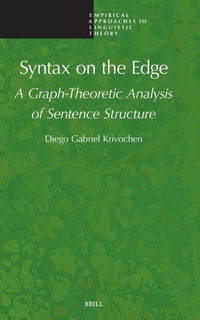
Syntax on the Edge
A Graph-Theoretic Analysis of Sentence Structure
Published on 24. August 2023
Book
Hardback
516 pages
978-90-04-54142-9 (ISBN)
Description
What is the most descriptively and explanatorily adequate format for syntactic structures and how are they constrained? Different theories of syntax have provided various answers: sets, feature structures, tree diagrams... Building on formal and empirical insights from a wide variety of approaches spanning more than 70 years (including Transformational Grammar, Relational Grammar, Lexical-Functional Grammar, and Tree Adjoining Grammar), this monograph develops a new, mathematically grounded, framework in which objects known as graphs, and the constraints that follow from them, are argued to provide the best characterisation of the system of expressions and relations that make up natural language grammars. This new approach is motivated and exemplified via detailed and formally explicit analyses of major syntactic phenomena in English and Spanish.
More details
Series
Language
English
Place of publication
Leiden
Netherlands
Target group
Professional and scholarly
Product notice
sewn/stitched
Cloth over boards
Dimensions
Height: 236 mm
Width: 157 mm
Thickness: 25 mm
Weight
699 gr
ISBN-13
978-90-04-54142-9 (9789004541429)
Copyright in bibliographic data and cover images is held by Nielsen Book Services Limited or by the publishers or by their respective licensors: all rights reserved.
Schweitzer Classification
Person
Diego Gabriel Krivochen, Ph.D. (2018), University of Reading, is currently a Lecturer in Syntax at the University of Oxford. He has published on theoretical syntax, English and Spanish grammar, and implicit learning of artificial grammars.
Content
Preface
Acknowledgments
List of Figures
Abbreviations
1 Introduction: Setting the Scene
?1.1?Methodological and Historical Context
?1.2?Transformations and the Preservation of Relations
?1.3?Declarative vs. Procedural Syntax
?1.4?On Graphs and Phrase Markers: First- and Second-Order Conditions on Structural Representations
?1.5?Structural Uniformity (and Two Ways to Fix It)
?1.6?You Only Have One Mother
2 Fundamentals of Graph-Theoretic Syntax
?2.1?Defining (L-)Graphs
?2.2?Syntactic Composition and Semantic Interpretation
?2.3?Adjacency Matrices and Arcs: More on Allowed Relations
3 A Proof of Concept: Discontinuous Constituents
4 Some Inter-Theoretical Comparisons
?4.1?Multiple-Gap Relative Constructions
?4.2?Dependencies and Rootedness
?4.3?Crossing Dependencies
5 Ordered Relations and Grammatical Functions
?5.1?A Categorial Excursus on Unaccusatives and Expletives
6 Towards an Analysis of English Predicate Complement Constructions
?6.1?Raising to Subject
?6.2?Raising to Object
?6.3?Object-Controlled Equi
?6.4?Subject-Controlled Equi
?6.5?A Note on Raising and Polarity: 'Opacity' Revisited
7 More on Cross-Arboreal Relations: Parentheticals and Clitic Climbing in Spanish
?7.1?Discontinuity and Clitic Climbing in Spanish Auxiliary Chains
8 On Unexpected Binding Effects: a Graph-Theoretic Approach to Binding Theory
?8.1?Grafts and Graphs
9 Complementation within the NP
10 Wh-Interrogatives: Aspects of Syntax and Semantics
?10.1?Simple Wh-Questions
11 MIG s and Prizes
12 The Structural Heterogeneity of Coordinations
13 A Small Collection of Transformations
?13.1?Passivisation
?13.2?Dative Shift
?13.3?Transformations vs. Alternations
14 Some Open Problems and Questions
?14.1?A Note on Leftward and Rightward Extractions
?14.2?Deletion without Deletion
?14.3?Long Distance Dependencies and Resumptive Pronouns
?14.4?Identity Issues in Local Reflexive Anaphora
?14.5?Ghost in the Graph
?14.6?A Derivational Alternative?
?14.7?Future Prospects
15 Concluding Remarks
Appendix: Some Notes on (Other) Graph-Based Approaches
References
Index
Acknowledgments
List of Figures
Abbreviations
1 Introduction: Setting the Scene
?1.1?Methodological and Historical Context
?1.2?Transformations and the Preservation of Relations
?1.3?Declarative vs. Procedural Syntax
?1.4?On Graphs and Phrase Markers: First- and Second-Order Conditions on Structural Representations
?1.5?Structural Uniformity (and Two Ways to Fix It)
?1.6?You Only Have One Mother
2 Fundamentals of Graph-Theoretic Syntax
?2.1?Defining (L-)Graphs
?2.2?Syntactic Composition and Semantic Interpretation
?2.3?Adjacency Matrices and Arcs: More on Allowed Relations
3 A Proof of Concept: Discontinuous Constituents
4 Some Inter-Theoretical Comparisons
?4.1?Multiple-Gap Relative Constructions
?4.2?Dependencies and Rootedness
?4.3?Crossing Dependencies
5 Ordered Relations and Grammatical Functions
?5.1?A Categorial Excursus on Unaccusatives and Expletives
6 Towards an Analysis of English Predicate Complement Constructions
?6.1?Raising to Subject
?6.2?Raising to Object
?6.3?Object-Controlled Equi
?6.4?Subject-Controlled Equi
?6.5?A Note on Raising and Polarity: 'Opacity' Revisited
7 More on Cross-Arboreal Relations: Parentheticals and Clitic Climbing in Spanish
?7.1?Discontinuity and Clitic Climbing in Spanish Auxiliary Chains
8 On Unexpected Binding Effects: a Graph-Theoretic Approach to Binding Theory
?8.1?Grafts and Graphs
9 Complementation within the NP
10 Wh-Interrogatives: Aspects of Syntax and Semantics
?10.1?Simple Wh-Questions
11 MIG s and Prizes
12 The Structural Heterogeneity of Coordinations
13 A Small Collection of Transformations
?13.1?Passivisation
?13.2?Dative Shift
?13.3?Transformations vs. Alternations
14 Some Open Problems and Questions
?14.1?A Note on Leftward and Rightward Extractions
?14.2?Deletion without Deletion
?14.3?Long Distance Dependencies and Resumptive Pronouns
?14.4?Identity Issues in Local Reflexive Anaphora
?14.5?Ghost in the Graph
?14.6?A Derivational Alternative?
?14.7?Future Prospects
15 Concluding Remarks
Appendix: Some Notes on (Other) Graph-Based Approaches
References
Index