

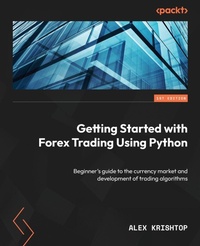
Getting Started with Forex Trading Using Python
Beginner's guide to the currency market and development of trading algorithms
Published on 17. March 2023
Book
Paperback/Softback
384 pages
978-1-80461-685-7 (ISBN)
Description
Discover the inner workings of today's forex market, the essential risks in forex algo trading, and how to mitigate them
Key Features
Build trading applications with research and without advanced Python programming skills
Dive into professional fx trading while enhancing your trading apps to be more accurate
Develop simple yet efficient backtesting applications to help keep your expectations realistic
Book DescriptionAlgorithm-based trading is a popular choice for Python programmers due to its apparent simplicity. However, very few traders get the results they want, partly because they aren't able to capture the complexity of the factors that influence the market. Getting Started with Forex Trading Using Python helps you understand the market and build an application that reaps desirable results.
The book is a comprehensive guide to everything that is market-related: data, orders, trading venues, and risk. From the programming side, you'll learn the general architecture of trading applications, systemic risk management, de-facto industry standards such as FIX protocol, and practical examples of using simple Python codes. You'll gain an understanding of how to connect to data sources and brokers, implement trading logic, and perform realistic tests. Throughout the book, you'll be encouraged to further study the intricacies of algo trading with the help of code snippets.
By the end of this book, you'll have a deep understanding of the fx market from the perspective of a professional trader. You'll learn to retrieve market data, clean it, filter it, compress it into various formats, apply trading logic, emulate the execution of orders, and test the trading app before trading live.What you will learn
Explore the forex market organization and operations
Understand the sources of alpha and the concept of algo trading
Get a grasp on typical risks and ways to mitigate them
Understand fundamental and technical analysis
Connect to data sources and check the integrity of market data
Use API and FIX protocol to send orders
Translate trading ideas into code
Run reliable backtesting emulating real-world market conditions
Who this book is forThis book is for financial traders and python developers who are interested in forex trading. Academic researchers looking to focus on practical applications will find this book useful. This book can also help established fx market professionals who want to take the first steps in algo trading. Familiarity with Python and object-oriented programming within the scope of an online course or self-study is a must. Knowledge of network protocols and interfaces is a plus but not a prerequisite, as is specific knowledge about markets and trading.
Key Features
Build trading applications with research and without advanced Python programming skills
Dive into professional fx trading while enhancing your trading apps to be more accurate
Develop simple yet efficient backtesting applications to help keep your expectations realistic
Book DescriptionAlgorithm-based trading is a popular choice for Python programmers due to its apparent simplicity. However, very few traders get the results they want, partly because they aren't able to capture the complexity of the factors that influence the market. Getting Started with Forex Trading Using Python helps you understand the market and build an application that reaps desirable results.
The book is a comprehensive guide to everything that is market-related: data, orders, trading venues, and risk. From the programming side, you'll learn the general architecture of trading applications, systemic risk management, de-facto industry standards such as FIX protocol, and practical examples of using simple Python codes. You'll gain an understanding of how to connect to data sources and brokers, implement trading logic, and perform realistic tests. Throughout the book, you'll be encouraged to further study the intricacies of algo trading with the help of code snippets.
By the end of this book, you'll have a deep understanding of the fx market from the perspective of a professional trader. You'll learn to retrieve market data, clean it, filter it, compress it into various formats, apply trading logic, emulate the execution of orders, and test the trading app before trading live.What you will learn
Explore the forex market organization and operations
Understand the sources of alpha and the concept of algo trading
Get a grasp on typical risks and ways to mitigate them
Understand fundamental and technical analysis
Connect to data sources and check the integrity of market data
Use API and FIX protocol to send orders
Translate trading ideas into code
Run reliable backtesting emulating real-world market conditions
Who this book is forThis book is for financial traders and python developers who are interested in forex trading. Academic researchers looking to focus on practical applications will find this book useful. This book can also help established fx market professionals who want to take the first steps in algo trading. Familiarity with Python and object-oriented programming within the scope of an online course or self-study is a must. Knowledge of network protocols and interfaces is a plus but not a prerequisite, as is specific knowledge about markets and trading.
More details
Language
English
Place of publication
Birmingham
United Kingdom
Target group
Professional and scholarly
Dimensions
Height: 235 mm
Width: 191 mm
Thickness: 21 mm
Weight
715 gr
ISBN-13
978-1-80461-685-7 (9781804616857)
Copyright in bibliographic data and cover images is held by Nielsen Book Services Limited or by the publishers or by their respective licensors: all rights reserved.
Schweitzer Classification
Other editions
Additional editions
Alex Krishtop
Getting Started with Forex Trading Using Python
Beginner's guide to the currency market and development of trading algorithms
E-Book
05/2024
1st Edition
Packt Publishing Limited
from
€27.59
Available for download
Person
Alexey Krishtop is a quantitative trader and researcher with 20 years of experience in developing automated trading solutions. He is currently the head of trading and research at Edgesense Technologies and CTO at ForexVox Ltd. He develops market models and trading algorithms for FX, commodities, and crypto. He was one of the first traders who started using Python as the ultimate environment for quantitative trading and suggested a few approaches to developing trading apps that, today, have become standard among many quant traders. He has worked as a director of education with the Algorithmic Traders Association, where he developed an exhaustive course in systematic and algo trading, which covers the worlds of both quantitative models and discretionary approaches.
Content
Table of Contents
Developing Trading Strategies - Why They Are Different
Using Python for Trading Strategies
FX Market Overview from a Developer's Standpoint
Trading Application - What's Inside?
Retrieving and Handling Market Data with Python
Basics of Fundamental Analysis and Its Possible Use in FX Trading
Technical Analysis and Its Implementation in Python
Data Visualization in FX Trading with Python
Trading Strategies and Their Core Elements
Types of Orders and Their Simulation in Python
Backtesting and Theoretical Performance
Sample Strategy - Trend-Following
To Trade or Not to Trade - Performance Analysis
Where to Go Now?
Developing Trading Strategies - Why They Are Different
Using Python for Trading Strategies
FX Market Overview from a Developer's Standpoint
Trading Application - What's Inside?
Retrieving and Handling Market Data with Python
Basics of Fundamental Analysis and Its Possible Use in FX Trading
Technical Analysis and Its Implementation in Python
Data Visualization in FX Trading with Python
Trading Strategies and Their Core Elements
Types of Orders and Their Simulation in Python
Backtesting and Theoretical Performance
Sample Strategy - Trend-Following
To Trade or Not to Trade - Performance Analysis
Where to Go Now?