

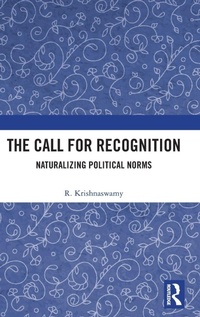
The Call for Recognition
Naturalizing Political Norms
1st Edition
Published on 24. March 2023
Book
Hardback
200 pages
978-0-367-64056-9 (ISBN)
Description
This book builds a case for how social norms are neither mere conventions nor are they merely anthropological phenomena, which are relativistic. In other words, it talks about how socio-political norms are built out of our natural social behaviour but at the same time also have objective normative validity.
The volume puts forth an alternative model called the recognitional model which can help us address some of the socio-political concerns we face in today's world. It addresses the problem with a purely legalistic framework of addressing social injustice in that law, due its universalistic assumptions, regarding human nature, tends to glide over the particular differences that might exist between people. This book discusses how we know that in our daily lives, we value people not only because that person is a legal human being but also because that person is our father, mother, our teacher, etc. There is a whole network of acts of social respect that we engage in with the other in our social sphere which the legal framework can't quite capture. This volume sheds light on the political consequence of legal reasoning in that it is formalistic in the sense that legal relations can't successfully codify the immediate epistemic context from which social identities emerge.
An introspective work, this book will be of great interest to scholars and researchers of linguistics, political philosophy, law and human rights, and social theory.
The volume puts forth an alternative model called the recognitional model which can help us address some of the socio-political concerns we face in today's world. It addresses the problem with a purely legalistic framework of addressing social injustice in that law, due its universalistic assumptions, regarding human nature, tends to glide over the particular differences that might exist between people. This book discusses how we know that in our daily lives, we value people not only because that person is a legal human being but also because that person is our father, mother, our teacher, etc. There is a whole network of acts of social respect that we engage in with the other in our social sphere which the legal framework can't quite capture. This volume sheds light on the political consequence of legal reasoning in that it is formalistic in the sense that legal relations can't successfully codify the immediate epistemic context from which social identities emerge.
An introspective work, this book will be of great interest to scholars and researchers of linguistics, political philosophy, law and human rights, and social theory.
More details
Language
English
Place of publication
London
United Kingdom
Publishing group
Taylor & Francis Ltd
Target group
College/higher education
Professional and scholarly
Academic and Postgraduate
Dimensions
Height: 240 mm
Width: 161 mm
Thickness: 16 mm
Weight
487 gr
ISBN-13
978-0-367-64056-9 (9780367640569)
Copyright in bibliographic data and cover images is held by Nielsen Book Services Limited or by the publishers or by their respective licensors: all rights reserved.
Schweitzer Classification
Other editions
Additional editions
Book
10/2024
1st Edition
Routledge India
€62.00
Shipment within 15-20 days
E-Book
03/2023
1st Edition
Routledge India
€53.99
Available for download
E-Book
03/2023
1st Edition
Routledge India
€53.99
Available for download
Person
R. Krishnaswamy is Associate Professor and Co-Director for the Centre for Social and Political Research, O.P. Jindal Global University, India. He has a Ph.D. from the University of Delhi in Philosophy. He has held a research fellowship at the University of Carleton, Ottawa, Canada. He has recently been a HESP/CEU post-doctoral fellow in the Philosophy Department at Central European University, Budapest, Hungary (now in Vienna). His research interests criss-cross across various disciplines. He works on issues related to the philosophy of mind and language.
Content
1. Introduction 2. Situating Recognition 3. Pluralism and Social Recognition 4. A Critique of Modern Institutions 5. Towards a New Ethical Paradigm 6. Socio-Natural Embeddedness 7. Socio-cultural Norms in the Public Place 8. Towards a Naturalistic Paradigm of Norms 9. Conclusion: Lifeworld, Norms and Politics. References.