

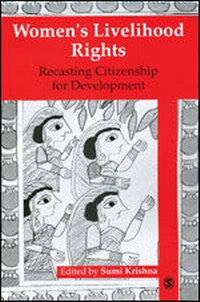
Women's Livelihood Rights
Recasting Citizenship for Development
1st Edition
Published on 18. September 2007
Book
Hardback
420 pages
978-0-7619-3600-8 (ISBN)
Description
This interdisciplinary book looks at women`s natural resource-based livelihoods in the wider context of development viewed through the lens of citizenship rights. Unravelling the patriarchal social fabric and policy structures in India, it argues that the concept of citizenship needs to be extended to include recognition of ways of life and livelihood, so that women take their legitimate space as productive human beings, entitled to dignity as a political right, and not merely to protection and welfare.
The editor weaves together a historical perspective on varied dimensions of livelihood, development and citizenship. Drawing upon rich field-based researches in 13 states across India, the authors deal with complex and inter-related themes: the need to recognise women`s right to resources and their livelihood and employment strategies; the challenges of democratic governance and of restructuring institutional systems to make them responsive; and the role of women`s collective agency in development.
Reflecting upon and critically analysing context-specific issues in several less-studied locations, the book shows that there is much to be learnt from empathetic interaction with the collective struggles of poor women, and from action and dialogue on the ground. Further, it suggests that feminist politics has to network strategically with other struggles to counter the resistance of traditional and contemporary patriarchal structures, and to work towards recasting citizenship for a gender-just development that ensures women`s livelihood rights.
The editor weaves together a historical perspective on varied dimensions of livelihood, development and citizenship. Drawing upon rich field-based researches in 13 states across India, the authors deal with complex and inter-related themes: the need to recognise women`s right to resources and their livelihood and employment strategies; the challenges of democratic governance and of restructuring institutional systems to make them responsive; and the role of women`s collective agency in development.
Reflecting upon and critically analysing context-specific issues in several less-studied locations, the book shows that there is much to be learnt from empathetic interaction with the collective struggles of poor women, and from action and dialogue on the ground. Further, it suggests that feminist politics has to network strategically with other struggles to counter the resistance of traditional and contemporary patriarchal structures, and to work towards recasting citizenship for a gender-just development that ensures women`s livelihood rights.
Reviews / Votes
The book looks at women's resource based livelihood in the wider context of development viewed through lens of citizenship rights... The book will be of interest to a wide variety of readers including research institutions, NGOs, donor agencies, practitioners and students working in the field of gender, environment, development and natural resource management. The editor and contributors deserve compliments of the readers for their endeavour. A useful contribution. -- Indian Journal of Public Administration The book is not simply about the constraints on women. It is rather an anthology of compelling stories of grassroots struggles by women for their livelihood and citizenship rights...the introduction by Sumi Krishna provides the reader with a good historical and theoretical understanding of development, livelihood and citizenship...there should be no doubt about the utility of the book. With its fresh perspectives and insights, it is sure to be useful for research institutions, NGOs and individual researchers working in the field of gender and development, natural resource management and livelihood policy. -- Indian Journal of Gender Studies The essays in this volume provide a rich wealth of information and analysis....a rich grounded set of studies that provides analyses that will be informative to scholars interested in development, gender and equity as well as to activists and policymakers in the field of economic development. -- The Book Review Women's Livelihood Rights is a good body of research that reads the gaps and fissures in the implementation of policies laid down for the betterment of women. An interdisciplinary book, it dexterously weaves together a historical perspective on varied dimensions of women's livelihood, development and citizenship. -- The Tribune The book weaves together a historical perspective on different dimensions of livelihood, development and citizenship. It argues that the concept of citizenship must include ways of life and livelihood to enable women to take their legitimate space as productive human beings. -- The Asian Age A significant contribution in a valuable compilation indeed. -- Statesman The strong message across this volume is that feminist policies have to network strategicaly with other struggles in order to counter the resistance of traditional and contmporary patriarchal structures, and to work towards recasting ciizenship for a gender-positive development that ensures women's livelihood rights. -- Development AlternativesMore details
Edition
First Edition
Language
English
Place of publication
Thousand Oaks
United States
Target group
College/higher education
Professional and scholarly
Dimensions
Height: 216 mm
Width: 140 mm
Weight
582 gr
ISBN-13
978-0-7619-3600-8 (9780761936008)
Copyright in bibliographic data and cover images is held by Nielsen Book Services Limited or by the publishers or by their respective licensors: all rights reserved.
Schweitzer Classification
Person
Sumi Krishna is a distinguished independent scholar and former President of the Indian Association for Women's Studies. She has over 40 years of experience in environment, development and gender, encompassing biodiversity, natural resource management, people's movements and livelihood issues; has advised universities and institutions on integrating science and social science curricula and methodologies. She is a widely published author and is based in Bengaluru.
Content
Preface
Recasting Citizenship for Women's Livelihood and Development - Sumi Krishna
PART ONE: RECOGNITION AND RESOURCE RIGHTS
Whose Rights? Women in Pastoralist and Shifting Cultivation Communities: A Continuing Struggle for Recognition and Rights to Livelihood Resources - Sagari R Ramdas and Nitya S Ghotge
Transgressing Political Spaces and Claiming Citizenship: The Case of Women Kendu Leaf Pluckers and the Community Forestry Federation, Ranapur, Orissa - Neera M Singh
Legal Identity and Natural Resource Management: The Foraging Irula Women of Killai, Cuddalore District, Tamil Nadu - Thamizoli and Ignatius Prabhakar
PART TWO: WORK AND EMPLOYMENT STRATEGIES
Marginal Lives in Marginal Lands: Livelihood Strategies of Women-headed, Immigrant Households on the 'Char' lands of the River Damodar, West Bengal - Gopa Samanta and Kuntala Lahiri-Dutt
Migrant Tribal Women's Struggle for Livelihood: A Study of the Employment Assurance Scheme in Jhabua, Madhya Pradesh - Sandeep Joshi
PART THREE: THE CHALLENGE OF DEMOCRATIC GOVERNANCE - Chhaya Datar Restructuring the Employment Guarantee Scheme: Efforts to Provide Livelihood Opportunities through Women's SHGs and Horticulture in Maharashtra
In the Name of the Community: Gender, Development and Governance in Arunachal Pradesh - Deepak K Mishra and Vandana Upadhyay
The Reinforcement of Gender Stereotypes through Modern Education: The Case of Mizoram - B Lakshmi
PART FOUR: RESTRUCTURING INSTITUTIONAL SYSTEMS
Mainstreaming Gender in Agricultural Research and Extension: How do we Move beyond Efficiency Arguments? - Meghana Kelkar
Women and Water Policy: Issues and Alternatives - Seema Kulkarni
Do Property Rights in Land Ensure Greater Participation of Women in Resource Management? Notes from a Study in Rural Karnataka - M Indira
'Just' Laws are not enough: A Note on the Common Civil Code, Marriage and Inheritance in Goa - Shaila Desouza
PART FIVE: WOMEN'S COLLECTIVE AGENCY, DEVELOPMENT AND CITIZENSHIP
The Sangha Mane: The Translation of an Internal Need into a Physical Space - Vinalini Mathrani and Vani Periodi
SHGs as Change Agents in Enhancing the Political Participation of Women in Local Self-Governance - Mandakini Pant
Exploring Linkages between Citizenship, Livelihood Security and Gender Equality: Planned Interventions and Outcomes in Rajasthan - Shobhita Rajagopal
PART SIX: DIGNITY IN STRUGGLE: LESSONS FROM THE PAST
Women's Development under Patriarchy: The Experience of the Sathins - Rajesh Ramakrishnan, Viren Lobo and Depinder Kapur
Index
Recasting Citizenship for Women's Livelihood and Development - Sumi Krishna
PART ONE: RECOGNITION AND RESOURCE RIGHTS
Whose Rights? Women in Pastoralist and Shifting Cultivation Communities: A Continuing Struggle for Recognition and Rights to Livelihood Resources - Sagari R Ramdas and Nitya S Ghotge
Transgressing Political Spaces and Claiming Citizenship: The Case of Women Kendu Leaf Pluckers and the Community Forestry Federation, Ranapur, Orissa - Neera M Singh
Legal Identity and Natural Resource Management: The Foraging Irula Women of Killai, Cuddalore District, Tamil Nadu - Thamizoli and Ignatius Prabhakar
PART TWO: WORK AND EMPLOYMENT STRATEGIES
Marginal Lives in Marginal Lands: Livelihood Strategies of Women-headed, Immigrant Households on the 'Char' lands of the River Damodar, West Bengal - Gopa Samanta and Kuntala Lahiri-Dutt
Migrant Tribal Women's Struggle for Livelihood: A Study of the Employment Assurance Scheme in Jhabua, Madhya Pradesh - Sandeep Joshi
PART THREE: THE CHALLENGE OF DEMOCRATIC GOVERNANCE - Chhaya Datar Restructuring the Employment Guarantee Scheme: Efforts to Provide Livelihood Opportunities through Women's SHGs and Horticulture in Maharashtra
In the Name of the Community: Gender, Development and Governance in Arunachal Pradesh - Deepak K Mishra and Vandana Upadhyay
The Reinforcement of Gender Stereotypes through Modern Education: The Case of Mizoram - B Lakshmi
PART FOUR: RESTRUCTURING INSTITUTIONAL SYSTEMS
Mainstreaming Gender in Agricultural Research and Extension: How do we Move beyond Efficiency Arguments? - Meghana Kelkar
Women and Water Policy: Issues and Alternatives - Seema Kulkarni
Do Property Rights in Land Ensure Greater Participation of Women in Resource Management? Notes from a Study in Rural Karnataka - M Indira
'Just' Laws are not enough: A Note on the Common Civil Code, Marriage and Inheritance in Goa - Shaila Desouza
PART FIVE: WOMEN'S COLLECTIVE AGENCY, DEVELOPMENT AND CITIZENSHIP
The Sangha Mane: The Translation of an Internal Need into a Physical Space - Vinalini Mathrani and Vani Periodi
SHGs as Change Agents in Enhancing the Political Participation of Women in Local Self-Governance - Mandakini Pant
Exploring Linkages between Citizenship, Livelihood Security and Gender Equality: Planned Interventions and Outcomes in Rajasthan - Shobhita Rajagopal
PART SIX: DIGNITY IN STRUGGLE: LESSONS FROM THE PAST
Women's Development under Patriarchy: The Experience of the Sathins - Rajesh Ramakrishnan, Viren Lobo and Depinder Kapur
Index