

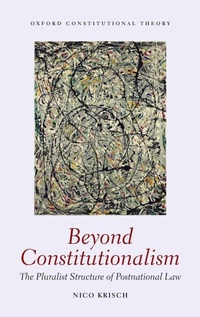
Beyond Constitutionalism
The Pluralist Structure of Postnational Law
1st Edition
Published on 28. October 2010
Book
Hardback
384 pages
978-0-19-922831-7 (ISBN)
Description
Under pressure from globalisation, the classical distinction between domestic and international law has become increasingly blurred, spurring demand for new paradigms to construe the emerging postnational legal order. The typical response of constitutional and international lawyers as well as political theorists has been to extend domestic concepts - especially constitutionalism - beyond the state. Yet as this book argues, proposals for postnational constitutionalism not only fail to provide a plausible account of the changing shape of postnational law but also fall short as a normative vision. They either dilute constitutionalism's origins and appeal to 'fit' the postnational space; or they create tensions with the radical diversity of postnational society.
This book explores an alternative, pluralist vision of postnational law. Pluralism does not rely on an overarching legal framework but is characterised by the heterarchical interaction of various suborders of different levels - an interaction that is governed by a multiplicity of conflict rules whose mutual relationship remains legally open. A pluralist model can account for the fragmented structure of the European and global legal orders and it reflects the competing (and often equally legitimate) claims for control of postnational politics. However, it typically provokes concerns about stability, power and the rule of law.
This book analyses the promise and problems of pluralism through a theoretical enquiry and empirical research on major global governance regimes, including the European human rights regime, the contestation around UN sanctions and human rights, and the structure of global risk regulation. The empirical research reveals how prevalent pluralist structures are in postnational law and what advantages they possess over constitutionalist models. Despite the problems it also reveals, the analysis suggests cautious optimism about the possibility of stable and fair cooperation in pluralist settings.
This book explores an alternative, pluralist vision of postnational law. Pluralism does not rely on an overarching legal framework but is characterised by the heterarchical interaction of various suborders of different levels - an interaction that is governed by a multiplicity of conflict rules whose mutual relationship remains legally open. A pluralist model can account for the fragmented structure of the European and global legal orders and it reflects the competing (and often equally legitimate) claims for control of postnational politics. However, it typically provokes concerns about stability, power and the rule of law.
This book analyses the promise and problems of pluralism through a theoretical enquiry and empirical research on major global governance regimes, including the European human rights regime, the contestation around UN sanctions and human rights, and the structure of global risk regulation. The empirical research reveals how prevalent pluralist structures are in postnational law and what advantages they possess over constitutionalist models. Despite the problems it also reveals, the analysis suggests cautious optimism about the possibility of stable and fair cooperation in pluralist settings.
Reviews / Votes
In this eloquently written and well-documented book, Krisch embraces legal pluralism as a promising way to deal with postnational law that is characterized by an international legal order in which the centre of gravity ha[s] shifted away from the nation-state. * Tom de Boer, Leiden Journal of International Law * Krisch in this book not only presents a systematic defense of the pluralist view but also provides an incisive diagnosis of the state of our globalizing world. * Ming-Sung Kuo, Law and Politics Book Review * Krisch's book is a pleasure to read. It contains a clearly written, original and thought-provoking defense of a pluralist understanding of postnational law. * Wouter Werner, Edinburgh Law Review * Reviewing this book has been an enormously edifying experience...[The] book...explores important ideas and suggests new ways forward. * Modern Law Review * Nico Krisch has written one of the most lucid and circumspect contributions, which is likely to show significant repercussions in the field...In sum, Nico Krisch has written a truly wonderful book. * Ingo Venzke, International Law and Politics *More details
Series
Language
English
Place of publication
Oxford
United Kingdom
Target group
College/higher education
Academics and students working in constitutional theory, international law and governance, or legal and political theory.
Dimensions
Height: 240 mm
Width: 161 mm
Thickness: 25 mm
Weight
740 gr
ISBN-13
978-0-19-922831-7 (9780199228317)
Copyright in bibliographic data and cover images is held by Nielsen Book Services Limited or by the publishers or by their respective licensors: all rights reserved.
Schweitzer Classification
Other editions
Additional editions
Book
09/2012
Oxford University Press
€74.28
Shipment within 15-20 days
E-Book
09/2012
1st Edition
OUP eBook
€37.99
Available for download
Person
Nico Krisch is a Professor of International Law at the Hertie School of Governance in Berlin, where he moved in 2009 after being a Senoat the Law Department of the London School of Economics and Political Science. Previously, he held research positions at Merton College, Oxford, NYU Law School and the Max Planck Institute for International Law in Heidelberg. He is the author of Selbstverteidigung und kollektive Sicherheit (Self-defense and Collective Security, 2001), a co-editor of The Emergence of Global Administrative Law (Law & Contemporary Problems, 2005), and of articles on United Nations law, on hegemony in international law, and on the legal order of global governance. He is also a member of the Executive Board of the European Society of International Law.
Content
PART I: VISIONS OF POSTNATIONAL LAW ; 1. Postnational Law in Search of a Structure ; 2. The Promise and Perils of Postnational Constitutionalism ; 3. The Case for Pluralism ; PART II: PLURALISM IN POSTNATIONAL PRACTICE ; 4. The Open Architecture of European Human Rights Law ; 5. Sanctions and Rights between Hierarchy and Heterarchy ; 6. Pluralism in Postnational Risk Regulation ; PART III: PLURALISM'S VIRTUES (AND VICES) ; 7. Cooperation and Power in a Pluralist World ; 8. Pluralist Challenges ; 9. Conclusions: Postnational Pluralism and Beyond