

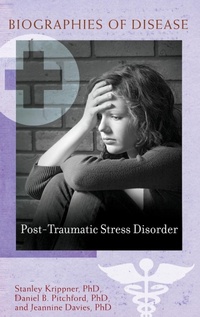
Post-Traumatic Stress Disorder
Published on 9. March 2012
Book
Hardback
192 pages
978-0-313-38668-8 (ISBN)
Description
Three distinguished experts share cutting-edge insights on Post-Traumatic Stress Disorder (PTSD), showing why it occurs, how it affects the development and existence of those it impacts, and how it can be treated.
Post-Traumatic Stress Disorder is a comprehensive and thoughtful examination of the nature, causes, and treatment of PTSD. Drawing on the vast experience of its team of authors, the book details the insidious nature and history of PTSD, from the internal and external factors that cause this form of suffering to the ways it manifests itself psychologically and socially. The most cutting-edge research on treatment, intervention, and prevention is thoroughly discussed, as are the spiritual and psychological strengths that can emerge when one progresses beyond the label of "disorder."
The book begins with a historical review of the topic. Subsequent chapters offer in-depth exploration of the significant foundations, function, impacts, and treatments associated with PTSD. Each chapter addresses practical issues, incorporating case studies that bring the information to life and ensure an appreciation of the myriad social, psychological, and biological experiences surrounding PTSD. This book answers complex questions like "How does PTSD manifest itself?" and more critically: "How can its effects be mitigated or overcome?" Finally, it discusses how PTSD survivors can move beyond post-traumatic stress to post-traumatic strengths.
Post-Traumatic Stress Disorder is a comprehensive and thoughtful examination of the nature, causes, and treatment of PTSD. Drawing on the vast experience of its team of authors, the book details the insidious nature and history of PTSD, from the internal and external factors that cause this form of suffering to the ways it manifests itself psychologically and socially. The most cutting-edge research on treatment, intervention, and prevention is thoroughly discussed, as are the spiritual and psychological strengths that can emerge when one progresses beyond the label of "disorder."
The book begins with a historical review of the topic. Subsequent chapters offer in-depth exploration of the significant foundations, function, impacts, and treatments associated with PTSD. Each chapter addresses practical issues, incorporating case studies that bring the information to life and ensure an appreciation of the myriad social, psychological, and biological experiences surrounding PTSD. This book answers complex questions like "How does PTSD manifest itself?" and more critically: "How can its effects be mitigated or overcome?" Finally, it discusses how PTSD survivors can move beyond post-traumatic stress to post-traumatic strengths.
Reviews / Votes
What could be more timely and more potentially useful for the consumer of books on mental health topics than a brief and well-written volume that describes the essential characteristics, causes, and crucial psychological processes of posttraumatic stress disorder (PTSD)? . . . I would recommend this book to anyone who wants an easy-to-read, comprehensive source that summarizes the current clinical and empirical literature on PTSD. * PsycCRITIQUES * What sets this book apart are the numerous case examples that facilitate personal connection with concepts. . . . A first-rate overview of current treatments . . . this book is wonderfully distinctive in that it discusses the positive side of PTSD, i.e., 'post-traumatic strengths.' Highly recommended. * Choice *More details
Series
Language
English
Place of publication
United States
Publishing group
Bloomsbury Publishing Plc
Target group
Primary & secondary/elementary & high school
College/higher education
Illustrations
11 bw illus
Dimensions
Height: 240 mm
Width: 161 mm
Thickness: 15 mm
Weight
458 gr
ISBN-13
978-0-313-38668-8 (9780313386688)
Copyright in bibliographic data and cover images is held by Nielsen Book Services Limited or by the publishers or by their respective licensors: all rights reserved.
Schweitzer Classification
Other editions
Additional editions
Stanley Krippner | Daniel B. Pitchford Ph.D. | Jeannine A. Davies Ph.D.
Post-Traumatic Stress Disorder
E-Book
03/2012
1st Edition
Greenwood Press
€58.29
Available for download
Persons
Stanley Krippner, PhD, is the Alan Watts Professor of Psychology at Saybrook University in San Francisco, CA.
Daniel B. Pitchford, PhD, is faculty for Saybrook University's College of Humanistic and Transpersonal Psychology and the College of Mind-Body Medicine in San Francisco, CA.
Jeannine Davies, PhD, is a researcher and psychotherapist in private practice based in Vancouver, B.C.
Daniel B. Pitchford, PhD, is faculty for Saybrook University's College of Humanistic and Transpersonal Psychology and the College of Mind-Body Medicine in San Francisco, CA.
Jeannine Davies, PhD, is a researcher and psychotherapist in private practice based in Vancouver, B.C.
Content
Series Foreword
Acknowledgments
Chapter 1. Trauma: An Introduction
Chapter 2. Recognizing PTSD
Chapter 3. The Varieties of PTSD
Chapter 4. PTSD in Children and Adolescents
Chapter 5. Four Cases of PTSD
Chapter 6. The Neuroscience of PTSD
Chapter 7. Treatment Approaches to PTSD
Chapter 8. The Positive Side of PTSD: Post-traumatic Strengths
Timeline
Glossary
Bibliography
Index
Acknowledgments
Chapter 1. Trauma: An Introduction
Chapter 2. Recognizing PTSD
Chapter 3. The Varieties of PTSD
Chapter 4. PTSD in Children and Adolescents
Chapter 5. Four Cases of PTSD
Chapter 6. The Neuroscience of PTSD
Chapter 7. Treatment Approaches to PTSD
Chapter 8. The Positive Side of PTSD: Post-traumatic Strengths
Timeline
Glossary
Bibliography
Index