

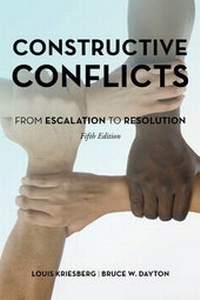
Constructive Conflicts
From Escalation to Resolution
5th Edition
Published on 29. September 2016
Book
Hardback
452 pages
978-1-4422-4325-5 (ISBN)
Description
Constructive Conflicts provides a framework for analyzing social conflicts of all kinds, with emphasis on how conflicts can lead to positive change. The fifth edition of this comprehensive and highly-regarded book has been updated and revised throughout. The book introduces key principles, uses a wide range of case studies, applies core ideas about conflicts, synthesizes interdisciplinary perspectives, and shares the latest research. Louis Kriesberg and Bruce W. Dayton examine the many factors that cause social conflicts to move more or less constructively through a series of stages: emergence, escalation, de-escalation, becoming transformed and settled, and often emerging again in new forms. This fifth edition pays increased attention to the significant role of social movements and non-governmental organizations as conflict actors, the use of non-coercive but persuasive means for both escalating and de-escalating conflicts, and the kinds of post-conflict activities that are most likely to result in enduring peace.
Reviews / Votes
Remarkably, Kriesberg and Dayton cover the complex spectrum of conflict stages and dynamics in a single book of reasonable length, even while treating the constructive/destructive conflict contrasts in multi-disciplinary depth, and with both historical and up-to-date contemporary case examples. Moreover, this edition of a landmark text sports new material on the roles of social movements and NGOs in conflict transformation-a welcome decentering of the state. -- Patrick G. Coy, Kent State University In a world ravaged by conflict at the interpersonal, intergroup, and international levels, Constructive Conflicts provides hope and the analytical and peace building tools necessary to transform relationships and structures and build constructive peace. Louis Kriesberg and Bruce Dayton are cognizant that hybrid approaches that combine both external and local peace builders are critical in building a sustainable peace. Constructive Conflicts is a must read for undergraduate and graduate students in peace and conflict studies programs. -- Sean Byrne, PACS, University of Manitoba Ever-changing realities have prompted this fifth edition of Kriesberg and Dayton's groundbreaking work on constructive conflict, marking an even more important addition to the field of conflict resolution. Addressing the increasing role of non-state actors (NGOs) and social movements, as well as the varied contexts in which today's conflicts have emerged, the new edition provides tools for better understanding a wide range of conflicts and the finer points of transition from large-scale violence to non-coercive measures. Once again a most valuable contribution. -- Galia Golan, Professor Emerita, Hebrew University of Jerusalem Constructive Conflicts provides a wealth of common sense, easily applied lessons that serve the needs of participants in peace negotiations, demobilization processes, or post-conflict reconstruction efforts. In an arena where the mistakes that accompany on-the-job-learning can result in tragic consequences, Kriesberg and Dayton have distilled decades of experience into this highly readable volume. Of particular note are their suggestions for engaging civil society, marginalized populations, and non-governmental organizations in these processes as planners, implementers, and beneficiaries, without which too many well-intentioned initiatives are doomed to failure. -- Donald Steinberg, president and CEO, World Learning The updated edition of this classic study illustrates the application of the authors' "constructive conflict" approach by exploring a wide range of recent as well as familiar conflicts. The volume is a conflict encyclopedia, addressing the cycles of escalation and termination as well as the types of tools and actors (including the rising role of NGOs) central to an understanding of how conflicts are waged, mediated, and sometimes settled. The material is lucidly presented, making the volume appropriate for conflict resolution coursework as well as for practitioners in need of fresh ideas on what to do. -- Chester A. Crocker, James R. Schlesinger Professor of Strategic Studies, Edmund A. Walsh School of Foreign Service, Georgetown University Constructive Conflicts combines interesting case studies with a strong theoretical foundation in a readable and insightful format. Recognizing that conflicts are inevitable and oftentimes necessary to promote freedom and justice, the authors focus on ways that both partisans and intermediaries can work to ensure such struggles can be waged for the common good instead of narrow interests, promote reconciliation rather than polarization, and lead to genuine resolution. -- Stephen Zunes, University of San Francisco For nearly two decades I have used Lou Kriesberg's books on constructive conflict in teaching mediation and negotiation. Now, this new edition with Bruce Dayton could not be more timely and needed. It provides perspectives and skills for those hoping to de-escalate conflict in their local communities, and it helps us understand how social movements, NGOs, and others can contribute to peacebuilding in a violent world. -- George A. Lopez, Hesburgh Professor of Peace Studies Emeritus, Kroc Institute, University of Notre DameMore details
Edition
Fifth Edition
Language
English
Place of publication
Lanham, MD
United States
Target group
College/higher education
US School Grade: From College Freshman to College Graduate Student
Illustrations
Illustrations; Tables; Black & White Illustrations
Dimensions
Height: 238 mm
Width: 158 mm
Thickness: 28 mm
Weight
735 gr
ISBN-13
978-1-4422-4325-5 (9781442243255)
Copyright in bibliographic data and cover images is held by Nielsen Book Services Limited or by the publishers or by their respective licensors: all rights reserved.
Schweitzer Classification
Persons
Louis Kriesberg is professor emeritus of sociology and Maxwell Professor Emeritus of Social Conflict Studies at Syracuse University. He is the founding director of the Program on the Analysis and Resolution of Conflicts and past president of the Society for the Study of Social Problems.
Bruce W. Dayton is associate professor of peacebuilding and conflict transformation and director of the CONTACT Peacebuilding Program at the SIT Graduate Institute, School for International Training.
Bruce W. Dayton is associate professor of peacebuilding and conflict transformation and director of the CONTACT Peacebuilding Program at the SIT Graduate Institute, School for International Training.
Content
List of Figures and Tables
Preface and Acknowledgments
Acronyms
1 Analyzing Social Conflicts
2 Underlying Conditions for Social Conflicts
3 The Emergence of Conflicts
4 Alternative Conflict Strategies
5 Adopting Conflict Strategies
6 Escalation of Conflicts
7 De-escalation of Conflicts
8 Mediation in Conflicts
9 Settling Conflicts
10 Conflict Outcomes and Consequences
11 Synthesis, Specifications, and Challenges
Appendix A: Selected Organizations in the Field of Constructive Conflicts
Appendix B: Selected Websites Relating to Social Conflicts
Index
About the Authors
Preface and Acknowledgments
Acronyms
1 Analyzing Social Conflicts
2 Underlying Conditions for Social Conflicts
3 The Emergence of Conflicts
4 Alternative Conflict Strategies
5 Adopting Conflict Strategies
6 Escalation of Conflicts
7 De-escalation of Conflicts
8 Mediation in Conflicts
9 Settling Conflicts
10 Conflict Outcomes and Consequences
11 Synthesis, Specifications, and Challenges
Appendix A: Selected Organizations in the Field of Constructive Conflicts
Appendix B: Selected Websites Relating to Social Conflicts
Index
About the Authors