

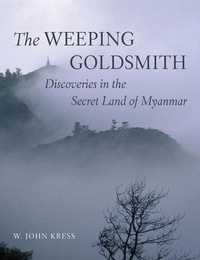
The Weeping Goldsmith
Discoveries in the Secret Land of Myanmar
Published on 15. October 2009
Book
Hardback
288 pages
978-0-7892-1032-6 (ISBN)
Description
In the great tradition of Darwin's Voyage of the Beagle, this book is a first-person narrative of daunting travel and scientific discovery in the little-known country of Myanmar. Dr. Kress explored many areas in this enigmatic country, surveying its teak forests, bamboo thickets, timber plantations, rivers, and mangroves to document its incredible botanical diversity. Myanmar is one of the great biodiversity hot spots in Asia, but because of its social isolation and reputation for political repression it has been closed to - or avoided by - many scientists. Nevertheless, Dr. Kress was determined to search for and record plants that had not been studied since they were first discovered by Western botanists over a century ago. Among the rarities he came upon was a new species of plant called the weeping goldsmith, a ginger flower whose Burmese name was derived from the legend that the local goldsmiths were reduced to tears because none of their own creations could rival its exquisiteness. Dr. Kress also relates how he came to appreciate the people and culture of Myanmar through an understanding of their flora, natural habitats, and human-dominated environments.
Included are fascinating excerpts from his field journals that serve as counterpoints to the accounts of earlier plant explorers. Illustrating the text are some 200 of Dr. Kress's own colour photographs of the incredible plants, people, landscapes, and temples he witnessed in his travels as well as 30 archival images of Burma taken by past explorers.
The back matter features an illustrated portfolio of representative native plants. This lively armchair exploration should appeal to a general readership as well as to botanists, conservationists, and environmentalists.
Included are fascinating excerpts from his field journals that serve as counterpoints to the accounts of earlier plant explorers. Illustrating the text are some 200 of Dr. Kress's own colour photographs of the incredible plants, people, landscapes, and temples he witnessed in his travels as well as 30 archival images of Burma taken by past explorers.
The back matter features an illustrated portfolio of representative native plants. This lively armchair exploration should appeal to a general readership as well as to botanists, conservationists, and environmentalists.
Reviews / Votes
Praise for The Weeping Goldsmith: - A Booklist Top 10 Science & Technology Book of 2009 "A fascinating memoir...engagingly written and beautifully illustrated. Highly Recommended" - ChoiceMore details
Language
English
Place of publication
New York
United States
Product notice
sewn/stitched
Cloth over boards
With dust jacket
Dimensions
Height: 259 mm
Width: 197 mm
Thickness: 32 mm
Weight
1351 gr
ISBN-13
978-0-7892-1032-6 (9780789210326)
Copyright in bibliographic data and cover images is held by Nielsen Book Services Limited or by the publishers or by their respective licensors: all rights reserved.
Schweitzer Classification
Person
W. John Kress is a Curator of Botany and Research Scientist at the National Museum of Natural History at the Smithsonian Institution. He is the co-author of A Checklist of the trees, shrubs, herbs, and climbers of Myanmar and Plant Conservation - A Natural History Approach, and has written many botanical articles. Wade Davis is an Explorer-in-Residence at the National Geographic Society and has written many books, including The Serpent and the Rainbow, One River, and Light at the Edge of the World.
Content
Table of Contents from: The Weeping Goldsmith Prologue 1. The Weeping Goldsmith 2. Waiting in Rangoon 3. Ancient Cities and Sacred Mountains 4. The Arrival of the Monsoon 5. Across Two Rivers 6. Buddhas Garden 7. The Choir of Cicadas 8. Paradise in Maymyo 9. Up the Chindwin River 10. Dust, Jade, and Prostitutes 11. The Arakan Capital at Mrauk U: Through Bamboo Hell 12. Buddhist Reverence and Respect Help Protect the Forests 13. Mt. Victoria: Walking in the Steps of a Giant 14. Why the Goldsmith Weeps Epilogue Acknowledgements Endnotes Bibliography